
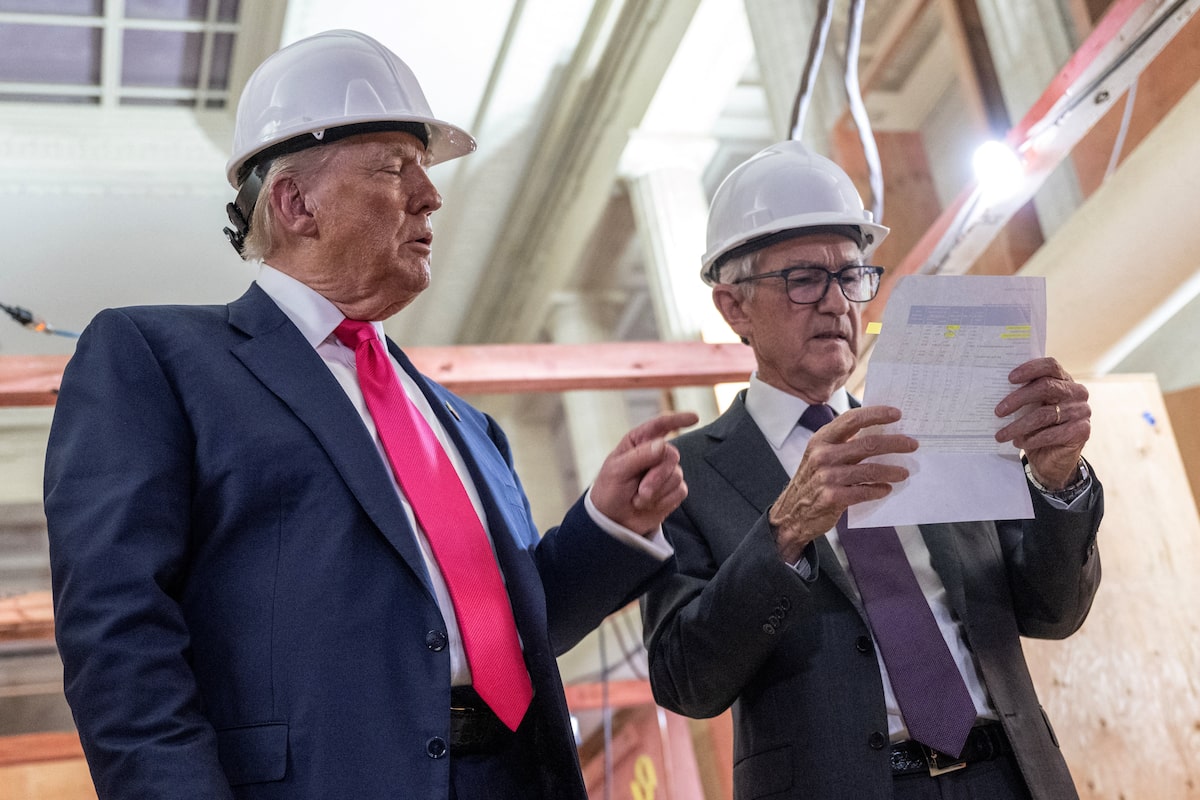
U.S. President Donald Trump points to a cost sheet as he speaks with Federal Reserve chair Jerome Powell in Washington in July, 2025.ANDREW CABALLERO-REYNOLDS/AFP/Getty Images
Since his election in 2024, U.S. President Donald Trump has called for sharp interest-rate cuts. And so, the concern in markets is that his recent appointment of Kevin Warsh as the new chair of the Federal Reserve may be coming with an implicit understanding that the Fed must immediately lower interest rates
Will it work? Maybe in the short term it will, but eventually interest rates are on a rising long-term trend.
Interest rates, in my opinion, bottomed out in 2016 and have been trending upward since then. And there is nothing any politician, including Mr. Trump, can do to change this. The COVID-19 pandemic temporarily paused this trend and if economic slowdowns arrive, they may do the same, but they will not reverse it.
From 1990 to 2016, we witnessed a secular decline in nominal interest rates driven by positive baby boomer demographics, decelerating inflation, declining taxation and positive geopolitical developments that ushered in globalization, such as the fall of the Berlin Wall and the admission of China into the World Trade Organization.
U.S. inflation isn’t subsiding. It’s heating up again
In 2016, things started to change. Baby boomer demographics started to turn negative, underlying inflation began to accelerate and higher taxation going forward started to build into market expectations, given record-high government debts and deficits, while adverse geopolitical developments, such as deglobalization, started to emerge. I am not talking about cyclical developments, but rather about long-term trends.
Let me explain. The nominal interest rate is the reward someone expects for making an investment. This reward consists of three subrewards.
The first is the reward for postponing consumption for the future, that is, the real interest rate; the second is the reward for possible loss of purchasing power, that is, the premium for expected inflation; and the third is the reward for possible loss of capital, that is, the risk premium – which I will ignore here, even though the geopolitical policy risks of recent years have elevated the importance and size of this premium in the equation.
In the short run, the real interest rate is driven by the vicissitudes of the economy (the business cycle), together with central banks’ efforts to smooth the business cycle. Its long-term (secular) trend is affected by factors that change only slowly, namely technology and demographics.
In the short run, inflation is driven by the heightened intensity of economic activity and the pressures it entails on productive capacity and the labour and commodities markets. In the long-term, it is taxes, economic efficiency and productivity that affect inflationary expectations.
Opinion: Kevin Warsh’s ode to central bank independence portends his vision as Fed chair
Why is the secular trend of real rates on the way up?
Demographic developments are pushing the real interest rate trend higher. Most baby boomers have already retired and have stopped saving; in fact, they are in their de-saving (decumulation) years, which reduces the supply of funds. This happens in the face of increased demand for capital by corporations that need to embed innovation and new technologies into their production processes, such as artificial intelligence, electric vehicles and renewable energy, as well as by governments that need to borrow to fund structural deficits. To clear the demand-supply imbalance, the real interest-rate trend is pushed up, not unlike what happened in the late 1970s and early 1980s. On top of this, while globalization added to global liquidity in the past, particularly as it relates to North American markets, emerging deglobalization (resulting from beggar-thy- neighbour policies, tariff wars, protectionism, geopolitical instability and so on) will have, and is already having, the opposite effect, as funds are pulled out of North America by Japanese institutional investors and other foreign investors, who have been selling their U.S. Treasury bond holdings.
Why is secular inflation on the way up?
Productivity may be adversely affected as experienced baby boomers retire (or have retired) and are replaced by less-experienced workers who will nevertheless be in high demand due to low population growth. These workers will demand higher wages. Pandemic-related deficits and ballooning debts will eventually require higher taxes going forward. In addition, other structural changes will also lead to higher inflation in the long run. First, deglobalization will prompt companies that are trying to guard against supply chain interruptions to bring production back to North America to an environment of higher production costs. Second, years of underinvestment in the oil and gas industry, heavy regulation and fear of ESG regulation have shifted not only oil price dynamics, but also those for all commodities. This has created shortages in metals at a time when demand has increased owing to AI, renewable energy and EV production.
But what about AI? Will it not have a dampening effect on inflation and interest rates, and a positive effect on productivity and profit margins?
AI may supercharge productivity, but for now this is purely hypothetical. Historically, new technologies have been disappointing in terms of increasing productivity. Despite technological advances since the 1980s, productivity has fallen by 50 per cent in the United States and Japan.
But let’s say that AI lowers inflation by reducing the number of workers and/or making workers more productive. This is one side of the equation. The other side is that it will simultaneously increase demand for capital. This will push up the real interest-rate trend and offset or negate the decline in inflation. As a result, no matter how one looks at the inflation and interest-rate problem, AI will not save the day.
Such an eventuality will have serious implications for the growth stocks that have propelled the market higher in recent years. We may be setting up ourselves for a repeat of what happened to the Nifty Fifty growth-stock darlings of the 1960s. These stocks had built in unrealistic growth expectations when interest rates were lower, but they were then punished in the 1970s when rates started to rise and growth expectations did not materialize, with most of these stocks underperforming the broader market averages.
George Athanassakos is a professor of finance and holds the Ben Graham Chair in Value Investing at the Ivey Business School, Western University. His latest book is Value Investing: From Theory to Practice.