

With the final day of NHL action complete as the league takes a break for three weeks for the Winter Olympics, the Montreal Canadiens’ currently sit on 72 points, with only five teams ranked ahead of them in the overall standings.
As impressive as that performance through 57 games has been, Montreal is only three points clear of fifth place in the division. The Detroit Red Wings required one extra game to reach 72 points and rank third. The Buffalo Sabres hold the first wild-card spot, and another Atlantic team, the Boston Bruins, sit in the second with a four-point cushion over the next team in the chase.
With the lowest projected point total of the aforementioned teams being 99 for the Bruins, it’s entirely possible that these five will all make the playoffs. The jockeying for Atlantic seeding should be the most intense of any post-season battle over the final third of the season.
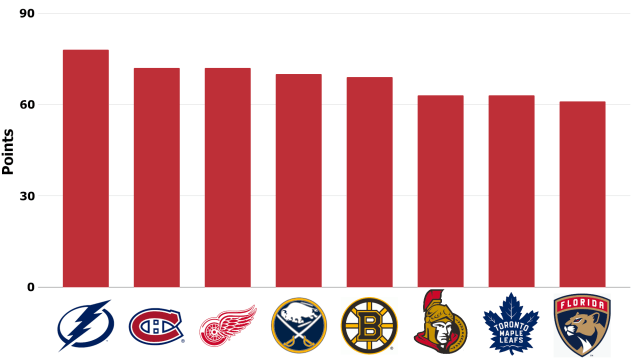 Points held by Atlantic Division teams at time of Olympic break
The eight teams are currently divided into three tiers: Tampa Bay at the top with 78 points and also the fewest number of games played among the eight; Montreal, Detroit, Buffalo, and Boston as likely playoff teams, and; Ottawa, Toronto, and Florida a bit of a distance from that race.
It’s interesting to note that even the last-place team here, Florida, holds a points percentage of .535, which makes it looks like the Panthers have had an above-average season. The issue is that points percentage is based on a system assigning two points to each game, and that isn’t what occurs in actuality. There have been 908 NHL games to this point and 2049 points awarded. That is 2.257 points per average game, and the numbers look different when basing points percentage on that actual per-game total.
Team
GP
Points
Points percentage
Actual points percentage
Tampa Bay
55
78
0.709
0.628
Montreal
57
72
0.632
0.560
Detroit
58
72
0.621
0.550
Buffalo
57
70
0.614
0.544
Boston
57
69
0.605
0.536
Ottawa
57
63
0.553
0.490
Toronto
57
63
0.553
0.490
Florida
57
61
0.535
0.474
With that calculation complete, the difference in quality between the teams is more obvious. Tampa Bay still looks great at .628, while Ottawa, Toronto, and Florida get exposed as the underperforming teams you’d expect them to be several points out of the playoff race.
There will be between 24 (Detroit) and 27 games (Tampa Bay) to add to these point totals before the season comes to an end. Not all of those schedules are the same, however, so it would be good to get an idea of how tough the remaining slates are for the teams in a chase. Using the same method of recalculating points percentage, we can see what awaits the team when the Olympics are over.
Team
Remaining opponents’ P%
Actual remaining opponents’ P%
Tampa Bay
0.578
0.512
Montreal
0.575
0.510
Detroit
0.579
0.513
Buffalo
0.554
0.491
Boston
0.586
0.519
Ottawa
0.574
0.508
Toronto
0.573
0.507
Florida
0.564
0.499
At first blush it seems odd that almost every team has a tough remaining schedule, but it does make sense with the majority of games having already been played versus the much weaker Western Conference and a lot of games left versus conference and division opponents to end the season. Doing this same exercise for teams in the woeful Pacific Division would suggest that they all have easy paths through the remainder of the campaign.
With at least a framework of the remaining schedules to look at, there are a few differences among the teams. Buffalo has the easiest remaining schedule of the eight teams at a .491 actual points percentage, thanks to just three more games versus teams in the top six: Tampa Bay twice and the Dallas Stars once. Boston will play every team currently ranked in the top nine outside of the Colorado Avalanche at least one more time and has completed the season series with each team currently in the bottom four, so the Bruins face an uphill battle to improve on the second wild-card spot they hold, and could come under pressure from teams in the Metropolitan Division for that placement.
Now that this part of the equation is known, it’s a matter of multiplying the Atlantic teams’ expected share of the points (1.000 minus the actual opponents’ point percentage) by the points still available (2.257 times the number of games remaining) to find about how many more points the Atlantic teams would be expected to add to their totals.
Team
GR
Opponents’ P%
Actual opponents’ P%
Expected P%
Expected points
Tampa Bay
27
0.578
0.512
0.488
29.7
Montreal
25
0.575
0.510
0.490
27.7
Detroit
24
0.579
0.513
0.487
26.4
Buffalo
25
0.554
0.491
0.509
28.7
Boston
25
0.586
0.519
0.481
27.1
Ottawa
25
0.574
0.508
0.492
27.7
Toronto
25
0.573
0.507
0.493
27.8
Florida
25
0.564
0.499
0.501
28.2
The biggest difference is seen when comparing the Sabres’ easiest schedule to the Bruins’ toughest. Despite them both having 25 more games to play, the Sabres would be expected to take about two more points. If those calculated totals are now added to what the teams already have, we can get a projection of the point totals the teams would finish with.
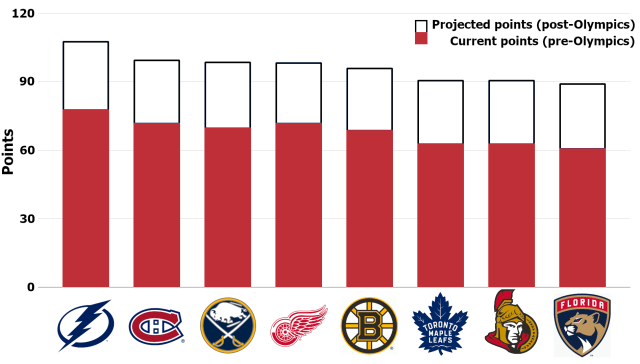 Points held by Atlantic Division teams at time of Olympic break (red) plus projected points to finish the season based on strength of schedule (white)
Thanks to the Sabres’ division-easiest schedule, they would overtake the Red Wings to take the third seed, but can’t make up enough ground to get past Montreal for second. The Bruins slip a little further behind the top four teams, while Toronto ever so slightly edges out the Senators by a fraction of a point for sixth place.
Despite one of the toughest schedules, the Lightning pull away simply because they have more games left to accumulate points. In theory a large number of games remaining is great for a team to build its point total. The reality could be very different however. Tampa Bay will play its 27 remaining games in the span of 50 days. They have five back-to-back sets, and only two two-day breaks, zero of which come in the last month of action. Already dealing with significant injuries to key players, this gruelling schedule is going to increase the probability of sustaining more, and fatigue is going to be a major factor. That last issue is going to affect every team, so we will likely see every club try to get its stars some rest down the stretch if they can afford to do so.
Tampa Bay has also played just 13 games versus division opponents so far with 13 still to go, so that will be another wrinkle added to the situation. Montreal and Boston lead the way with 19 intradivision games already played and have just seven left each the rest of the way. While it may seem like the Atlantic Division plays a lot of three-point games with everyone so tight, looking at only intradivision games doesn’t change the average number of points awarded. There have been 150 points handed out through 66 games, so the number is 2.273 points in those battles, not significantly greater than the league average.
Team
GR
GR vs. ATL
Back-to-backs
Two-day breaks
Tampa Bay
27
13
5
2
Montreal
25
7
6
5
Detroit
24
10
2
3
Buffalo
25
8
5
4
Boston
25
7
6
4
Ottawa
25
11
5
5
Toronto
25
10
6
5
Florida
25
10
5
3
Regardless of how you look at it, it’s going to be a close race down to the wire for the teams currently slotted from second to fifth, and a few different factors could see them reel in the Lightning to turn that into a five-team battle. This group probably doesn’t have to be overly concerned about the three clubs at the bottom of the division standings, leaving the only fights for which position the top five finish the year in.