
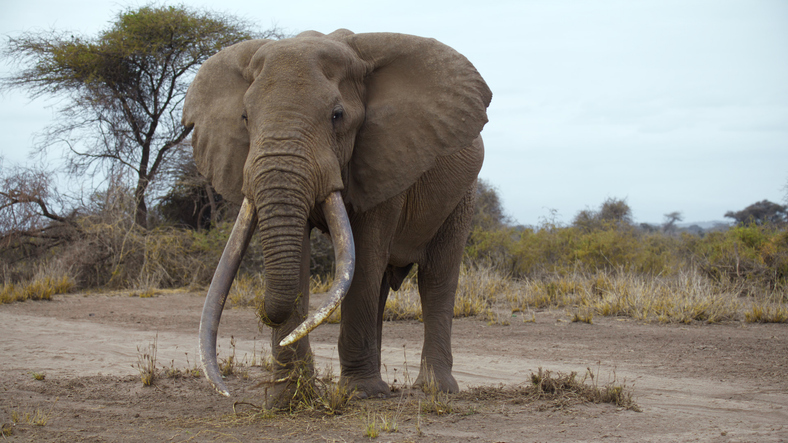
The death of Craig the elephant, one of Africa’s last great ‘super tuskers’, at the beginning of the year was both sad and inspiring. Given the era he lived through, when elephants like him were being killed in vast numbers, his longevity was a conservation success to celebrate.
Super tuskers are now vanishingly rare not because they are evolutionary curiosities but because for a long time now, elephants with the largest tusks have been selectively targeted. Across Africa, an estimated 1.3 million elephants were reduced to around 600,000 between the late 1970s and late 1980s. The majority of elephant losses have been driven by illegal poaching, but in some countries like South Africa, Zimbabwe and Namibia, elephants have also been killed through government-sanctioned culls, authorised under the banner of ‘sustainable utilisation’. The impacts have gone far beyond population numbers, affecting the genetics, social structures and ecological function of these elephants in ways conservationists are still coming to terms with.
Craig was fortunate to live in Kenya – which does not sanction large-scale elephant culls – and more specifically in Amboseli national park, where a long-running research and monitoring programme gave individual elephants unusual visibility. From the early years of that work in the 1970s, Craig was photographed and known to researchers over many decades, and this visibility to some extent helped to deter poaching within the park.
A very different story that has attracted recent attention comes from Zimbabwe. In 1984, in Hwange National Park, a young elephant later named Kariba saw her family killed during a state-authorised cull. Adults were shot, calves reportedly tethered to their dead mothers while tusks were removed. These so-called ‘ivory orphans’ were then sent to zoos and circuses around the world, a practice that is no longer accepted but whose legacy zoos are still forced to deal with today.
These stories remind us that human choices and action still matter
Kariba was shipped to a German zoo, where she was trained to perform tricks and give elephant rides. In 2012 she was moved to a zoo in Belgium. Following the death of her companion in 2022, she was left all alone. Her owner began looking for a solution for her loneliness but found that there were very few viable options. He didn’t want to bring in other elephants, no zoo that he felt could offer her a good quality of life was willing to take her, and he refused to sell her to a circus. It is deeply troubling that, despite bans on wild animals in circuses in most EU states, close to 50 elephants are still being forced to perform across Europe today, with trained animals like Kariba still in demand.
By chance, the search for a new home coincided with the opening of Pangea, Europe’s first large-scale elephant sanctuary. Kariba will soon become one of its first residents. The 1,000-acre reserve in Portugal was chosen for its elephant-friendly climate and habitat in the Alentejo region where, just a few tens of thousands of years ago, straight-tusked elephants roamed, shaping its landscapes and plant life. Besides giving individual elephants a meaningful life of natural space, choice, and companionship, Pangea could offer an opportunity to study how elephants and the Mediterranean ecosystem might once again respond to each other. At full capacity, Pangea is designed as a long-term sanctuary for up to around 30 elephants, developed in carefully phased stages.
These are two tales of African elephants from the same era with different but equally uplifting messages, one rooted in species conservation and the other in compassion and welfare. Craig’s story reflects decades of investment in protected landscapes, long-term science and political decisions that prioritised elephants as part of a living ecosystem. Kariba’s story, by contrast, speaks to a growing recognition of moral responsibility for the individuals impacted by the legacy of past policies – animals who cannot be returned to the wild but who nonetheless deserve lives of dignity and agency.
At a time when good news can feel increasingly hard to come by, and many of us feel powerless in the face of multiple global crises, these stories remind us that human choices and action still matter. The work in Amboseli continues, built on decades of commitment, while in the Alentejo a new chapter is just beginning. Both are causes worth talking about and worth supporting, and together they invite us to consider how we might contribute to a more thoughtful coexistence with nature.