
Want more ways to catch up on the latest in Bay Area sports? Sign up for the Section 415 email newsletter here and subscribe to the “Section 415″ podcast wherever you listen.
A buzzy term is gaining traction in tech circles: Enshittification.
It’s a complicated theory that, at its most basic level, describes the degradation of a product’s quality over time, even as technology improves. Think social media algorithms feeding you viral short-form videos instead of pictures of your friends. Search engines putting AI guesses or branded advertisements at the top of a results page. Netflix going from an on-demand, convenient Blockbuster to a subscription slop factory.
A version of this has been happening to the Warriors’ assets.
Golden State turned two lottery picks — James Wiseman and Jonathan Kuminga — into a Gary Payton II reunion, and veteran center Kristaps Porzingis, who has played over 30 minutes in a game four times since last April.
The Warriors turned Jordan Poole and Ryan Rollins into Chris Paul, who left Golden State for nothing. The Klay Thompson trade yielded Buddy Hield, which was at least a push, but now he’s gone, too.
Golden State’s best recent moves by far were the Andrew Wiggins heist of 2020 and last year’s Jimmy Butler trade. For the former, they sent out D’Angelo Russell for Wiggins — who helped them win the 2022 championship — and the pick that became Kuminga. Wiggins later was the key to getting Butler, who made the Warriors a scary playoff team.
Management deserves immense credit for those moves. They were absolute home runs.
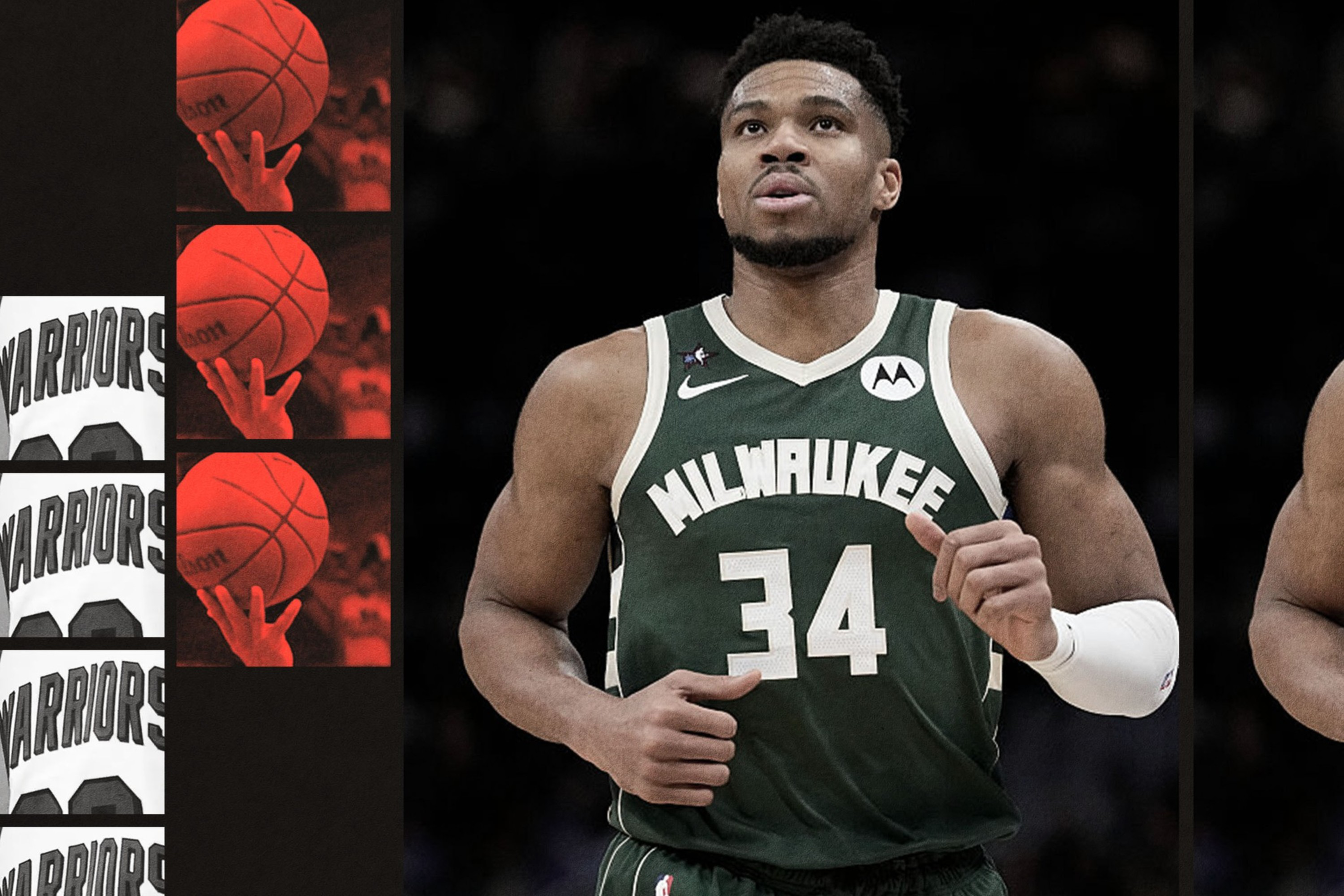
But now Butler is out for the season and will be 37 years old coming off a torn ACL next winter. Steph Curry has been banged up, and turns 38 in a month. Draymond Green’s performance has declined this season. Brandin Podziemski and Moses Moody, solid draft choices in the teens, haven’t taken significant leaps. The Warriors’ most valuable assets are their future draft picks, and those weren’t compelling enough for Milwaukee to send superstar Giannis Antetokounmpo to the Bay.
There’s nothing the Warriors can do about their asset deterioration. So let’s break down their books moving forward.
Salary cap overview
With roughly $204 million committed, the Warriors have the third-most expensive roster in the NBA. Only the Cavaliers and Knicks have higher active allocations.
Golden State is roughly $3 million below the second apron, where they’re hard-capped. The Warriors are about $49 million over the cap.
The Warriors are one of six teams paying the repeater luxury tax — a higher penalty rate for being above the tax line in at least four of the past five seasons.
Because the Warriors shedded salary at the deadline, ownership will save roughly $20 million in tax payments, according to ESPN’s Bobby Marks (opens in new tab).
Today
3 days ago
Friday, Jan. 30
Those figures will change slightly with back-end roster rearranging the Warriors opened up two roster spots with their moves. One of those is expected to go to Pat Spencer, who played his last eligible two-way game on Thursday in Phoenix.
As a first apron team, the Warriors are unable to sign a buyout player if their salary was over $14 million (this year’s non-taxpayer midlevel figure).
Looking ahead
A staple of the Warriors’ recent team-building strategy has been avoiding long-term commitments. This ensures maximum future flexibility.
Curry, Butler, and Green are each signed through next year, the 2026-27 season (Green has a $27 million player option). That alignment means Golden State has basically nothing on the books for 2027-28 and beyond.
That, obviously, will change. The Warriors will make additions as well as keep some current players. Podziemski will be eligible for a rookie-scale extension starting this summer. Even if he and the team don’t hammer out a long-term deal, the Warriors have his rights through the 2027-28 season (after which he’d become a restricted free agent).
Curry could also continue to play past 2026-27. He has performed at an All-NBA level this season, and told The Ringer (opens in new tab)that he could see himself shifting into a supporting role as he ages.
Here’s a basic view that shows the Warriors’ lack of future spending, via Spotrac.
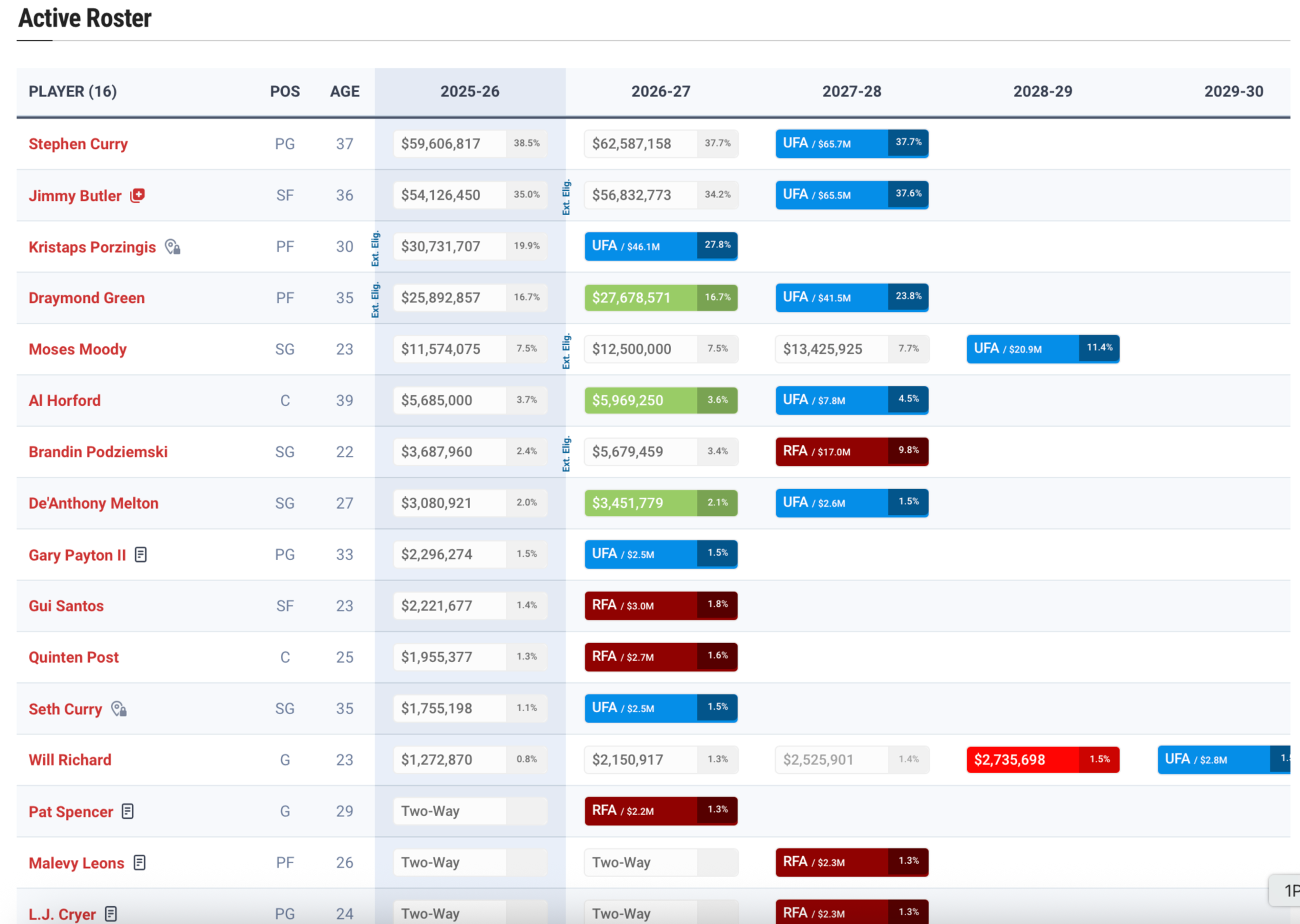 via Spotrac.com
Remember that repeater tax detail? The Warriors have been a tax team every season since 2020-21. Ducking the tax for two seasons — likely some of those seasons with a whole bunch of blue or translucent columns — would release ownership from paying tax premiums.
The Porzingis piece
The Warriors could not only sign-and-trade Porzingis this summer, they would be able to sign-and-trade him and aggregate his salary in a bigger trade.
Porzingis is on a $30 million expiring deal, which makes him an interesting piece.
In the last two months of his contract, Porzingis is incentivized to show he can stay on the court and return to being a productive player.
He has only played 17 games this season (though his advanced metrics were excellent in that sample with the Hawks). He deteriorated in the second half of last year as he dealt with an illness, which was ultimately diagnosed as POTS. Lower-leg injuries have also sidelined him. But he was recently cleared to play, and could debut for the Warriors before the All-Star break.
If Porzingis can make himself available, he should fit well with the Warriors, who have long sought a center who can space the floor and protect the rim next to Green. It’s possible that the Warriors could look to re-sign him — at a much lower annual cost — in that case.
Or, the Warriors could look to sign-and-trade him in the offseason as part of a bigger deal. Without Kuminga, they lack the type of meaty, mid-sized salaries required for matching salaries to complete big trades. In this route, the Warriors would be able to aggregate his sign-and-trade salary, too.
The other option would be for the Warriors to let Porzingis walk, shaving $30 million off their books. That wouldn’t make them a cap space team, but it would likely get them out of the luxury tax.
The biggest advantage of getting out of the tax could be gaining the opportunity to sign a player like De’Anthony Melton to the non-taxpayer midlevel exception. Melton has been terrific this season, so he’ll likely decline his $3 million player option for 2026-27.
Future draft picks
The Warriors have control of all of their first-round picks through 2032 at the moment, which was the biggest reason they had a trade package the Bucks might even consider for Antetokounmpo. The further the picks are pushed out into the future, the more valuable the league deems them, because those are years Curry could either be done playing or in decline.
Here’s a quick view of the Warriors’ future first-round picks:
2026 (own)
2027 (own)
2028 (own)
2029 (own)
2030 (own 1-20, to Dallas if 21-30)
2031 (own)
2032 (own)
The Stepien Rule prevents teams from trading future picks in consecutive years, requiring clubs to have at least one first-round selection in every two-year cycle. That’s why although the Warriors have all their picks, they could only offer up to four at the deadline, plus swaps in the intervening years.
To get specific: the Stepien Rule only directly impacts the 2029 and 2031 picks, because the Warriors could technically lose ownership of the 2030 choice.
Some teams, like Miami and New York, will unlock more future first-round picks to trade after the Draft.
The Warriors won’t quite get that benefit. After Draft Day, the only additional pick the Warriors will have to offer is a 2033 swap.
So if the Warriors were to target another superstar this summer, they’d be able to offer the 2028, 2030 (1-20), and 2032 picks — plus whoever they just selected in the Draft — and swaps in 2027, 2029, 2031, and 2033.