
Anyone who attended Manitoba Ag Days in Brandon last month is being asked to monitor for measles symptoms.
Billed as Canada’s largest indoor farm show, Ag Days was held from Jan. 20 to 22.
Read more:
Public health officials say anyone who was at Brandon’s Keystone Centre for the show or visited nearby hotels, restaurants and shops may have been exposed to measles.
They add possible exposures may also have occurred in Brandon on the days leading up to the show and the days after it.
Public health officials with Manitoba Health, Seniors and Long-Term Care said anyone who attended Ag Days in Brandon, visited hotels, restaurants and shops should monitor for symptoms until Feb. 13.
Anyone at the following locations on the specified dates and times is asked to monitor for symptoms until the identified dates:
Manitoba Ag Days, Keystone Centre, Brandon:
Jan. 20 from 9 a.m. to 7 p.m. Monitor for symptoms until Feb. 11
Jan. 21 from 9 a.m. to 7 p.m. Monitor for symptoms until Feb. 12
Jan. 22 from 9 a.m. to 7 p.m. Monitor for symptoms until Feb. 13
Great Western Roadhouse, inside the Canad Inns Destination Centre, 1125 18th St., Brandon:
Jan. 20 from 5 p.m. to 9 p.m. Monitor for symptoms until Feb. 11
Manitoba Ag Days, Agriculture in the Classroom event at the Provincial Exhibition of Manitoba Dome Building, Unit 1-A, 1200 13th St., Brandon:
Jan. 20 from 9:30 a.m. to 5 p.m. Monitor for symptoms until Feb. 11
Jan. 21 from 9:30 a.m. to 5 p.m. Monitor for symptoms until Feb. 12
Jan. 22 from 9:30 a.m. to 5 p.m. Monitor for symptoms until Feb. 13
Stacked Pancake and Breakfast House, 777 Norquay Dr., Winkler:
Feb. 1 from 9:30 a.m. to 3:30 p.m. Monitor for symptoms until Feb. 23
Boundary Trails Health Centre public health office, near Winkler:
Feb. 2 from 10:30 a.m. to 1 p.m. Monitor for symptoms until Feb. 24
Boundary Trails Health Centre emergency department, near Winkler:
Feb. 3 from 7 p.m. to Feb. 4 at 1:10 a.m. Monitor for symptoms until Feb. 26
What are the symptoms of measles?
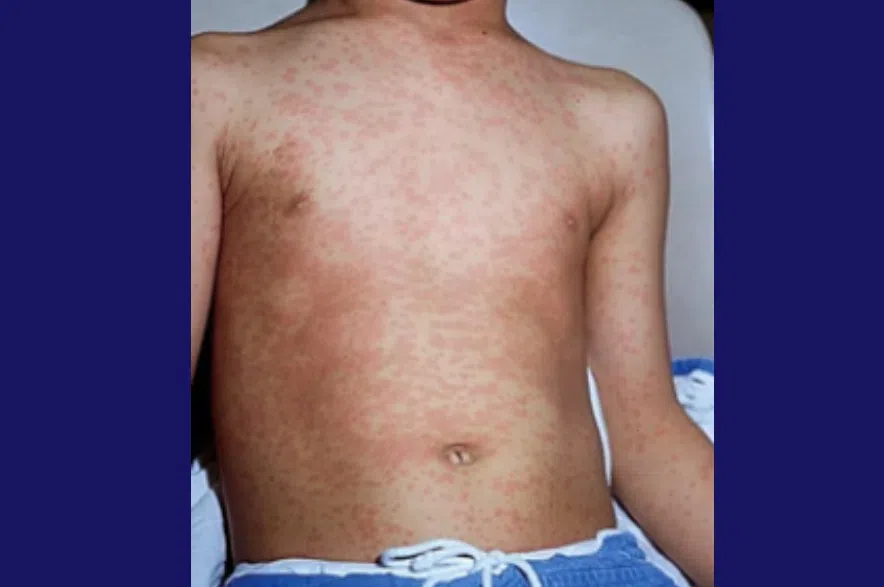
The SHA said that the symptoms of measles include fever, cough, runny nose, red eyes, fatigue, irritability (feeling cranky or in a bad mood), small, white spots (known as Koplik spots) inside the mouth and throat, and a red blotchy rash which develops on the face and spreads down the body about three to seven days after symptoms begin and can last four to seven days.
The SHA said anyone who has any of the listed symptoms and was at any of the listed locations during the identified times, should call HealthLine811, their primary care doctor or nurse practitioner.
Anyone in medical distress, should go to an emergency room or call 911, and identify they may have been exposed to measles.
The health authority also said that measles can be prevented by the safe, effective and free measles vaccine and with two doses, the vaccination is almost 100-per-cent effective
“Immunization is your best tool against measles, and two complete doses is what you need to have full vaccination. One dose is not enough,” the SHA’s Dr. David Torr said.
“Once immunized, the measles vaccine is extremely efficient, over 90 per cent of protection both against actually getting the infection and certainly against getting any complications or even death from measles.”
The second dose is especially important for people born in or after 1970.
Why is measles dangerous?
Measles is highly contagious and can spread very easily by breathing contaminated air after an infected person coughs or sneezes, or by touching a contaminated surface such as a doorknob or a shopping cart.
In rare cases can lead to respiratory failure, swelling of the brain and death.
If anyone breathes the contaminated air or touches a contaminated surface and then touches their nose, eyes or mouth, they can become infected.
The virus can live up to two hours in the air or on surfaces in a space where an infected person coughed or sneezed.
It can spread to others from four days before a rash appears until four days after a rash develops. Through this period, people need to stay in strict isolation to avoid spreading the infection.
Canada officially lost its measles elimination status in early November 2025.
The country eliminated measles in 1998 and maintained that status for more than 25 years, meaning there was no ongoing community transmission and new cases were travel-related.
The Pan American Health Organization revoked the status after confirming there has been ongoing transmission of the same strain of measles for more than one year.
But since Oct. 27, 2024, the virus has spread to more than 5,000 people in Canada, including two infants in Ontario and Alberta who were infected with measles in the womb and died after they were born.
Public health and infectious disease experts attribute the return of measles to declining vaccination rates, stemming from misinformation-fuelled vaccine hesitancy and distrust of science, as well as the disruption of routine immunizations during the COVID-19 pandemic.
— with files from The Canadian Press
Read more: