
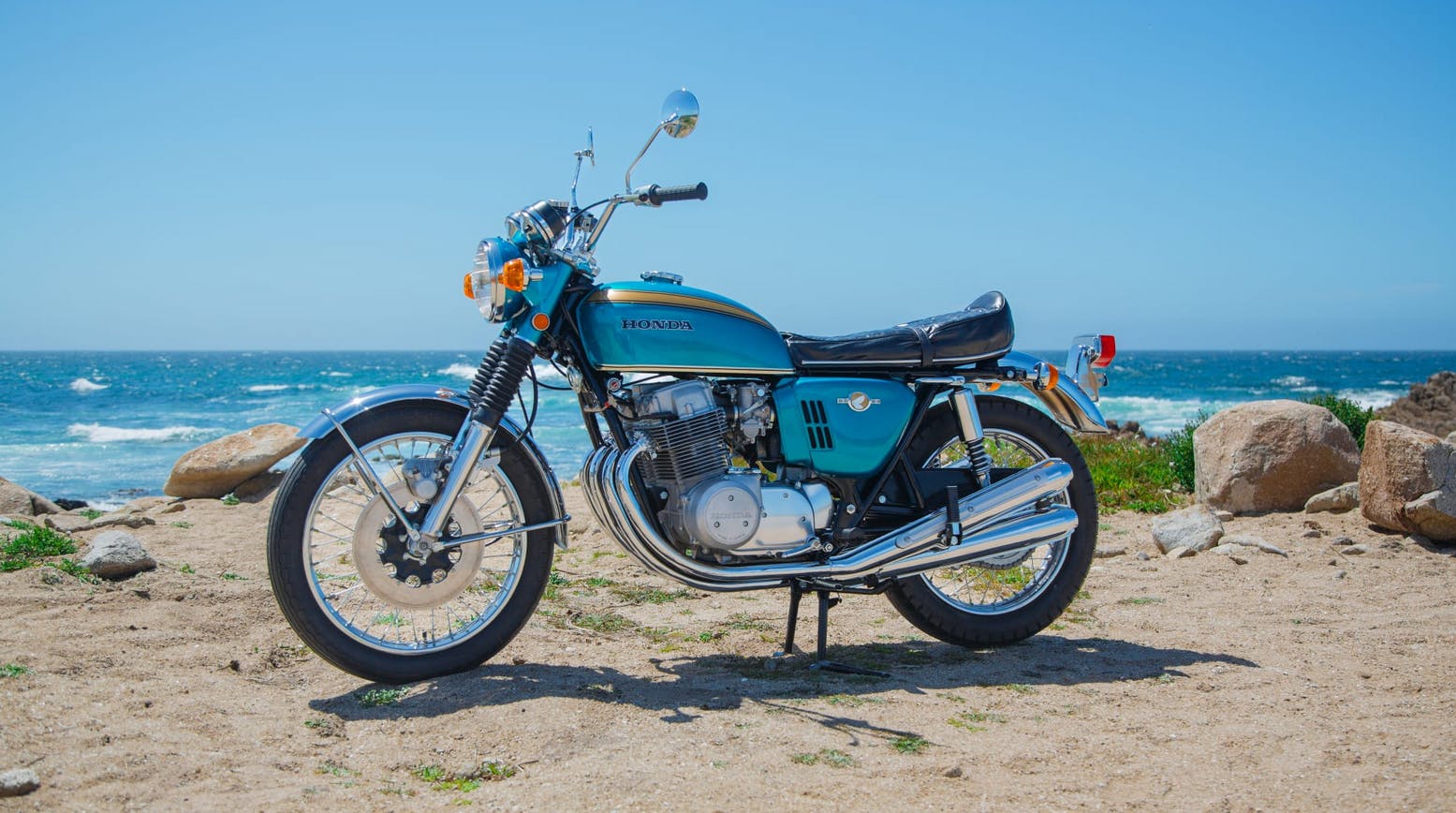
In this hobby, people throw around terms like “revolutionary” quite bit. It drives home the point that something is worth our reverence, but it is overused. For a vehicle to actually be revolutionary, I would argue, it should change the industry in a meaningful way from the date of its introduction onward. Think the Ford Model T for mass production, or the Pontiac GTO for muscle cars. In the bike world, the Honda CB750, like the GTO, ushered in a whole new segment—the superbike—when it came out at the end of the 1960s. Love your Hayabusa or GSX-R? Well, you have the 1969 CB750 to thank for kickstarting the craze.
That’s why this week’s sale of a CB750 prototype caught our attention. At $313,500, it’s one of the world’s most expensive Hondas on either two wheels or four. In fact, the only Hondas of any kind to sell for more at auction are rare-spec NSXs.
 Mecum
Mecum
Honda Motor Company began creating small commuter bikes for the masses in the late 1940s, attaching motors to bicycles. The company soon began selling economical, quiet, and clean overhead valve four-stroke motorcycles that became widely popular. In the 1960s in the U.S., Honda introduced an ad campaign—”You meet the nicest people on a Honda”—to tear down the bad-boy image long associated with motorcycles. As Honda’s two-wheeled reputation grew, it kept producing larger and more sporting, advanced bikes for both road and track.
Honda Service Manager Bob Hansen recommended to Soichiro Honda that they should build a street bike using technology from their Grand Prix program. By early 1968, a solution was in progress. It would be a 736cc, four-cylinder bike that was enjoyable to ride, but still capable of 200 km/h (124mph), a blistering speed for the time.
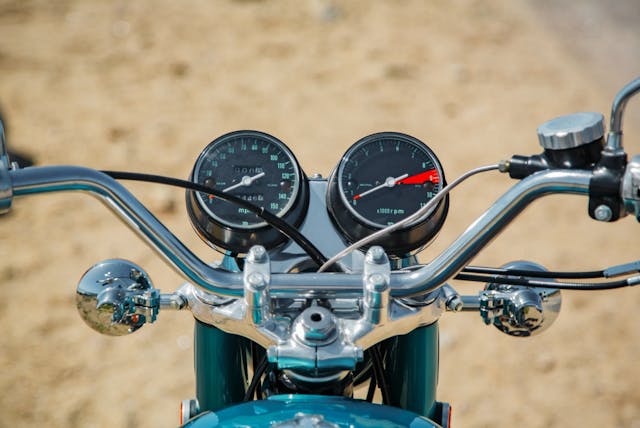
The soon-to-be CB750’s engine was all new and larger than any street bike engine Honda had yet tried. True to the original specification, the new engine would use tech from the RC181 race engine including an overhead cam and four carburetors, resulting in nearly 70 horsepower. For comparison, Harley-Davidson’s most powerful engines were significantly larger displacement, made slightly less power, and used older pushrod technology. The CB750 was also the world’s first mass-produced motorcycle with a parallel four-cylinder overhead cam engine, hydraulic disc brakes, double cradle frame, and four mufflers.
 Mecum
Mecum
 Mecum
Mecum
Early production models were ready for display at the Tokyo Motor Show in late 1968, with full production models going on sale for 1969. At the same time, Honda sent one prototype bike to Bob Hansen in October of 1968, followed by four additional prototypes to be shown to dealers in January of 1969, and export of customer bikes beginning in April of the same year. The bike would start a seismic shift in the motorcycle world from that point on.
The CB750 was a huge hit with the public for several reasons. The performance from its advanced four-cylinder overhead cam engine was one. Another was cost, as Honda was able to sell the CB750 for hundreds less than its two- and three-cylinder British rivals. Then there was reliability. Few really expected a sporty motorcycle in the 1960s to be reliable, which is why Honda build quality was such a revelation. Its electric start only added to its practicality. Its reputation was then bolstered by wins on the track at endurance races around the world, as well as the famed 1970 Daytona 200, with legendary rider Dick Mann at the controls. Honda sold hundreds of thousands of units, and the CB750 became one of the most important and popular motorcycles of all time.
 Mecum
Mecum
 Mecum
Mecum
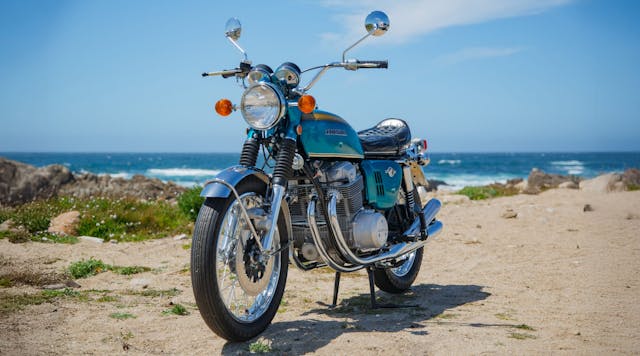
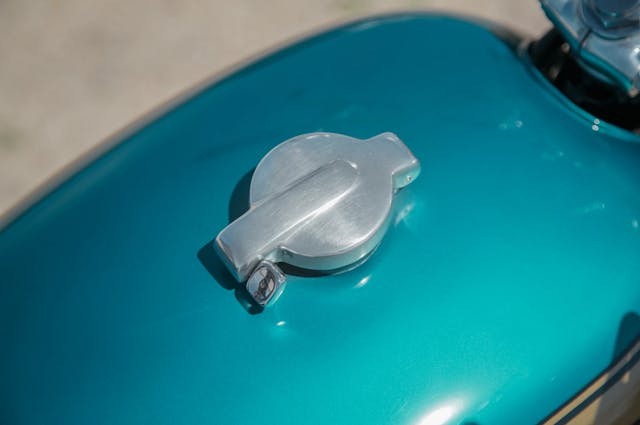
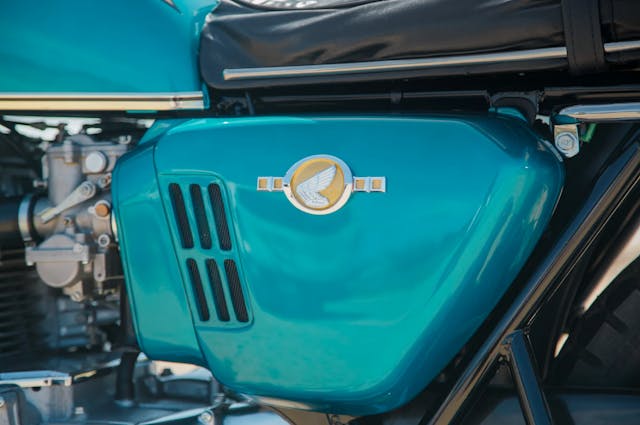
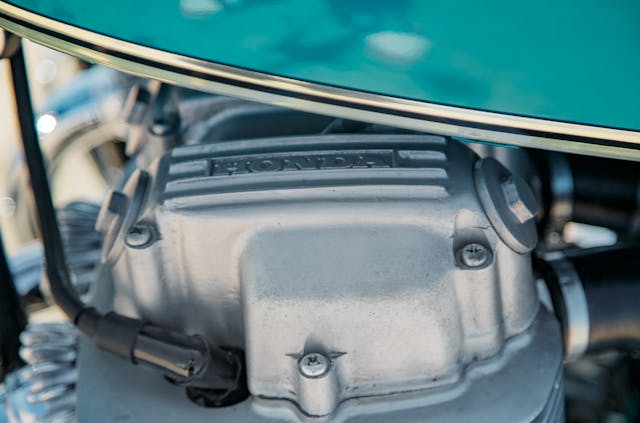
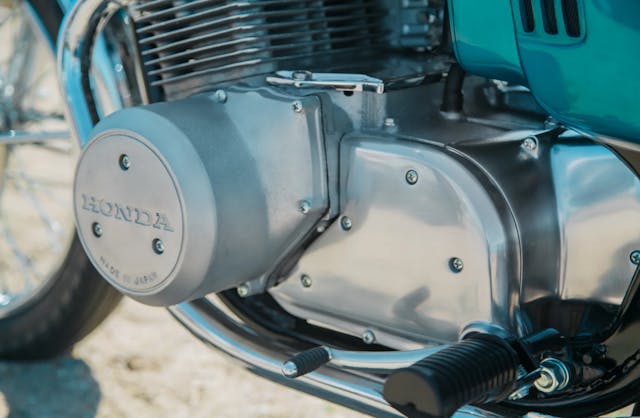
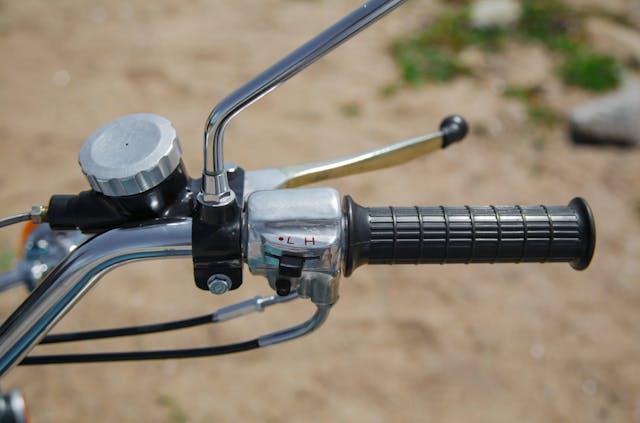
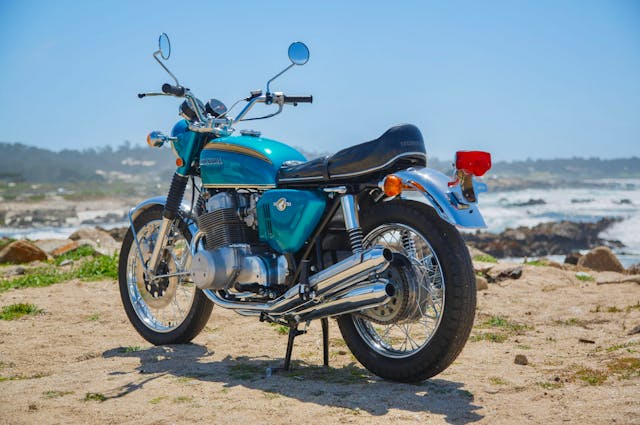
That brings us to today. Remember that singular CB750 prototype Honda sent to Bob Hansen in ’68? Well, it still exists, and it’s the one Mecum consigned for its annual Las Vegas bike sale this year. As one of the earliest CB750s in existence, it maintains a slew of features not seen on other early production examples, including one-off Keihin carburetors, “HONDA” cast in the cam cover (instead of “OHC 750”), and different emblems. According to Mecum, it was acquired in the mid-1990s by famed CB750 restorer Vic World. He later restored it, finishing in early 2024 and winning Best in Show at that year’s Quail Motorcycle Gathering.
When Mecum announced it had consigned the prototype Honda, it caused a stir. Motorcycle collectors and fans knew it’d sell big, but just how big? Its $313,500 final price (including buyer’s premium) set a new record for a Honda motorcycle and indeed any Japanese motorcycle.
 Mecum
Mecum
 Mecum
Mecum
Why does this sale matter to the rest of us? James Hewitt, Operations Manager for Hagerty Automotive Intelligence, and former sandcast CB750 owner sums it up nicely: “When it comes to collecting, people will always look for the nuanced variations or rare features, whether good or bad, that came throughout production and pay more for them. Why do you want a misstamped penny? Because no one else has one.” But even then there is a hierarchy in the CB750 world, as he explains: “When it comes to CB750s, the so-called “sandcast” engines were the first 7414 produced. Naturally, collectors want those. What came before the first production sandcasts? The prototypes. Naturally, more rare, more collectible means more valuable. In this case, more valuable by about seven times.”
To put it into automotive terms, what would you pay for the earliest Pontiac GTO you can get your hands on? This is like the two-wheeled version of that, and while most of us couldn’t fathom paying that for a car, let alone a motorcycle, it shows that the CB750 has some chops as a big time collector bike, worthy of being mentioned in the same breath as the greats like the Harley Knucklehead or the Vincent Black Shadow. Given the Honda’s importance to bike history, it’s about time.
 Mecum
Mecum