
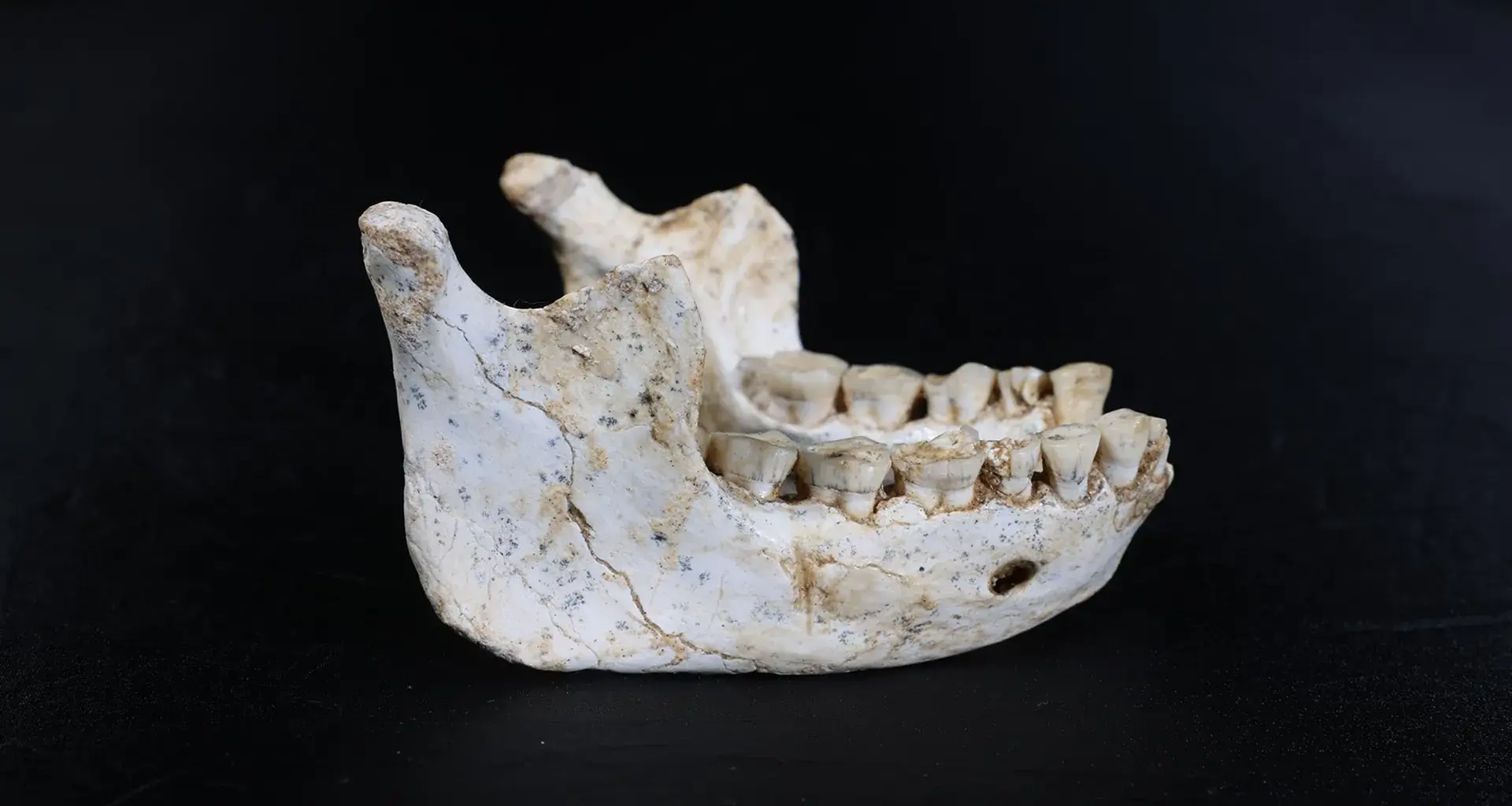
Perfectly timed fossils from Morocco reveal a forgotten African population living near the very root of the human family tree.
Fossils dated with exceptional precision Sediments at Thomas Quarry I preserve a clear record of a major flip in Earth’s magnetic field that occurred about 773,000 years ago. This natural timestamp allows scientists to pin down the age of these African hominin fossils with rare accuracy for the Pleistocene. A population near the base of the human family tree Lower jaws and other remains display a mix of ancient and more advanced features. This combination points to an African population closely related to Homo antecessor and living near the evolutionary split between African and Eurasian human lineages. Why northwest Africa matters for human origins More than 30 years of Moroccan French research along the Casablanca coast have uncovered a remarkably well preserved cave site that was once used by carnivores. These discoveries underscore northwest Africa’s central role in the early evolution of the genus Homo.
Precisely Dated Fossils From Coastal Morocco
An international team of scientists has analyzed newly identified hominin fossils from Thomas Quarry I (Casablanca, Morocco), offering one of the most securely dated snapshots of early human evolution in Africa. The research was led by Jean-Jacques Hublin (Collège de France & Max Planck Institute for Evolutionary Anthropology), David Lefèvre (Université de Montpellier Paul Valéry), Giovanni Muttoni (Università degli Studi di Milano) and Abderrahim Mohib (Moroccan Institut National des Sciences de l’Archéologie et du Patrimoine, INSAP).
The fossils have been dated to 773,000 plus or minus 4,000 years ago using an exceptionally detailed magnetostratigraphic record. This record captures the Brunhes/Matuyama boundary, the most recent major reversal of Earth’s magnetic field, which serves as a precise global time marker in the Quaternary period. Published in Nature, the study sheds new light on African populations that lived close to the evolutionary branch leading to Homo sapiens and helps clarify the shared ancestry of H. sapiens, Neanderthals, and Denisovans.
Decades of Fieldwork Lead to a Breakthrough
The discoveries are the result of more than 30 years of sustained archaeological and geological research carried out under the Moroccan-French Program “Préhistoire de Casablanca.” This long-running collaboration has involved large-scale excavations, detailed stratigraphic analysis, and extensive geoarchaeological studies across the southwestern part of Casablanca.
Over time, this careful work revealed the unusual quality of preservation at Thomas Quarry I, including its layered sediments, environmental record, and archaeological materials. These conditions ultimately led researchers to the hominin remains and the geological context that makes the current study possible.
As Abderrahim Mohib explains: “The success of this long-term research reflects a strong institutional collaboration involving the Ministère de la Jeunesse, de la Culture et de la Communication Département de la Culture of the Kingdom of Morocco (through INSAP) and the Ministère de l’Europe et des Affaires Étrangères of France (through the French Archaeological Mission Casablanca).” Additional support came from institutions in Italy, Germany, and France, including the Università degli Studi di Milano, the Max-Planck Institute for Evolutionary Anthropology, the LabEx Archimède — University of Montpellier Paul Valéry, the University of Bordeaux, and the Muséum National d’Histoire Naturelle.
A Geological Hotspot for Human Prehistory
Thomas Quarry I sits within the raised coastal formations of the Rabat-Casablanca littoral, an area internationally recognized for its remarkably complete record of Plio-Pleistocene shorelines, dunes, and cave systems. According to Jean-Paul Raynal, who co-directed the program during the key excavation period, repeated changes in sea level, wind-driven sedimentation, and rapid cementation of coastal sands created ideal conditions for preserving fossils and archaeological evidence.
These processes turned the Casablanca region into one of Africa’s most important archives of Pleistocene life. The area documents early Acheulean stone tool industries, shifting animal communities linked to climate change, and multiple phases of hominin presence over hundreds of thousands of years.
The Grotte à Hominidés and Its Exceptional Context
Excavated within the Oulad Hamida Formation, Thomas Quarry I is already known for containing the oldest Acheulean tools in north-western Africa, dated to about 1.3 million years ago. The site is also close to Sidi Abderrahmane, a landmark locality for Middle Pleistocene archaeology in Northwest Africa.
Within this broader setting lies the “Grotte à Hominidés,” a cave system created during a marine highstand and later filled with sediments that remained undisturbed over time. David Lefèvre describes it as “a unique cave system carved by a marine highstand into earlier coastal formations and later filled with sediments that preserved hominin fossils in a secure, undisturbed and undisputable stratigraphic context.”
Locking Fossils to a Moment in Time
Determining the age of Early and Middle Pleistocene fossils is often difficult because rock layers are incomplete or dating methods come with large uncertainties. The Grotte à Hominidés stands out because sediments accumulated rapidly and continuously, preserving an unusually detailed magnetic signal.
Earth’s magnetic field periodically flips polarity, and these reversals leave a clear and globally synchronized signature in sediments. The Matuyama-Brunhes transition (MBT), which occurred around 773,000 years ago, is the most recent major reversal and one of the most reliable chronological markers available. As Serena Perini explains: “Seeing the Matuyama-Brunhes transition recorded with such resolution in the ThI-GH deposits allows us to anchor the presence of these hominins within an exceptionally precise chronological framework for the African Pleistocene.”
The cave sequence records the end of the Matuyama Chron (reverse polarity), the MBT itself, and the beginning of the Brunhes Chron (normal polarity). By analyzing 180 magnetostratigraphic samples, an unprecedented number for a hominin site of this age, researchers pinpointed the exact position of the polarity switch at 773,000 years and captured its brief duration of 8,000 to 11,000 years. The hominin fossils were deposited during this narrow window, a conclusion further supported by animal remains found at the site.
Fossils Near the Base of the Human Family Tree
The human remains appear to come from what was once a carnivore den. Evidence includes a hominin femur marked by clear signs of gnawing. The assemblage consists of a nearly complete adult lower jaw, part of a second adult mandible, a child’s mandible, several vertebrae, and isolated teeth.
Detailed analyses using micro-CT scans, shape measurements, and anatomical comparisons reveal a mix of primitive and more derived features. Some traits resemble hominins from Gran Dolina in Atapuerca, often referred to as Homo antecessor, raising the possibility of very early population connections between north-west Africa and southern Europe. However, by the time of the Matuyama-Brunhes transition, these groups appear to have already diverged, suggesting any contact occurred earlier.
What Teeth Reveal About Ancestry
Matthew Skinner explains how internal tooth structures provided critical clues: “Using microCT imaging we were able to study a hidden internal structure of the teeth, referred to as the enamel-dentine junction, which is known to be taxonomically informative and which is preserved in teeth where the enamel surface is worn away. Analysis of this structure consistently shows the Grotte à Hominidés hominins to be distinct from both Homo erectus and Homo antecessor, identifying them as representative of populations that could be basal to Homo sapiens and archaic Eurasian lineages.”
Shara Bailey adds that the overall tooth shape supports this conclusion. “In their shapes and non-metric traits, the teeth from Grotte à Hominidés retain many primitive features and lack the traits that are characteristic of Neanderthals. In this sense, they differ from Homo antecessor, which — in some features — are beginning to resemble Neanderthals. The dental morphological analyses indicate that regional differences in human populations may have been already present by the end of the Early Pleistocene.”
Rethinking Africa’s Role in Human Evolution
The findings reinforce the idea that Northwest Africa was a major center of early human evolution during periods when shifting climates opened migration routes across what is now the Sahara. As Denis Geraads notes: “The idea that the Sahara was a permanent biogeographic barrier does not hold for this period. The palaeontological evidence shows repeated connections between Northwest Africa and the savannas of the East and South.”
The Grotte à Hominidés hominins lived around the same time as those from Gran Dolina, earlier than Middle Pleistocene fossils linked to Neanderthals and Denisovans, and roughly 500,000 years before the earliest known Homo sapiens remains from Jebel Irhoud. Their combination of ancient African traits and features that foreshadow later Eurasian and African populations offers rare insight into the last common ancestor of Homo sapiens, Neanderthals, and Denisovans — estimated from genetic evidence to have lived between 765,000 and 550,000 years ago. Fossil evidence from the Moroccan site aligns most closely with the earlier part of this range.
Jean-Jacques Hublin concludes that “the fossils from the Grotte à Hominidés may be the best candidates we currently have for African populations lying near the root of this shared ancestry, thus reinforcing the view of a deep African origin for our species.”