

Warning:
This article may contain graphic and/or adult content unsuitable for minors and sensitive readers.
Read the article
Stock image pixabay
You thought gambling in SA was bad enough as it is, but it’s getting worse.
A new study by research house Trade Intelligence shows 39% of online punters are gambling more than they did a year ago. More worrying is the fact that gamblers are sacrificing other spending priorities, particularly groceries, to place bets.
Some 65% of those surveyed cited ‘making more money’ as a top reason for gambling. The thrill and excitement of betting was less of a motivation, challenging the assumption that gambling is purely for entertainment.
Research such as this – coming on top of other studies released in 2025 – shows many households are turning to gambling out of desperation.
Some 44% of those surveyed said they would have bought groceries if the money had not been gambled away.
This gives further credence to claims by retailers that online gambling is reducing disposable income among vulnerable segments of the population.
Retailers such as Pick n Pay, Famous Brands and The Foschini Group (TFG) have highlighted the damage caused by online gambling to retail sales, now regarded as more troubling than competition from e-commerce platforms such as Temu and Shein.
Impact across income groups
Recent research by Experian, which has access to 55 million consumer records, shows that some categories of distressed households are spending up to 40% of their gross monthly income on gambling.
It’s a similar story for the poorest households, many of which are spending up to half of their South African Social Security Agency (Sassa) grants on bets, according to Experian.
Even affluent groups were found to be spending 10-12% of their incomes on gambling.
The middle market segment was found to spend 38-50% of its income on gambling, nearly a third more than they spend on groceries.
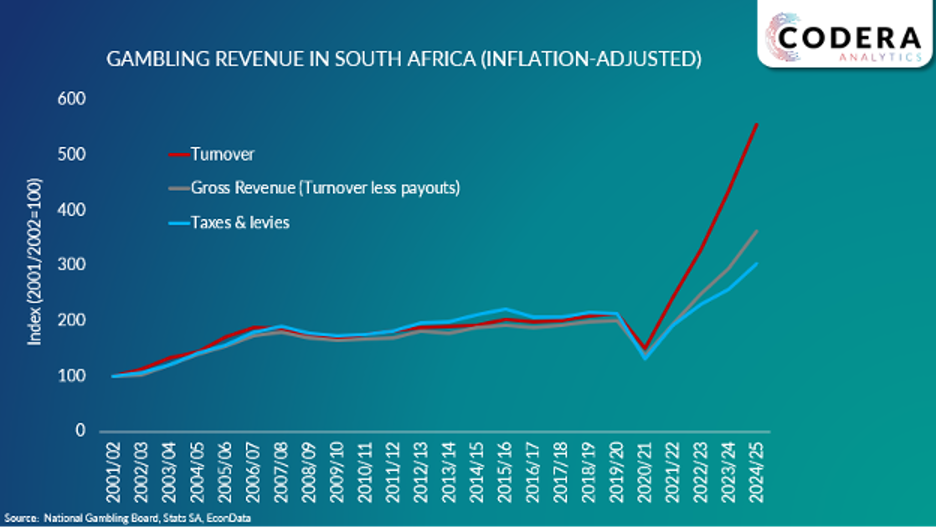
According to the National Gambling Board (NGB), R1.5 trillion was wagered or spent on all forms of gambling in the 2024/25 financial year.
This includes winnings that were recycled back into new bets. Still, this is an astonishing 20% of GDP. Divided by 365 days of the year, that’s R4 billion every day.
The NGB also reports that 70% of this spend is on online gambling.
Once bets that have been recycled are stripped out, the gross gambling revenue (GGR) earned by SA gambling houses comes to R74.5 billion – a figure that is growing by about 25% a year, well in excess of economic growth.
The biggest gambling platforms in SA are Betway, owned by New York-listed Super Group, and Hollywoodbets. Between them, they clocked more than 60 million online visits a month in 2025.
Sports betting is estimated to account for more than 60% of GGR, fuelled by mobile apps and heavily promoted local sports games.
Source: National Gambling Board, Stats SA, EconData
Illegal gambling
These figures do not consider the economic impact of illegal gambling, which is reckoned to account for about 62% of total gambling in SA. This includes bets placed by South Africans with operators licensed outside the country, in jurisdictions such as Malta or the Philippines.
Sean Coleman, head of the South African Bookmakers’ Association, reckons there are more than 2 000 illegal online gambling operators targeting SA.
Many of these are disguised as SA-domiciled sites but are often run from weakly regulated jurisdictions such as Curaçao, Gibraltar, or the Isle of Man.
National Treasury released a discussion paper in February 2025 proposing a 20% national tax on GGR, while the NGB has called for stricter enforcement of advertising laws by provincial licensing authorities.
This would include restrictions on when advertising is allowed and controls on celebrity endorsements.
The National Gambling Amendment Bill is intended to impose national controls on gambling, but has faced delays due to turf wars over national versus provincial powers.
While some have called for outright bans on online gambling, such bans will only drive it underground, warns Jaco van Jaarsveldt, head of commercial strategy and innovation at Experian.
He argues for more robust education around the consequences of gambling, with an understanding that the house always wins.
This story first appeared in Moneyweb.