

Business leaders have broadly welcomed the deal, saying it secures continued duty-free access for Bangladeshi garments and several other products in the world’s third-largest economy after LDC graduation, a concern that has loomed large for exporters
08 February, 2026, 10:00 am
Last modified: 08 February, 2026, 10:58 am
TBS Illustration
“>

TBS Illustration
Highlights:
EPA secures post-LDC duty-free access to Japan for garments
Bangladesh grants Japan wide duty-free access, risking domestic industries
Strict intellectual property rules may erode LDC benefits, jobs
Subsidy bans and e-commerce rules favor stronger Japanese firms
Tariff elimination on Japanese cars threatens revenue, textiles, engineering
Businesses urge capacity building, logistics reforms, diversification beyond agreements
Bangladesh’s signing of an economic partnership agreement with Japan on Friday has drawn a mixed response from businesses and trade experts, who see both strategic gains and significant long-term risks for the economy as the country approaches graduation from least developed country status.
Infograph: TBS
“>
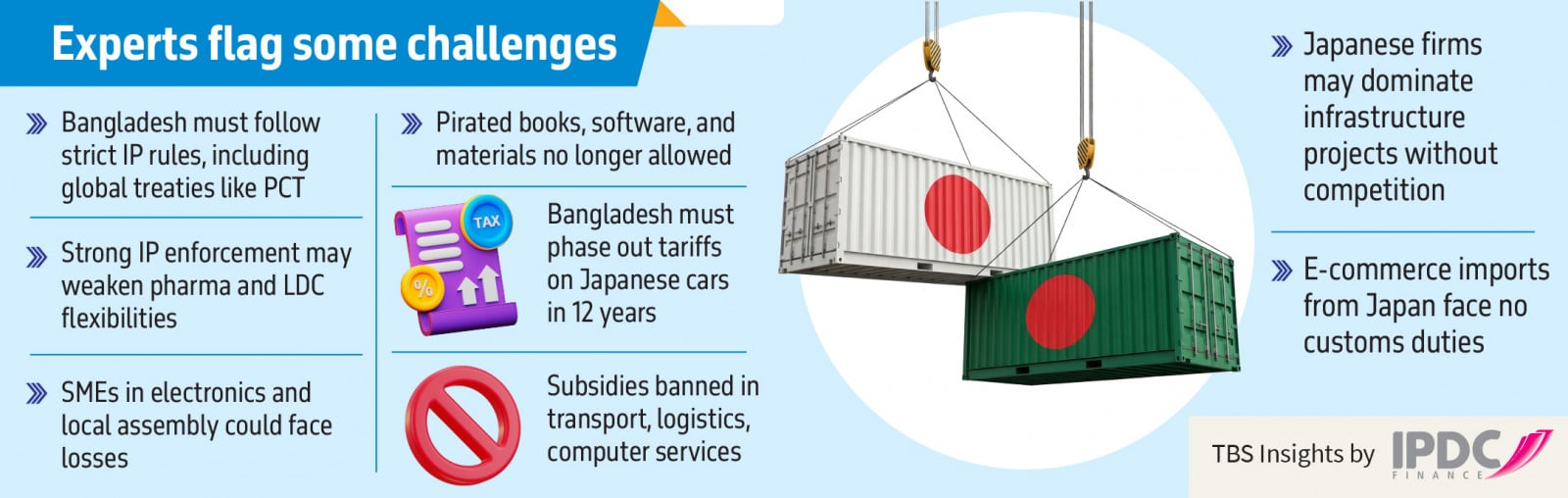
Infograph: TBS
Business leaders have broadly welcomed the deal, saying it secures continued duty-free access for Bangladeshi garments and several other products in the world’s third-largest economy after LDC graduation, a concern that has loomed large for exporters.
They said the agreement includes a trade facilitation chapter, obliging the government to take action to make the business environment more efficient. The agreement also contains detailed provisions on anti-corruption.

Keep updated, follow The Business Standard’s Google news channel
Under the EPA, if misdeclaration of imported goods is proven, traders can be fined an amount equivalent to the revenue lost by the government. Experts said this measure could curb arbitrary harassment of businesses.
Meanwhile, the BGMEA in a press statement yesterday said EPA marks a historic milestone in Bangladesh’s trade diplomacy.
“The deal ensures duty-free access for Bangladeshi garments and maintains favourable rules of origin, including single-stage processing, allowing garments to enter Japan tariff-free even after Bangladesh graduates from LDC status,” the trade body said.
Potential challenges
Trade analysts said that under the agreement, Bangladesh will grant Japan duty-free access for a wide range of products, including garments, fabrics, accessories, motor parts, light engineering goods, chemicals, glass, metals, jewellery and pharmaceuticals. Besides, Bangladesh has committed to gradually eliminating tariffs on Japanese car imports over 12 years.
Mohammad Hafizur Rahman, former director general of the WTO Cell at the Ministry of Commerce and a member of Bangladesh’s EPA negotiation team, said an analysis of the agreement revealed potential challenges for several domestic sectors.
He noted that Bangladesh’s plastics industry has developed sufficient capacity to meet domestic demand and export abroad, yet Japanese plastic products will now enter the local market duty-free.
Bangladesh has also offered duty-free access for Japanese glass and light engineering products, despite being self-sufficient in glass production and having export-oriented firms in the sector.
He warned that duty-free imports of Japanese light engineering goods could undermine domestic producers that lack comparable scale and technology.
He added that Bangladesh had granted Japan duty-free access for all types of metals and jewellery, even though jewellery is considered a promising and fast-growing sector with export potential.
In pharmaceuticals, Bangladesh exports medicines to many countries, benefiting from flexibilities available to LDCs. However, under the EPA, Japanese medicines and protective devices will enter Bangladesh duty-free, while Japan has not extended reciprocal duty-free access to Bangladeshi leather products, which remain the country’s second-largest export after garments.
Intellectual property rights obligations
Under the intellectual property rights chapter, Bangladesh has agreed to accede to several international protocols typically implemented by developed economies.
Among them is the Patent Cooperation Treaty (PCT), which allows companies to seek patent protection in multiple countries through a single application. A PCT application has the same legal effect as filing separate patent applications in each contracting state, and the treaty currently has 158 members.
If Bangladesh delays its LDC graduation by three years while being compelled to implement these agreements under the EPA, he warned, the country could lose LDC-related benefits despite formally retaining LDC status.
Before graduation, Bangladesh has benefited from a large market for imitation products. Electronic products copied from Japanese brands are often manufactured locally, involving small and medium enterprises that generate employment and allow consumers access to modern products at lower prices.
Strict enforcement of intellectual property rules could disrupt these activities, raising costs and reducing employment, Hafizur Rahman said. He also pointed to the widespread use of copied foreign books and software, practices that remain common even in countries like India.
“The biggest problem is that once intellectual property concessions are granted to one country, they must be extended to all countries,” he said. “The impact of these conditions in the Japan agreement will be felt across all sectors.”
Former Bangladesh Trade and Tariff Commission member Mostafa Abid Khan, who was also part of the EPA negotiation team, said signing the PCT would obligate Bangladesh to grant patents even if its LDC graduation is delayed.
Commerce Secretary Mahbubur Rahman, however, played down fears over intellectual property provisions in services, saying there was “no reason for Bangladesh to be alarmed” about IP-related conditions in that area.Restrictions on subsidies and e-commerce
The agreement bars Bangladesh from providing subsidies in transportation, logistics and computer services, including freelancing.
Hafizur said withdrawing subsidies would allow Japanese firms, with far greater capacity, to dominate logistics and transport projects at the expense of local companies.
Abid said he had opposed including the subsidy chapter during early negotiations, warning that Bangladesh would incur losses if it could not support logistics and transport development.
The agreement also prevents Bangladesh from imposing tariffs on Japanese goods imported through e-commerce and includes conditions on cross-border data transfers, an area where Bangladesh currently lacks adequate regulatory and technical capacity.
Garments, cars, leather, agriculture
In garments, Japan will continue to grant duty-free access for Bangladeshi exports, but Bangladesh has offered reciprocal duty-free treatment for Japanese garments, accessories and cotton. Hafizur and Abid cautioned that this could affect the local textile sector, as Bangladesh has begun producing higher-end fabrics in certain segments.
The EPA mandates the complete elimination of all import-related duties on Japanese vehicles over 12 years, including customs duty, supplementary duty and regulatory duty. If combined duties currently stand at around 120%, they would need to be reduced by 10 percentage points annually from the next fiscal year, potentially eroding government revenue.
Despite strong lobbying, Japan did not offer zero tariffs on Bangladeshi leather products, deferring the issue to future negotiations. Japan also did not grant duty-free access for all agricultural products.
Business voices stress capacity building
Syed Ershad Ahmed, president of the American Chamber of Commerce in Bangladesh, said, “We aren’t focusing on reducing logistics cost and making those services competitive. We aren’t taking adequate steps to develop skills and make our workforce more productive.”
He also referred to Bangladesh’s limited capacity to diversify export basket and little progress in research and innovations to cater to transforming global demands. “How many commodities do we really have to export? Are we doing enough R&D and innovations to diversify and expand?” he asked.
Regulatory bottlenecks and customs hassles also stand in the way, he pointed out, demanding full automation of customs clearance for raw material imports and enhancement of cargo handling capacity at Chattogram Port to reduce export lead time.
Cutting corruption, ensuring public order and meeting energy demand also remain crucial for investment. “Otherwise only signing of EPA or FTA won’t bring any results,” he said.