
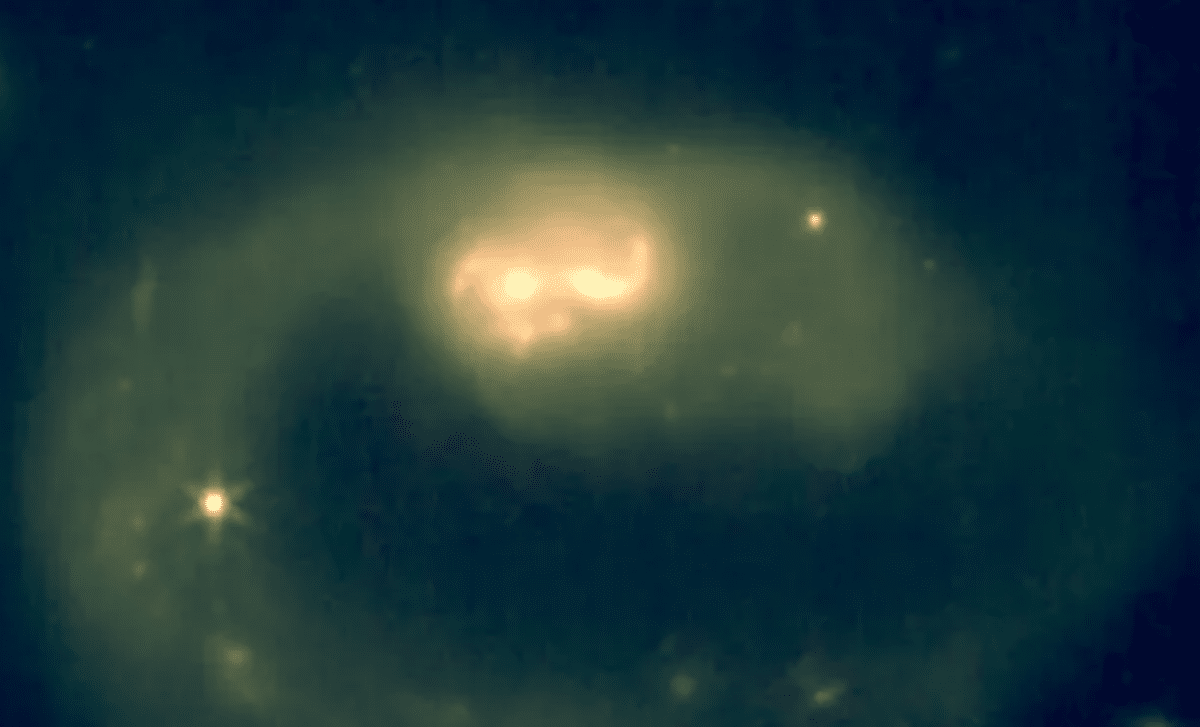
In a groundbreaking study published in the journal Nature, astronomers using the James Webb Space Telescope (JWST) have uncovered a surprising array of organic molecules in a distant galaxy, IRAS 07251–0248. This discovery offers fresh insights into the early stages of life’s building blocks, revealing how complex molecules may form in extreme regions of space. The JWST’s unprecedented ability to detect infrared light allowed scientists to peer into this galaxy’s obscured heart, unveiling an astonishing chemical diversity that could play a crucial role in understanding the origins of life beyond Earth.
The Unexpected Chemical Complexity
The JWST’s investigation of IRAS 07251–0248, an ultra-luminous infrared galaxy, has provided scientists with an invaluable snapshot of molecular chemistry in a distant galactic environment. The galaxy, known for its dense core shrouded in dust and gas, emits a significant amount of infrared light, which the JWST can detect without obstruction. This allowed researchers to analyze the chemical composition of the galaxy’s gas, dust, and ice.
“We found an unexpected chemical complexity, with abundances far higher than predicted by current theoretical models,” said Ismael García Bernete, team leader and researcher at the Center for Astrobiology (CAB).
The team’s results indicated a significantly richer chemical network than what had been anticipated. This suggests that some galactic nuclei may harbor a continuous source of carbon, fueling the chemical processes needed for the creation of organic molecules. This discovery challenges prior assumptions about the amount and distribution of complex organic material in such extreme environments, suggesting a far more abundant molecular production than previously thought.
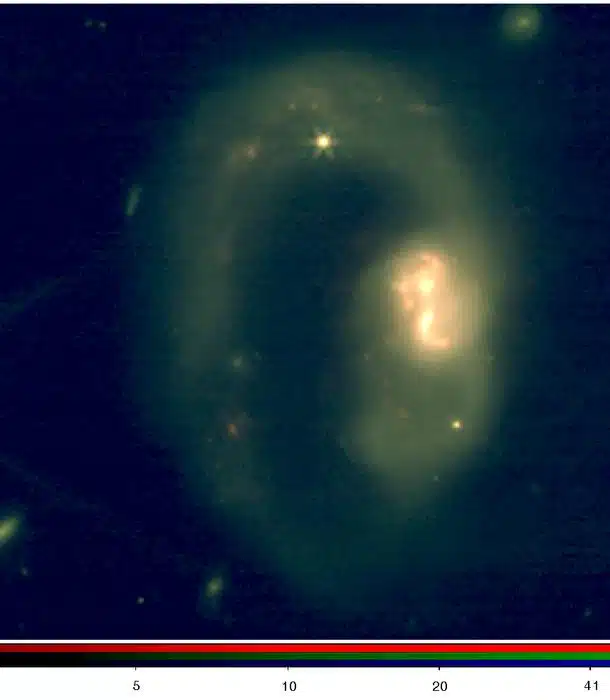 JWST NIRCam) false colour image of IRAS07251-0248 (Image credit: Mikulski Archive for Space Telescopes, Space Telescope Science Institute, Association of Universities for Research in Astronomy, Inc., NASA.)
Organic Molecules: Building Blocks of Life
Among the wealth of chemicals identified, several small organic molecules stood out, including methane, acetylene, benzene, and the highly reactive methyl radical. These molecules are often considered the basic building blocks for life, forming the foundational components needed to create more complex organic compounds. The discovery of these molecules in a distant galaxy could revolutionize our understanding of how life-sustaining compounds form in space.
Despite the fact that small organic molecules like those found in IRAS 07251–0248 are not present in living cells, they hold significant potential for prebiotic chemistry. “Although small organic molecules are not found in living cells, they could play a vital role in prebiotic chemistry, representing an important step towards the formation of amino acids and nucleotides,” explained Dimitra Rigopoulou, a team member from the University of Oxford. This suggests that these simple compounds could serve as crucial intermediaries in the formation of more complex molecules required for life as we know it.
Cosmic Rays and Their Role in Organic Chemistry
The team’s findings also pointed to the role of cosmic rays in shaping the chemical environment of this galaxy. While extreme temperatures and the stirring of gases could explain some of the molecular complexity observed, the researchers hypothesize that high-energy particles, known as cosmic rays, may play a pivotal role. These particles likely bombard and fragment larger molecules, such as carbon-rich grains of dust, breaking them into smaller organic molecules in the process. This cosmic chemistry adds a layer of complexity to the creation of organic compounds in space, emphasizing the importance of high-energy processes in the molecular evolution of the universe.
Implications for Life Beyond Earth
The significance of these findings extends far beyond this specific galaxy. The discovery that organic molecules can form and accumulate in distant, chemically-rich galactic environments presents a compelling case for the potential of life elsewhere in the universe. The study not only demonstrates how galaxies like IRAS 07251, 0248 might act as “factories” for organic molecules but also highlights the role that cosmic processes play in the formation of the building blocks of life. As such, this research could guide future investigations into the chemical evolution of other galaxies and planetary systems, especially those with the necessary conditions for life.
Published in Nature on February 6, the study underscores the power of the JWST in studying distant and previously obscured regions of space. With its ability to penetrate dense cosmic dust and gather data on far-off molecular structures, the JWST is set to reshape our understanding of the universe’s chemical landscape, potentially uncovering new pathways for the origins of life.