
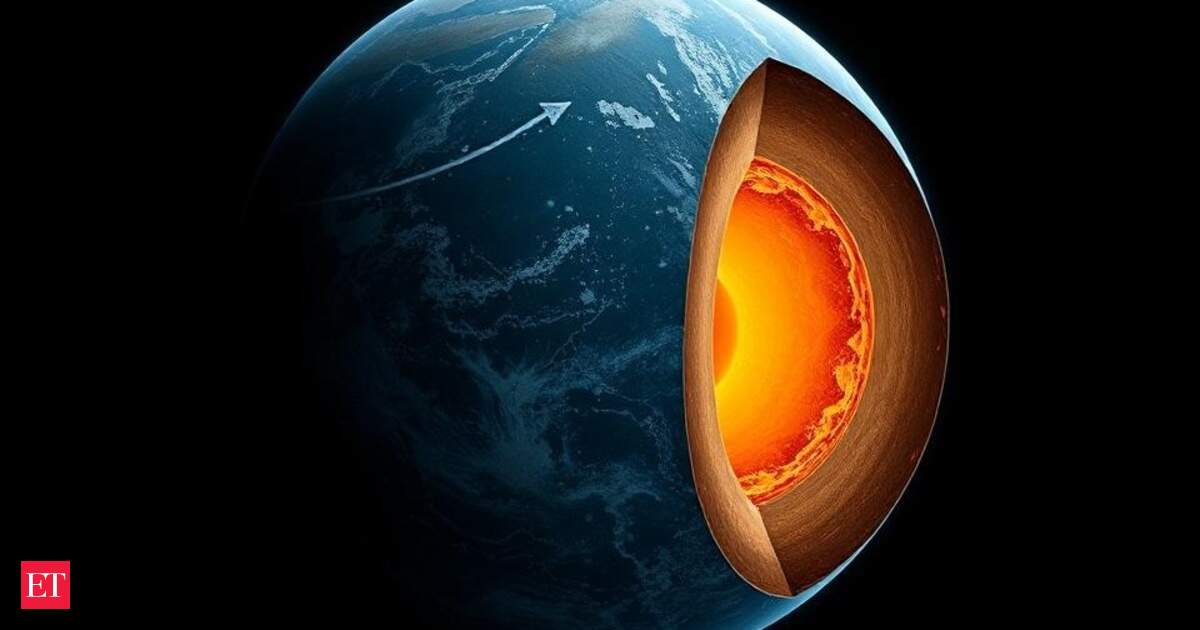
Beneath our feet lies a hidden world as mysterious as space itself, the Earth’s core. This distant interior region, more than 3,000 miles (5,000 km) beneath the surface, is out of reach of instruments and eyes alike. Yet scientists are discovering that it is not static or unchanging. Instead, evidence suggests that the Earth’s inner core has started to slow down how it rotates compared with the surface, and this subtle shift may be gently altering the very length of our days. TIL Creatives
I illustrate Earth’s internal structure, showcasing its distinct layers and the dynamic movement within its core.
A Planetary Gearbox Deep UndergroundWhat exactly are scientists talking about when they say the core could be slowing? The Earth has layers: a solid rocky crust, a thicker solid mantle beneath that, and at the very center, two metallic parts, a liquid outer core and a solid inner core composed mainly of iron and nickel. These layers don’t all rotate in lockstep. Because the inner core is suspended inside the liquid outer core, it can spin at a slightly different rate than the surface.
According to researchers from the University of Southern California and the Chinese Academy of Sciences, the inner core began to slow relative to the Earth’s surface around 2010. This conclusion comes from seismic data, recordings of waves generated by earthquakes and even historic nuclear tests, which showed changes in how fast those waves traveled through Earth’s deepest layers.
“It’s very hard to notice, on the order of a thousandth of a second,” John Vidale, Dean’s Professor of Earth Sciences at USC, told Forbes about the expected effect on the length of a day. “Almost lost in the noise of the churning oceans and atmosphere.”
 Live Events
What Does “Slowing Down” Even Mean?For decades, studies of the core suggested it rotated slightly faster than the surface, a phenomenon called superrotation. But the new results show a shift: the solid inner core is now moving more slowly than the overlying layers, a state scientists describe as “backtracking” or subrotation.
The reasons for this shift are still being explored, but gravitational forces from dense regions of the mantle and the vigorous motion of the liquid outer core, the very layer that sustains Earth’s magnetic field, are likely influences in this underground dance.That churning of the outer core constantly interacts with the solid inner core. Because they interface across a boundary that is neither rigid nor simple, the torque and drag forces between them can slow the inner core’s spin relative to the rest of the planet. Scientists hope that further research will reveal exactly why these changes are occurring.Tiny Ripples on the Surface: Day Length ChangesWhy should this matter to people who never leave the surface? The short answer: because Earth’s rotation rate, the speed at which the planet spins, defines the length of our day. At its most basic, one full spin equals 24 hours.
According to the seismic study, subtle core changes may contribute to slight variations in Earth’s rotation. Slowing deeper layers could alter the rotational coupling between Earth’s interior and outer shell so that the surface itself rotates a tiny bit faster or slower. These shifts would shift day length by fractions of a millisecond, thousandths of a second, too small for humans to notice in everyday life.
For context, News outlets reported that in 2024 and 2025, Earth had already recorded some of the shortest days on record, measured at about 1.3 to 1.66 milliseconds shorter than a 24-hour period. While these are not direct measurements of inner core change, they show the kinds of tiny variations scientists are tracking in Earth’s rotation.
How Core Behavior Interacts with Other ForcesIt’s important to separate short-term wobbles from long-term change. Earth’s rotation varies naturally over years and decades due to many factors, including the Moon’s gravitational pull, ocean currents, atmospheric winds, and tectonic shifts. Research from the University of Liverpool has shown that variations in day length over one- to ten-year intervals often stem from deeper core processes interacting with those surface forces.
But the recent focus on inner-core deceleration suggests there might be cycles in how the core spins, possibly over decades, adding a new layer to scientists’ understanding of Earth’s internal mechanics. Some research even points to oscillations spanning about 70 years. These aren’t effects that will make seconds disappear from our clocks anytime soon, but they help scientists better understand the interplay between Earth’s deepest parts and life on the surface.
Why Scientists CareUnderstanding core dynamics isn’t an abstract academic pursuit. The inner core’s movement is tied to the magnetic field that protects the planet from harmful solar radiation. A changing rotation rate might, in very subtle ways, influence that magnetic field over long timescales, though scientists emphasize that any such impact is far beyond human lifetimes and still highly uncertain.
Ultimately, when scientists say the Earth’s core is slowing down, they are peering into the most remote parts of our world and discovering that even the deep interior is dynamic and changing. That knowledge not only enriches our understanding of the planet we call home but also reminds us that Earth, inside and out, is a complex, dynamic system, not a static piece of rock.