
Calling India’s beauty and personal care (BPC) market crowded would be an understatement — it is a red-ocean battlefield. For decades, the category has been dominated by large FMCG giants, such as Marico and Hindustan Unilever, and global beauty majors like Garnier, L’Oreal, and Maybelline.
Structurally, the market is split along clear price lines — domestic FMCG brands focused on value-conscious mass consumers and international brands, which cater to the affluent or aspirational class.
This price and positioning gap began to narrow around 2016, when a new wave of D2C beauty brands entered the market, promising global-grade formulations at affordable prices. These startups leveraged digital distribution, influencer-led marketing, and contract manufacturing to scale rapidly.
By 2026, however, the D2C narrative has begun to fray. Several beauty brands, including Sugar Cosmetics, Wow Skin Care, and Juicy Chemistry, just to name a few, are grappling with a slowdown in revenues. While Sugar Cosmetics saw its operating revenue slip 21% YoY in FY25 to ₹398 Cr, Juicy Chemistry saw its revenue plummet to INR 19 Cr in FY25 from INR 20 Cr the previous year. WOW Skin Science, which is yet to file its FY25 numbers, saw its revenue decline 9% YOY in FY24.
Reason: Limited differentiation, weak offline distribution, rising customer acquisition costs, and the inability to scale profitably.
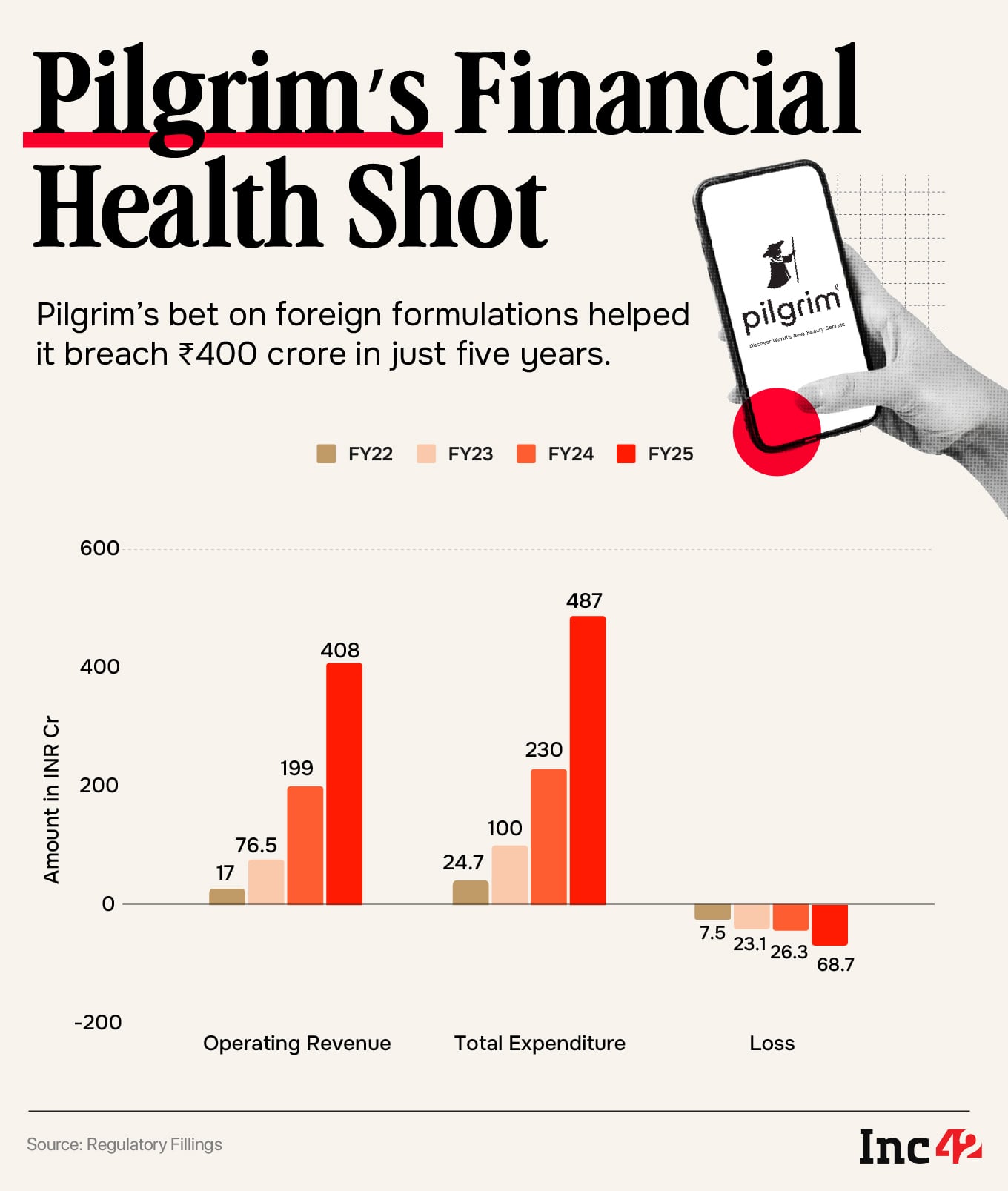
However, Mumbai-based Pilgrim seems to be bucking this trend. Founded in 2019 by Anurag Kedia and Gagandeep Makker, the company scaled its revenue 24X in just three years — from a mere ₹17 Cr in FY24 to a sizeable ₹400 Cr in FY25. Having raised $54 Mn+ since its inception, the BPC brand is said to be on track to breach the ₹600 Cr revenue mark by FY26 end.
Now, before we unpack what sets Pilgrim apart in a brutal market, it’s worth tracing the company’s journey from the very start.
A False Start
Pilgrim’s origins are closely tied to the founder’s earliest entrepreneurial bet. What’s, however, interesting is that Kedia never wanted to become an entrepreneur, even though business ran in his DNA.
Kedia grew up in Jaipur in a business family, but, as they say, familiarity breeds contempt. In Kedia’s case, this meant avoiding entrepreneurship at all costs. After graduating from IIT Bombay and completing his MBA from IIM Ahmedabad, he joined KPMG as a consultant, where he gained exposure to how large enterprises scale.
Here, he got exposure to how large enterprises operate and scale, completely shifting his mindset. Well, how far can an apple fall from the tree? He, however, decided to start something of his own.
In 2006, Kedia took his first entrepreneurial leap by cofounding Four Fountains De, a chain of spas that later pivoted to beauty salons. While the business grew, it also revealed the limits of service-led models in India, particularly their dependence on real estate, manpower, and operational complexity. Kedia exited the business in 2018, selling the company in distress in 2020.
The experience shaped two core convictions.
“First, product businesses scale more efficiently than services. Second, the beauty category, despite its challenges, offers a long-term opportunity if executed well,” Kedia said.
While his first venture did not play out as planned, he did not want to exit the sector. He used a different lens to look at the massive $31 Bn Indian BPC space.
Diving deep into the beauty market in 2018, Kedia observed two converging trends:
Beauty ecommerce was growing rapidly, with consumers getting increasingly comfortable buying products online.
A large cohort of millennials, newly employed or graduating, was emerging as a distinct consumer segment.
Unlike GenZ, who would later dominate brand narratives, millennials were ‘conscious consumers’. Through early conversations, Kedia and Gagandeep Makker, his junior at IIT Bombay, who later joined him as a cofounder, identified three recurring purchase filters among this group:
Good For Me: Transparency around ingredients and formulations
Good For Society: Cruelty-free products and ethical certifications
Good For The Planet: Sustainability and reduced plastic usage
A parallel insight that the demand for international beauty products, particularly Korean skincare, was on the rise in India further bolstered their confidence in the space.
What they also discovered was that importing beauty products was expensive, and people may shy away from adopting an expensive brand never heard of before.
span {
margin: 0;
padding: 3px 8px !important;
font-size: 10px !important;
line-height: 20px !important;
border-radius: 4px !important;
font-weight: 400 !important;
font-style: normal;
font-family: noto sans, sans-serif;
color: #fff;
letter-spacing: 0 !important;
}
.code-block.code-block-55 .tagged {
margin: -4px 0 1px;
padding: 0;
line-height: normal;
}
@media only screen and (max-width: 767px){
.code-block.code-block-55 {
padding:20px 10px;
}
.code-block.code-block-55 .recomended-title {
font-size: 16px;
line-height: 20px;
margin-bottom: 10px;
}
.code-block.code-block-55 .card-content {
padding: 10px !important;
}
.code-block.code-block-55 {
border-radius: 12px;
padding-bottom: 0;
}
.large-4.medium-4.small-6.column {
padding: 3px;
}
.code-block.code-block-55 .card-wrapper.common-card figure img {
width: 100%;
min-height: 120px !important;
max-height: 120px !important;
object-fit: cover;
}
.code-block.code-block-55 .card-wrapper .taxonomy-wrap .post-category {
padding: 0px 5px !important;
font-size: 8px !important;
height: auto !important;
line-height:15px;
}
.single .code-block.code-block-55 .entry-title.recommended-block-head a {
font-size: 10px !important;
line-height: 12px !important;
}
.code-block.code-block-55 .card-wrapper.common-card .meta-wrapper .meta .author a, .card-wrapper.common-card .meta-wrapper span {
font-size: 8px;
}
.code-block.code-block-55 .row.recomended-slider {
overflow-x: auto;
flex-wrap: nowrap;
padding-bottom: 20px
}
.code-block.code-block-55 .type-post .card-wrapper .card-content .entry-title.recommended-block-head {
line-height: 14px !important;
margin: 5px 0 10px !important;
}
.code-block.code-block-55 .card-wrapper.common-card .meta-wrapper span {
font-size: 6px;
margin: 0;
}
.code-block.code-block-55 .large-4.medium-4.small-6.column {
max-width: 48%;
}
.code-block.code-block-55 .sponsor-tag-v2>span {
padding: 2px 5px !important;
font-size: 8px !important;
font-weight: 400;
border-radius: 4px;
font-weight: 400;
font-style: normal;
font-family: noto sans, sans-serif;
color: #fff;
letter-spacing: 0;
height: auto !important;
}
.code-block.code-block-55 .tagged {
margin: 0 0 -4px;
line-height: 22px;
padding: 0;
}
.code-block.code-block-55 a.sponsor-tag-v2 {
margin: 0;
}
}
]]]]>]]>
This was when they decided to work on globally inspired formulations, priced for aspirational Indian consumers, but manufactured locally.
Pilgrim: A Pandemic Launch
Pilgrim was conceived as a brand that would ‘travel the world’ for formulations and deliver them to Indian consumers at affordable prices. The founders launched the brand with 10-12 SKUs, largely inspired by Korean beauty traditions, sourcing ingredients globally while manufacturing through third-party partners in India.
The timing, however, was brutal. Pilgrim’s first inventory reached warehouses in March 2020, just as India entered a nationwide lockdown. For months, products remained unsold, and the risk of shutdown loomed large.
Shrouded in uncertainty, the founders chose not to give up. Instead, they doubled down on social media, establishing their presence and building the brand through educational content and direct engagement with potential users.
When restrictions eased in May 2020, their groundwork paid off, and Pilgrim clocked ₹5 Lakh in sales in its first month. The number scaled to ₹20 Lakh per month by the end of the year. The founders closed FY21 with a revenue of ₹5 Cr.
Before FY21 ended, Pilgrim expanded its portfolio with a second range inspired by French vinotherapy, using grape-based formulations. Growing demand and an expanding SKU base necessitated investments in manufacturing and team building.
This led to Pilgrim’s first institutional funding of ₹13 Cr led by Fireside Ventures, with participation from Rukam Capital and founders of startups such as boAt and NoBroker. With fresh capital, the startup accelerated expansion, closing FY22 with ₹17 Cr in revenue.
In FY23, the founders launched a vegan skincare range built around Spanish squalene — a plant-derived hydrating ingredient sourced from Spanish olives. By the end of the year, revenue had scaled to ₹72 Cr.
The Road To ₹400 Cr Revenue
In 2023, Pilgrim made a strategic push into the offline market, a move Kedia views as essential for building a long-lasting consumer brand. The transition, however, was neither quick nor cheap.
For one, convincing retailers to stock an emerging D2C brand was an uphill task, especially in a market dominated by established names with proven sell-through.
“In the early days, retailers often asked us why they should stock Pilgrim’s products and why consumers would choose to buy them,” Kedia said.
Then, offline retail also meant delayed customer feedback, making it harder to quickly iterate on products or messaging. At the same time, higher fixed costs put pressure on cash flows, testing the startup’s operating discipline at every step.
Offline expansion drove a significant portion of Pilgrim’s losses, particularly due to sales hiring and mall kiosks. To fund this phase, the startup raised $9 Mn in a Series B round led by Vertex Ventures, with participation from existing investors.
Today, offline contributes around 20% of Pilgrim’s revenue, while online remains the primary cash generator. The brand draws roughly 50% of its sales from tier I cities, with the remainder coming from tier II and III markets, largely driven by social-led discovery.
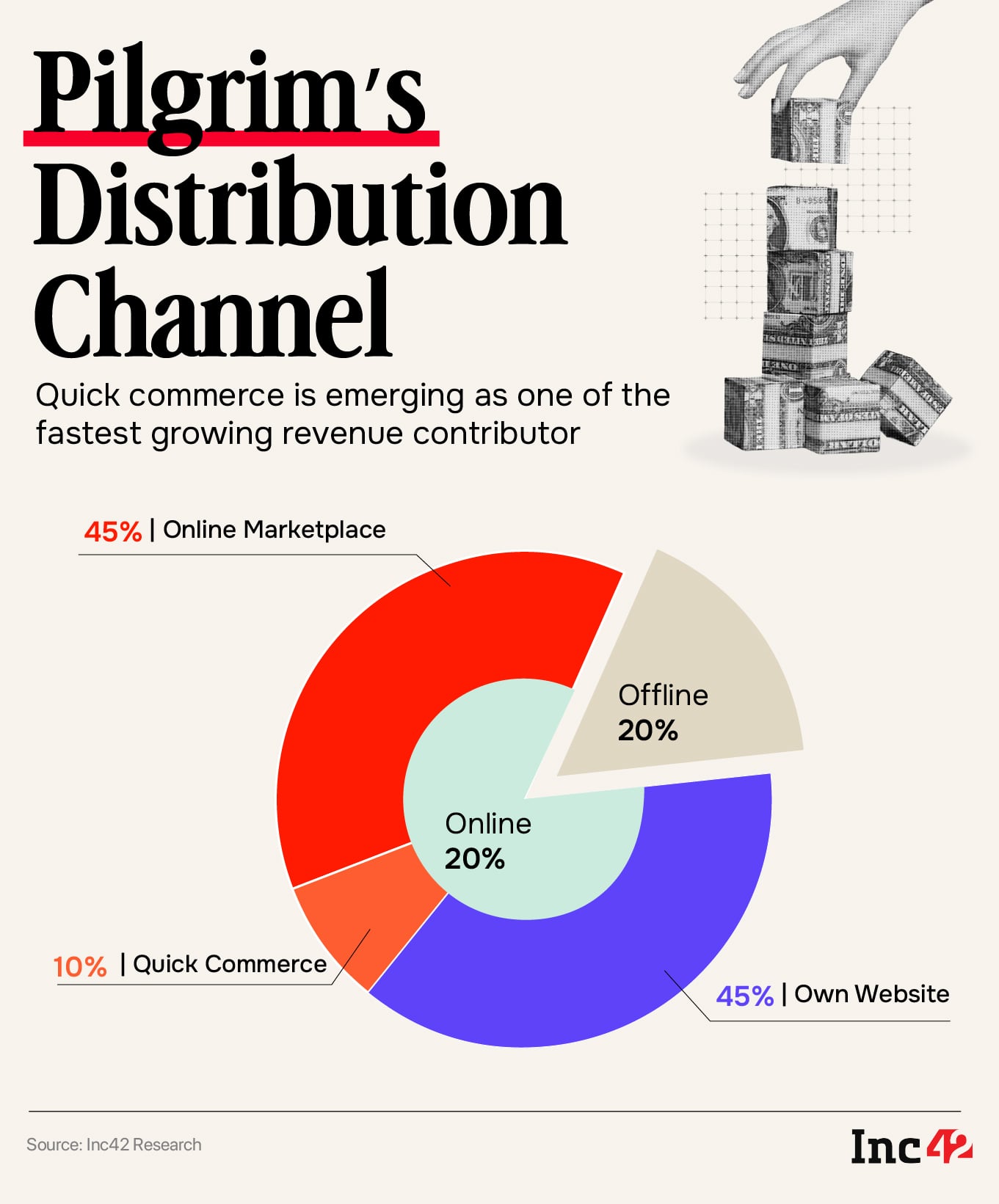
By FY25, Pilgrim’s operating revenue crossed ₹400 Cr, thanks to the startup’s growth engine, which, as per Kedia, is rooted less in aggressive discounting and more in consumer feedback loops.
Unlike legacy brands that “tell” consumers what they need, Pilgrim invests heavily in listening, through surveys, calls, video interactions, and in-person conversations. These insights feed directly into R&D decisions, pricing strategy, and marketing execution.
The result is strong repeat behaviour. “Roughly 40% of customers who purchase from Pilgrim’s website return at least three times within 12 months,” Kedia said.
Backed by a war chest of ₹200 Cr, Pilgrim is focussed on scaling both its product portfolio and adjacencies. This includes Pilgrim Professional, a B2B line for sales, and a new dermatology-led brand, PHD (Proven Honest Derma), developed in partnership with an international dermatologist.
As for Kedia, it marks a full circle moment — returning to the salon ecosystem, but this time, with a scalable, product-first playbook.
Edited By Shishir Parasher
Graphics By Varshita Srivastava
]]>