
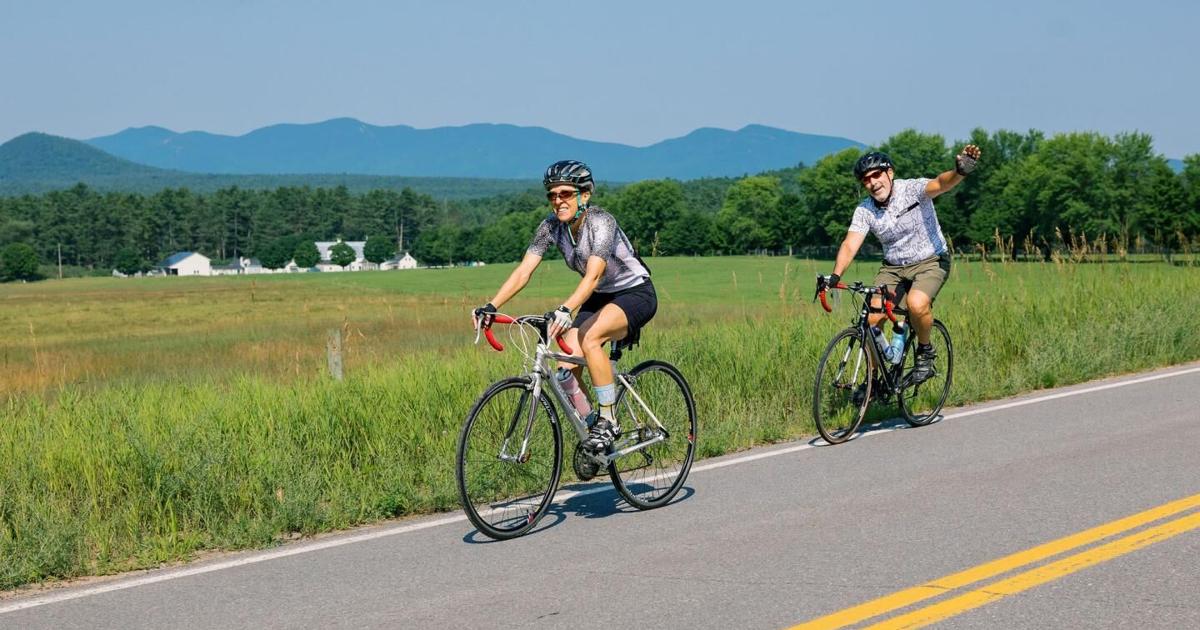
WATERTOWN — A nonprofit cycling advocacy group is working to widen the gap for vulnerable road users in New York, such as bicyclists.
The New York Bicycling Coalition says that 40 states plus the District of Columbia require that motorists give cyclists at least 3 feet of room when passing. New York state law requires only that motorists provide a “safe distance” when passing a cyclist. This, according to NYBC Executive Director Anne Savage, is too vague and subjective.
Changing the law, she said, will not only address safety concerns, but could boost the growing bicycle tourism industry in the state.
“Historically, these types of laws have been cycling specific,” Savage said in a phone interview from Albany, where NYBC is based. “Almost every state in the union has passed at least a 3-feet law to protect cyclists. New York is very far behind.”
Three counties in New York are no longer waiting for the state to act. In October, Ulster County, on the heels of Monroe and Suffolk counties, became the third county in the state to pass a 3-foot law. It protects not just people on bicycles, but all “vulnerable road users.” In Ulster County, those users include pedestrians, horse riders, construction workers and emergency services workers.

Anne Savage, executive director of the New York Bicycling Coalition. NYBC
Similar laws for vulnerable road users have been enacted in nearby states such Pennsylvania, Vermont and Massachusetts. In those states, the standard for safe passing is 4 feet.
A New York bill addressing the issue has been stuck in legislative traffic. In 2021, Sen. Pete Harckham, who represents Westchester County and parts of the Hudson Valley, and his Senate colleagues approved the “Share the Road Provision” that will require motorists outside of New York City to give bicyclists at least 3 feet of space on roadways when passing them. It has been stalled in the Assembly Transportation Committee.
“The current bill, which has been passed in the Senate for the last three sessions, protects cyclists and pedestrians,” Savage said. “A pedestrian in New York state law includes anyone who is using a mobility device, so anyone who is a wheelchair user is included, as a pedestrian, by matter of law.”
Savage said that NYBC is in regular contact with Assemblyman Phil Steck, who represents the eastern portions of Schenectady and northern portions of Albany County and is sponsoring the bill in the Assembly. “We are hopeful that they will be able to achieve something this session,” Savage said.
The office of Assemblyman William B. Magnarelli, chair of the Assembly Transportation Committee, did not respond to an inquiry concerning potential issues the committee may have with the bill. Magnarelli’s 129th District includes Syracuse and surrounding areas.
“We have not gotten a convincing explanation of why this bill has been so hard to pass,” Savage said. “Sometimes, they talk about enforceability, but the current law just says, ‘safe distance,’ which in my mind is substantially less enforceable than a specific set of feet. I don’t think it’s a coherent argument to say that defined safe passing would not be enforceable, because it would be clearly more enforceable than what we’ve got now.”
Laws in some states related to “vulnerable road users” include operators of Amish buggies. For example, Vermont’s Vulnerable User Law, enacted in 2024 and requiring 4 feet of clearance, includes Amish buggies, as the law protects individuals operating non-motorized, animal-drawn carriages. Here, an Amish buggy leaves Heuvelton on West Union Street in the spring of 2018. Watertown Daily Times
The board of directors of the Adirondack Cycling Club, dedicated to the encouragement of all aspects of community bicycling, believes it is important for the organization to support the bill.
“Our view is that any effort to increase cycling safety is a step in the right direction,” ACC President Mark Malchoff said. “It certainly would improve upon the current and vague ‘safe distance’ language as defined in section 1146 of the Vehicle and Traffic Law. Let’s hope that Defined Safe Passing becomes the law in New York, or failing that, is soon enacted by numerous counties across the state.”
Even though she advocates the bill, Savage does have some issues with it. She would prefer a law for all “vulnerable road users,” which, for example, would expand it to cover users such as Amish people in buggies.
“There are things about the current bill that we would like to see improved,” Savage said. “But at this point, we are hopeful that we could pass something to bring New York into the fold of all the other states. Every single state that abuts New York has at least a 3-foot law. Most of them have a 4-foot law.”
Counties take action
In Ulster County, the new law enacted late last year defines “vulnerable road users” as pedestrians, persons using service animals, plus the animal itself, an individual “waiting to board, or just having alighted, mass transit,” workers on a highway and people “who due to race or economic disparity have been excluded from the expectation of safe, accessible transportation.”
For penalties, Ulster County says drivers guilty of violating the law are subject to a fine not to exceed $225 for a first offense, $325 for a second, and $425 for any third and subsequent offense.
“We would love to see the law statewide, and think that’s what should be done, to apply to all counties,” Savage said. “We are seeing counties taking matters into their own hands.”
NYBC is aware of efforts in at least two other New York counties working to pass defined safe passing laws on their own, Savage said.
“If there was a county legislator interested in championing this in Lewis County, for example, they sure could,” Savage said. “You could define for your community vulnerable road users however you wanted, because New York State does not have a defined list of vulnerable road users under state law.”
The New York Bicycling Coalition is lobbying for a state law, common in other states, that would require motorists to give at least 3 feet when passing a cyclist.
Benefits of being bike friendly
New York, Savage said, is seeing an increase in the use of bicycles “as a mechanism for both recreation and mobility.”
“One of the reasons I care about defined safe passing, besides it is good public policy to educate drivers on how to be safer with all vulnerable road users, is that the League of American Bicyclists classifies states on how bike friendly they are,” she said.
In its 2024 State Ranking and Report Card, the League listed New York 15th in bicycle friendly states. It praised the 2024 adoption of “Sammy’s Law,” which allows New York City to set 20 mph speed limits in certain areas, and the growing number of municipalities reducing speed limits to 25 mph.
Also in its New York report card, the League of American Bicyclists said the state should prioritize increasing its use of Federal Highway Administration resources for bicycle and pedestrian infrastructure.
“New York ranks in the bottom half of the states, with only $3.20 per capita spent on such projects,” the report says. “By tapping into federal dollars, New York can accelerate the development of protected bike lanes, multi-use trails, complete streets initiatives, bike and pedestrian bridges, traffic calming measures and other improvements.”
In late 2024, the village and town of Potsdam were awarded $158,568 from the U.S. Department of Transportation through the “Safe Streets and Roads for All Planning and Demonstration Grant Program.”
The village was the lead applicant for the project, which will allow the communities to create a Comprehensive Safety Action Plan that improves safety and accessibility to destinations within, to and from Potsdam.
“It took a while to receive our contract for this, but we have that in hand now and have released a (request for qualifications) for a qualified consultant to assist in the development of our comprehensive safety action plan,” said Potsdam Mayor Alexandra M. Jacobs Wilke. “We have also been developing plans to be able to collect data and conduct demonstration projects and other public-facing activities that will happen hopefully starting this summer.”
The mayor became aware of the grant opportunity because of her participation in the inaugural Active People, Healthy Nation Champions Institute, sponsored by the Centers for Disease Control and Prevention and Smart Growth America.
“We hope to work closely with the state DOT on this along with other regional stakeholders, to look at ways to make our community easier to transit for everyone, whether you walk, bike, use an accessibility device or drive,” Jacobs Wilke said.
‘Active’ state plan being developed
Savage said that an updated bicycle master plan for the state, now in development, would also improve safety and tourism. The state DOT is developing a strategic plan to improve walking, bicycling, using micromobility (which includes scooters ), or using wheelchairs throughout the state.
The Active Transportation Strategic Plan will provide direction and guidance for active transportation investments. “Active transportation” requires quality facilities so people can move around safely and efficiently. These include sidewalks, road crossings, bike lanes, shared lanes, shared-use paths and rail trails.
The draft plan is scheduled to be released this year.
Savage would like to see the state in the top 10 of the League of American Bicyclists ranking.
“It’s preventing us from getting some bike tourism. If we had that, we could add more capacity for us to engage in bike tourism, which is obviously impactful in your neck of the woods in particular.”
Bicycle safety is a two-way street, and Savage noted that NYBC also focuses on education for cyclists.
“We do a lot of cycling education and NYBC has materials available online,” she said. “We can also send materials to bike clubs for example, if they are going to do a bike gathering and they want to share information on how to ride safely.”
In business with bikes
In 2019, Doug Haney of Saranac Lake founded Bike Adirondacks, a seasonal (May to late October) business focused on promoting bicycling in the region through curated routes, charity events, custom tours, and cycling apparel, aiming to connect people with the Adirondack landscape and its communities. Previously, Haney worked with the Women’s Sports Foundation and U.S. Olympic Committee before landing in the Adirondacks in 2001.
Haney said that bicycle tourists pay attention to rankings such as those compiled by the League of American Bicyclists.
“They know that one state has better laws than others,” he said. “They know that there are roads in some places that have no shoulder and know there are roads that have a specific bicycle lane. They are more apt to travel to, and frankly move to, a place that is more bicycle friendly.”
Customers at Bike Adirondacks, Haney said, generally come from a 400-mile radius of the Adirondack Park.
“The comments we get from them are what you’d expect. They are surprised by the welcomeness of not just vehicles on the road, but by our communities as a whole. It’s common to see bicyclists on the road in the Adirondacks. The communities naturally adapt to that.”
Haney said that one of the things his business focuses on is to showcase the landscape of the Adirondacks. “We do that in a variety of ways. The biggest one is that every one of our events has a nonprofit partner or community group that the event supports.’’
‘Instantly popular’
Haney said that many cyclists are seeking a “less vehicle-intensive” experience.
“That’s why you are seeing a surge in the gravel bike market,” he said. “People are more comfortable on a rural road without a lot of traffic than they are on a more common thoroughfare. There’s also a lot of communities working hard for state corridors like rail trails and conversions of abandoned rail lines into vehicle-free corridors.”
Late last year, the third and final phase of the Adirondack Rail Trail opened. The 34-mile multipurpose trail starts at Lake Placid and ends at Tupper Lake. It’s managed by the New York State Department of Environmental Conservation. The nonprofit Adirondack Rail Trail Association partners with the agency to address trail maintenance and amenities.
“It’s been instantly popular,” Haney said of the trail. “The more that New York State can do to provide safer opportunities for people to recreate, whether walking, running, riding a bike or pushing a baby stroller, the stronger our communities will be.”