

Listen to this article
Estimated 6 minutes
The audio version of this article is generated by AI-based technology. Mispronunciations can occur. We are working with our partners to continually review and improve the results.
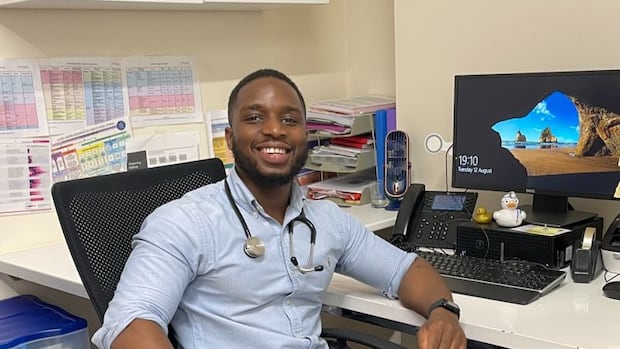
After spending several years training and working as a physician in the U.K., Stephen Osei-Osafo recently packed his stethoscope and moved across the world, to start a medical practice in British Columbia.
He made the move due to, as he describes it, turmoil and ongoing job uncertainty for those working with the National Health Service (NHS).
A study from the British Medical Association released last year found that about 20 per cent of family physicians in the U.K., are looking for other work due to a lack of employment options within the NHS.
Though Osei-Osafo was fortunate to have a job, he worried instability for doctors working for the NHS could make it difficult for him to provide long-term care to his patients — something he strongly values as a physician.
Then, he heard Canada was facing a shortage of family doctors.
“When I heard that Canada was in need, I said, sign me up.”
He landed in Surrey, B.C.’s second largest city by population, where he’s been building his practice since November.
“I have to say, one of the things that struck me straight away was the kindness of the Canadian people,” Osei-Osafo said.
“Meeting them day-to-day, interacting with them, serving them in the community that I work in, I’ve just been so delighted at how respectful and receptive people are. It’s just really been a delight from start to finish so far. I’m really happy to be here.”
Osei-Osafo spoke with CBC’s On The Coast about his choice to leave the U.K. for B.C.
LISTEN | Why Stephen Osei-Osafo left the U.K. for B.C.:
On The Coast9:08Why a U.K. trained doctor left the NHS to practice family medicine in B.C.
Dr. Stephen Osei-Osafo is a U.K. trained family physician now working in Surrey. He describes why he decided to leave the National Health Service, what the process was like moving to B.C. and the differences between the two systems.
This interview has been edited for length and clarity.
Why did you choose British Columbia?
The sheer need that I have found out about that Canada was experiencing was a big draw towards Canada. But British Columbia specifically, that was actually thanks to a recruiter that I met. About a year ago, I luckily met a recruiter named Gary, a very helpful guy, and he was representing the clinic in Surrey that I now work at. There were quite a few different recruiters from different places, one in Ontario, one from the Saskatchewan area as well.
The one thing that attracted me to British Columbia, I have to be honest, was the fact that the weather was quite similar to what I was used to in London. I’m not the biggest fan of snow, so Gary made sure that he told me that we don’t have too much snow in B.C. Coupled with the need, I think that’s what tipped it over for me.
What were some of the hurdles to working in B.C., if any, along the way?
There was a government-funded organization here in B.C., called Health Match B.C. and I got in contact with them very early under Gary’s advice and they made the process really smooth for me. They kind of met me where I was at, told me what I needed to do. There was an exam for me to complete at the time, I believe that’s no longer a requirement, but I had to do that exam. After that it was pretty plain sailing. There were some things to do, working out logistics where I would live specifically, but in terms of making sure all my qualifications transferred over, Health Match B.C. was really the game changer in that process.
Is the health care system in Canada or British Columbia similar to that of the U.K.?
Yes, there are many similarities. Pretty much the same kind of structure to the day occurs where, you know, I come in in the morning, prepare my room, prepare for my patients. And then I’ll have patients back-to-back all morning and at lunchtime and then in the afternoon. A lot of similarities. It feels a lot like home in many ways.
Where are you at in terms of establishing that continuity of care you mentioned? Or is it still a little early?
I would say that I’m definitely right in the thick of that right now. That’s one thing that’s really made me satisfied in the position I’m in, in Surrey. In the short time that I’ve been there, I’ve been able to build really strong relationships with the patients and a lot of rapport. As family physicians, we focus on cradle-to-grave care, where we aim to serve patients over a long period of time. I believe when you do that, you’re able to be the patient’s blind spot and see things that perhaps themselves or loved ones would not be able to see, for example, things like weight loss if they were really ill. That’s been something that I’ve already been able to see the fruit of in my practice here.
How does it feel to be living here?
I love the place that I live. I actually live quite close to work. There’s a lot of greenery. There’s a lot of open space. Just the sheer size and scale of everything. There’s a lot more open space than I had back home in the U.K., and I’ve really just loved being able to meet new people.
So are you telling all of your colleagues from back in the U.K. to come on over?
Every single day. I’m just flying the flag for B.C. at the moment. I think that with what’s going on back in the U.K., it’s really a time to consider what you really want to get out of this career. Traditionally in the U.K., the family physician, the GP was someone who stayed in the community over a long period of time and served at that community, was kind of the medical pillar of that community. And it’s a lot more difficult because of what I’ve spoken about kind of competition ratios for residency, career security uncertainty. It’s here. There is a real need for doctors who are here long-term. And you are well received and you are looked after and you can really get a lot out of this job, as I’m finding out.