
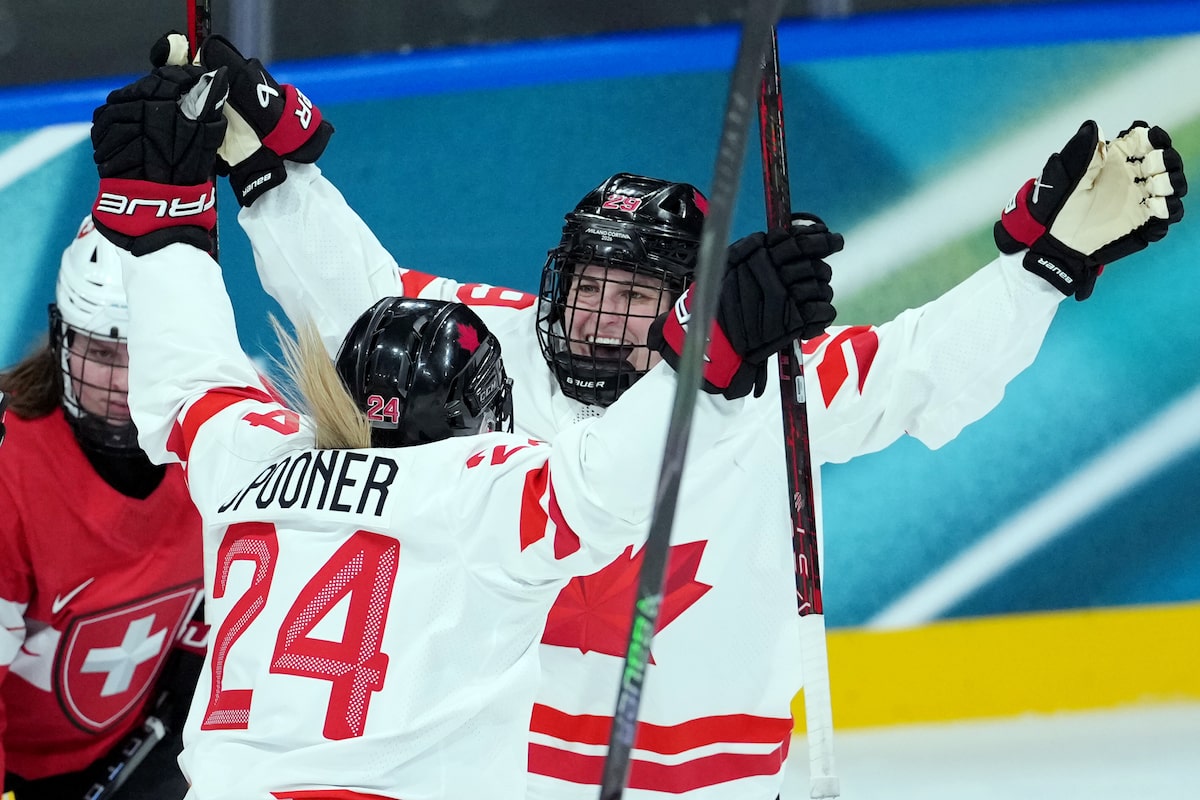
Marie-Philip Poulin and Natalie Spooner celebrate a goal against Switzerland during Saturday’s game. It could be the last Olympics for both players.DARRYL DYCK/The Canadian Press
Written in black marker on layers of white tape that are usually hidden by her hockey gloves, Marie-Philip Poulin has inscribed a short message on the handle of her stick.
It is a mission statement and a maxim that sums up Team Canada’s headspace at the Milan Cortina Olympics, particularly as the women’s team looks for gold in a tournament where it may no longer be the favourite against the powerhouse Americans.
“Her first. Your last. Our best.”
It is a nod to the seven Olympic rookies the team has brought to Milan who are playing their first games on the sport’s biggest stage. It is an acknowledgement of the veterans of past gold-medal teams who may not see another Winter Games after this one. And it is a call to action for all of them, for the sum to be greater than its parts.
“It’s a good one,” Poulin said of the six-word phrase she wrote, carrying the stick with her as she strode off the ice after Canada defeated Switzerland 4-0 in its opening game at the Olympics.
“It’s a good quote.”
Beyond that, the captain didn’t want to talk much about it, whisking herself and the stick to the dressing room as she and the rest of Team Canada prepare for their next few games: Czechia on Monday, and their biggest rival, the Americans, on Tuesday.
But the stick speaks for itself.
Canada’s first win at the Olympics on Saturday was a study in all three aspects of the phrase, and what the team will need to conjure if it is to win the tournament.
‘Their first’
Canada leaned heavily on its rookies in its opening game, in particular Daryl Watts and Julia Gosling.
Stepping onto Olympic ice for the first time, both scored timely goals. Watts also added an assist and was a dominant physical presence, hitting and roughing up the Swiss after their defence took liberties with a few of her Canadian teammates.
‘Your last’
The game was won by two players who may be playing their final Olympics.
Spooner’s opening goal midway through the first period was a rebound on a shot by Poulin, and ultimately held up as the winner.
At 35, Spooner has come back from a serious knee injury that almost ended her career to make this team. This is likely her Olympic swan song. It may also be the same for Poulin, who is 34.
‘Our Best’
After Canada struggled early, failing to score in the first period against the Swiss, they began to look like their old selves as the game progressed.
Contributions came from all over the lineup, including crucial players like Sarah Fillier, Renata Fast, and Sarah Nurse. Canada will need everyone at their best if they are to defend their gold medal from 2022 against the U.S., which had to settle for silver in Beijing.
Speaking after the game, Fast, who is playing in her third Olympics, heaped praise on the Olympic debuts of Gosling and Watts.
“Both of them have played on the national team for a couple of years now, and we know the impact they can have,” Fast said.
“So to see them show up on the goal sheet and get a goal is really good for us.”
When it came to the veteran Spooner, Fast said she was particularly happy to see the four-time Olympian score the winner, given what she’s gone through with the knee injury.
“Spooner is so tough,” Fast said.
“I think what impresses us is just her resilience that she’s shown. A lot of people would pack it in with injuries like that … to see her make the Olympic roster and then have the impact that she’s having, it’s huge.”
Team Canada head coach Troy Ryan slotted Spooner in as the 13th forward, cycling her through different situations, including as a net-front presence on the power play, where she scored. Her evolution as a veteran has been significant, he said.
“Probably five years ago, or four years ago, she started to really adjust her game to play more that way. She used to be more of a [player who would] lug the puck through the neutral zone. And she now just wants to set up. It’s almost like a big centre in basketball. She gets her rebounds and gets to the front of the net and tries to finish down there,” Ryan said.
“It’s just awesome to see her get rewarded with a typical Spooner goal in the net front.”
When it comes to the third element of Poulin’s mission statement, calling for the team to be at its collective best, Ryan didn’t think the squad played to its potential in the first period, when Canada couldn’t muster a goal against the Swiss.
Part of that was nerves, Ryan said, with so many players suiting up in Milan for the first time, and with more experienced players trying to find their game as the tournament begins.
“There’s a lot of emotion going on out there,” Ryan said. “It just looked really antsy and just a little bit panicky.”
Fast agreed.
“It’s the first game of the Olympics for us, so obviously to come out, to start, you’re going to be gripping your stick a little bit tight,” she said.
As Canada prepares to face the U.S. in the seeding round on Tuesday, with designs on an eventual showdown for the gold medal should things progress as they have at past Olympics, the message on Poulin’s stick will be something they’ll no doubt be holding onto just as tightly.