
It was a pitta bread that finally broke Jason Wood. It arrived with hummus instead of the vegetable crudites he had preordered in a restaurant that he had painstakingly researched, as he always did, weeks before he and his husband visited. “In that moment, I just snapped,” he recalls. “I hit rock bottom, I got angry … I started crying, I started shaking. I just felt like I couldn’t do it any more, like I had been crushed by all this pressure I put on myself.”
Today, Wood, 40, speaks calmly. Neat and groomed, he seems orderly by nature. But at that time, his attempts to control every aspect of his life had spiralled. He painstakingly monitored what he ate (sometimes only organic, sometimes raw or unprocessed; calories painstakingly counted), his exercise regime (twice a day, seven days a week), and tracked every bodily function from his heart rate to his blood pressure, body fat and sleep “schedule”. He even monitored his glucose levels repeatedly throughout the day. “I was living by those numbers,” he says.
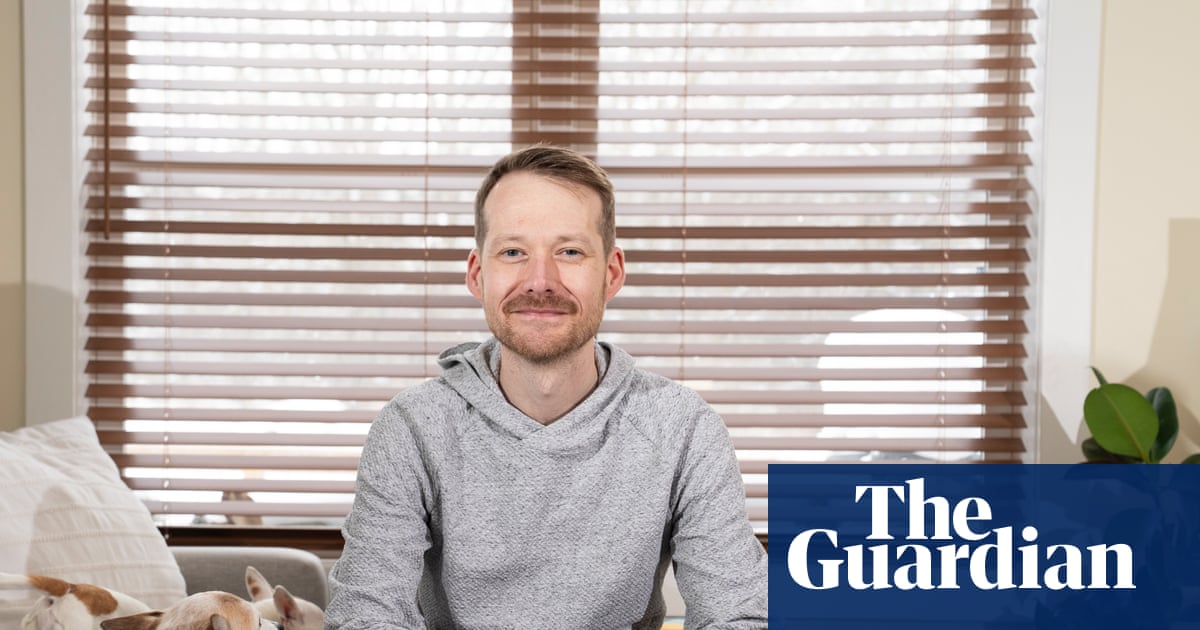
‘I had been crushed by all this pressure I put on myself’ …. Jason Wood. Photograph: Courtesy of Jason Wood
Two or three times a month he would visit wellness clinics for IV drips of vitamin cocktails, plus oxygen treatments administered through a tube in the nose – the package costing $250 to $300 (about £180 to £220) a pop for health benefits he struggles to specify. He would also request reams of blood tests every six months checking 15 to 20 biomarkers, from testosterone to creatinine to lipids. He estimates that he spent about $10,000 in total. He never deviated from his routine for social events; it had become a cage: “I got up before sunrise, around 4am,” he recalls. “I would work out, then I’d have a light breakfast, maybe a chia seed pudding, then a chickpea salad for lunch … I’d get back to the gym in the afternoon …” A protein-based dinner would be followed by “a protein drink before bed at 9pm”.
And the motivation? Wood, who lives in Grand Rapids, Michigan, was clear that his ultimate goal was to extend his life. How could that be a bad thing, he reasoned. What he realised upon seeking mental health support after he had a breakdown was just how deeply he feared dying – a fear triggered by the premature loss of his parents to cancer; his dad when he was just 11, his mum when he was 19. His lifestyle had become about controlling the uncontrollable.
“There was just this fixation with living for as long as I possibly could,” he says. “This talk around longevity plays right into insecurities and fears, and makes us want to hand over our money.”
Wood now believes he was suffering from longevity fixation syndrome, an unofficial diagnosis for an anxiety-driven, compulsive obsession among those who are consumed by the idea of living for as long as possible. The term was recently coined by Jan Gerber, CEO and founder of the Swiss mental health rehab clinic Paracelsus Recovery, who revealed he was seeing a “significant” increase in patients presenting with habits such as those outlined by Wood. Gerber notes that such behaviour is also closely aligned with the eating disorder orthorexia, a fixation with “clean” eating and exercise.
This talk around longevity plays into insecurities and fears, and makes us want to hand over our money
Wood agrees: “I believe many of the underlying factors and desired outcomes which fuel orthorexia are the same for longevity fixation syndrome. But with the latter, there are more variables you feel like you need to control, so even more anxiety.”
A slick Zurich clinic – which charges more than £88,000 a week for a four-week individualised residential treatment programme (including a 24-hour live-in therapist) to treat mental health and addiction – coining a new disorder has raised a few eyebrows. Labels are not always helpful. Yet the issue itself does not seem manufactured: a number of therapists in the US, Europe and the UK, working with clients from all societal stratas, agree that the symptoms are a growing problem.
While an existential fear of death is nothing new, and nor are claims to conquer mortality with elixirs or holy grails, extending your lifespan is no longer an aspiration dependant on following a disciplined diet and exercise regime alone. Nowadays, there is also an increasingly expansive menu of biohacks purported to boost health, offered at self-styled “longevity clinics”. Rather than being confined to Hollywood and the uber-rich, such clinics are beginning to proliferate among the affluent mainstream. Conduct an online search for longevity and, in the UK alone, there are numerous results for longevity services or longevity medicine.
Groundbreaking research funded by Silicon Valley first began to make claims about life-lengthening and ageing reversal using gene manipulation and blood transfusions in the 1990s and early 00s. Fast forward to today, and the idea that biology can be tweaked to slow ageing has exploded – not only in research labs and startups but in the more mainstream nutrition and skincare industries. In 2023, the size of the global market for complementary and alternative medicine for anti-ageing and longevity was estimated to be worth $63.6bn, and projected to reach $247.9bn by 2030.
Of course, anti-ageing solutions are catnip to celebrities. Orlando Bloom has tried filtering his blood of microplastics; Jennifer Aniston reportedly swears by peptide injections for skin rejuvenation. And then there are the many ultra-disciplined influencers such as Kayla Barnes-Lentz and the human biologist Gary Brecka loudly proclaiming the benefits of adopting habits to tweak our biology, from regular bedtimes and breath work to cold plunges and supplements.
Jennifer Aniston reportedly swears by peptide injections. Photograph: Jamie McCarthy/Getty Images
At the extreme end of the spectrum, there is also a significant tribe of uber-rich tech bros seemingly intent on actual immortality. The poster boy for this is Bryan Johnson, 48, the American venture capitalist who sold his company to PayPal for $800m and likes to wear a T-shirt reading “Don’t Die”. He has been infused with his son’s youthful plasma (although later admitted this didn’t show benefits) and is building an algorithm around his biomarker scores. “I’m going to try and achieve immortality by 2039,” he has said.
But research published last year in Proceedings of the National Academy of Sciences found that – after looking at 23 high-income, low-mortality countries – no generation born after 1939 is expected to reach an average age of 100. Whether the biohacks carry positive benefits for longevity or not is still up for debate; what seems clearer is the mental health fallout for those trying to live for ever.
In Assen, in the north-east of the Netherlands, Mark (not his real name), 26, says a fear of death to the point of “panic attacks” led to his health “optimisation” five years ago. It was an attempt to “extend my life expectancy”, he says.
Mark would deliberate for weeks over having a single beer or a slice of birthday cake, and such indulgences would be “followed by a week of guilt”; he took numerous supplements daily including omega-3, zinc, magnesium and creatine, went to the gym five times a week, and had to get nine to 10 hours of sleep a night. “I bought a blood pressure monitor to check daily, thinking if it was too high I might die,” he says. Once, he spent the whole day consumed with bringing down what he perceived as a high number. “My social life did suffer,” he says.
His panic attacks peaked last year and he saw a therapist. “I needed to train my brain into accepting the ‘danger’ it was detecting was a false alarm,” he says. “To live my life and accept any feelings of fear or panic; to let them be there without ‘feeding’ them.” He came to accept that “physical health is important, but mental health is important, too”.
Clients of the Balance Rehab Clinic, which has sites in London, Zurich, Marbella and Mallorca, are offered bespoke one-to-one residential programmes encompassing therapeutic support for issues such as chronic stress and trauma (it does not publish its prices). Its clinical director, the psychiatrist and psychotherapist Dr Sarah Boss, estimates that about half of the clinic’s clients now present with some traits of longevity fixation syndrome, although most aren’t aware that their habits have become problematic.
And the numbers have increased over the past two years. “We definitely see this [obsession around longevity] more and more, especially in wealthy people who have more access to [biohacking] and more time to spend on it,” says Boss. “They are trying to measure everything, day and night,” she says. Many clients arrive with their own infrared saunas and ice baths. “They’re taking them around as if [they were] a bike or golf clubs.”
We see it more and more, especially in wealthy people. They are trying to measure everything, day and night
Boss describes a client under 40 who arrived with a hyperbaric oxygen therapy chamber, which he used daily. He was taking 15 supplements. “Everything from Q10 to supplements to help with muscle mass, metabolism, to detox,” she recalls. He’d had stem cell injections and at one point asked to leave to have more. He also ordered regular blood tests, which is something she sees frequently. “There’s such a big market around it and there are no limits,” she says. “People can spend €40,000 (£35,000) on blood tests.”
She also describes a female client in her 40s who checked in due to anxiety. She was monitoring her biomarkers and sleep with an Oura Ring (a wearable device that tracks health metrics), taking numerous supplements, and eating what she believed to be “anti-ageing foods” – “a vegetable and fruit-based diet, seeds, special powders, very little protein, no carbohydrates …,” says Boss. She was also taking metformin, a drug used to manage type 2 diabetes (which she did not have), and which some studies have found may slow ageing. Boss weaned her off the supplements and metrics tracking, “and she completely normalised,” she says.
Boss often finds that childhood experiences drive this sort of behaviour. Many clients suffer from “attachment trauma”, and there is a “fear of dying – not just ageing … but really the existential fear of death.” She believes this fear has been exacerbated by the Covid pandemic. “All of a sudden, [people] felt threatened,” she says. “I think that started something in a lot of people, unconsciously.” This was followed by a boom in the longevity industry. “You can buy a million things online, false promises … It’s growing daily,” she says.
Patients are encouraged to get back in tune with their bodies with activities such as yoga and breath work. Photograph: Posed by model; Super Scout/Getty Images
Boss’s patients are taught to get back in tune with their bodies instinctively, rather than through data, using activities including yoga, breath work and sport – but for fun. “The key is to regulate them again, to connect them to their own nervous system,” she says. Talking therapy around acceptance of death often helps patients gain an understanding of deeper issues, too.
For Wood, it was ultimately this acceptance of death that helped him recover. “I realised I am human, death is a part of life … it’s going to happen when it happens,” he says. His therapist encouraged him to quit his apps and relax his routine. “It was like somebody had ripped away my security blanket … I was very scared and sceptical,” he admits. “[But] I trusted their advice… so I went all in. I have a very much all-or-nothing mindset, so at that moment I needed to just cut ties with the apps and tracking.”
Wood is now director of community engagement for the National Association of Anorexia Nervosa and Associated Disorders in the US, but he says that “it’s very difficult to recover in a society like this, because we see the influencers, we see all this content all the time”.
Lina Mookerjee, senior accredited psychotherapist with the British Association for Counselling and Psychotherapy, who is based in Cumbria, believes that 75% of her clients show symptoms of longevity fixation syndrome. They may not be undertaking cryotherapy or peptide injections, but their concern about longevity, often underpinned by fears around mortality, has shot up since the pandemic. “It was an absolute step-change,” she says. The fixation has run alongside increased “hypervigilance” and “hyperactivity” – all demonstrations of “I have no control over my life,” she says.
Generally, Mookerjee says, those presenting with these symptoms are professional, university-educated people in their 30s to 50s, who have “lost trust in their own judgment” and rely on devices.
Lina Mookerjee says that as many as 75% of her clients show symptoms of longevity fixation syndrome. Photograph: Courtesy of Lina Mookerjee
She has also identified a “superhero syndrome” in clients trying to override a loss or illness. “Once they recognise ‘the driver for me is coming from a deep insecurity’ something starts to change.” They become less hypervigilant around health and can begin to live normally again.
Mental health professionals are becoming increasingly aware of the damaging effects of longevity fixation. And, amid the many online proponents of tracking and hacking, there are a growing number of devotees who have begun to talk about the unhealthy side-effects of the practice – and in some cases, seek help.
“I see the amount of pain [longevity culture] can cause, the amount of insecurity,” says Wood. “It’s nice to finally have a term to apply to it. With a proper name and better understanding of what they are facing, I believe more people will be able to access the treatment and support they deserve.”