
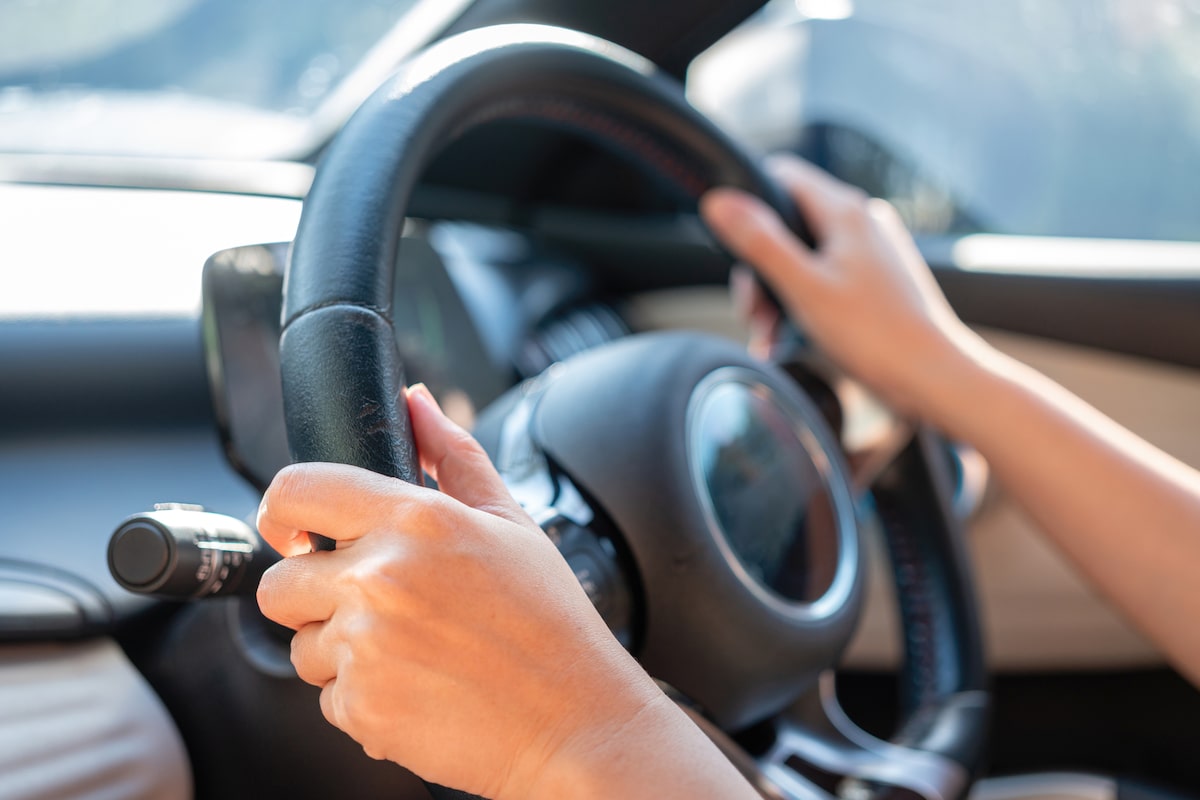
What’s the best way to hold the steering wheel? I’ve heard 10 and two o’clock, nine and three o’clock and eight and four o’clock. It seems like it keeps changing. Does it really make that much of a difference? – Ryan, North Bay, Ont.
When it comes to holding the steering wheel, there’s still a gripping debate.
“For years, 10 and two [o’clock] was the standard,” said Angelo DiCicco, chief executive officer of the Ontario Safety League, a Mississauga-based non-profit focusing on driver education. “Modern vehicles changed the equation.”
Before airbags were common, the advice was to keep your hands higher on the wheel, with your left hand at roughly ten and your right hand at roughly two. That position is still taught by many driving schools, DiCicco said.
“But most safety organizations now recommend hand positions [lower on the wheel] closer to nine and three or sometimes eight and four,” he said. “That keeps your arms out of the airbag’s primary deployment path while still giving you strong, balanced control of the wheel.”
Plus, before power steering, a higher grip gave you more heft to turn the wheel, DiCicco said.
“Technology has advanced so much that you don’t need very heavy steering input anymore,” he said.
Driving handbooks in a few provinces, including Alberta, Manitoba and Ontario, say to keep your hands at nine and three. Saskatchewan says to use either nine and three or eight and four. Nova Scotia says to use ten and two, but nine and three is “also acceptable.”
British Columbia says to use whatever is comfortable, as long as your hands are both at roughly the same height, but notes that if you use ten and two, your hands could hit your face if the airbag goes off.
Smooth operator
But Carl Nadeau, a driving expert with Michelin and a former race car driver, said keeping your hands at nine and three generally gives you the best control of your car, as long as your seats are properly adjusted.
“It makes a lot of difference when you drive,” he said. “It’s a lot smoother.”
Your seat should be close enough – don’t recline it like you’re taking a nap on a plane – that you can keep your elbows slightly bent, he said.
Bent elbows also help you keep a more relaxed grip on the steering wheel, he said.
“If you’re tense on the steering wheel, if you’re white-knuckle driving, you’re going to throw your car in micro-slides [on slippery roads],” he said. “Every movement should be precise and smooth, not exaggerated and jerky.”
But it also comes down to what’s comfortable for you in your vehicle, DiCicco said.
“I typically drive with my hands closer to ten and two than nine and three, because that’s the habit I got into and I’m also taller,” he said. “I won’t quibble about [where your hands are] as long as they’re pretty much equally balanced.”
But you don’t want your hands much lower than eight and four, he said.
“There’s sometimes confusion about airbags [so] people drive with their hands very low to stay out of the way,” he said, adding that a low grip gives you less precise control. “That’s not a smart trade-off. The best outcome is to stay in control of the vehicle and avoid the crash altogether.”
Helping hands?
Why worry about grip on the steering wheel?
“Control is the bigger story here,” DiCicco said. “You should get into the habit of having both hands on the steering wheel.”
Some drivers drive most of the time with only one hand on the wheel, and might not even realize it, he said.
“A single hand low on the wheel – around 6 o’clock (at the bottom) – severely limits your range of motion,” he said. “Your ability to make a rapid evasive manoeuver left or right is dramatically reduced. In an emergency swerve, that delay matters.”
While two hands on the wheel should be your default position, “it’s not about being rigid,” he said.
“[Two hands] gives you options,” he said. “If you need to take one hand off briefly to scratch your nose or adjust [a control], you still have a hand in a strong, controlled position.”
And you shouldn’t take both hands off the wheel, even briefly.
“A car is 3,000 to 4,000 pounds,” Nadeau said. “Through the steering wheel, you’re controlling this huge metal mass on the road. When people realize that the smoother they are, the less drama there is when they drive, it changes their behaviour.”
Have a driving question? Send it to globedrive@globeandmail.com and put ‘Driving Concerns’ in your subject line. E-mails without the correct subject line may not be answered. Canada’s a big place, so let us know where you are so we can find the answer for your city and province.