
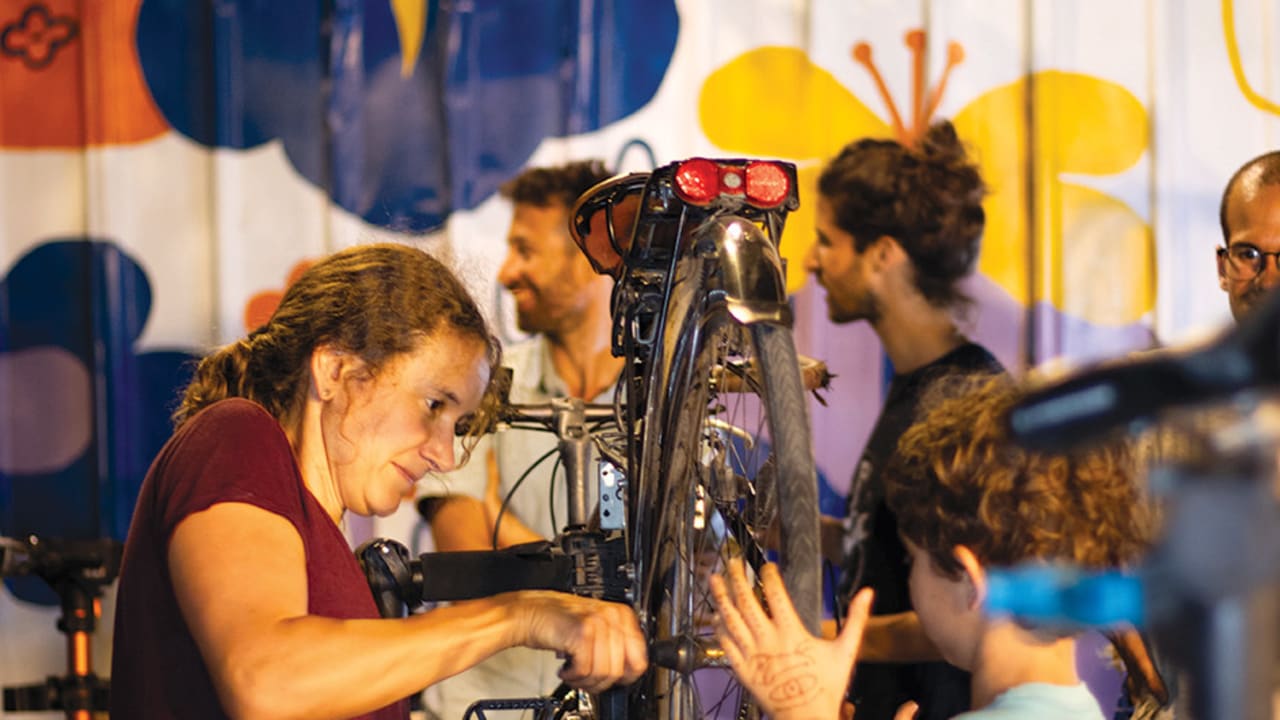
Pnimeet is a pretty nifty name for a cycling-related outfit. It translates from the Hebrew as the patently pertinent “inner tube” but also as something along the lines of “interior” or “inward.”
To my mind, possibly feeding off the hippie era and its immediate sociocultural aftermath of my youth, that suggests a spiritual-emotional subtext to the activity of rotating bicycle pedals and making one’s way from A to B under one’s own physical power.
OK, for some years now, the latter has been compromised, to some degree or other, when electric bikes come into the equation. But the element of getting around town or farther abroad without the help of a polluting internal combustion engine, or even rechargeable vehicle battery packs, still figures highly in there.
Pnimeet Collective Bicycle Workshop is a community-environmental venture that seeks to promote the use of bicycles as a mode of transportation in urban environments. That may be easier said than done, particularly in a country where the go-to mobility option is invariably the car. The advent of the light rail, for now, in Jerusalem and Tel Aviv has helped matters, particularly in Tel Aviv, where the ongoing construction of train lines often incorporates the creation of adjacent bike paths.
Mind you, when you think of cities such as Vienna, Amsterdam, or Copenhagen, we undoubtedly still have a long way to go to make our cities truly bike-friendly.

As an experienced, verily addicted cyclist who pedals thousands of kilometers a year, both in and between towns, I naturally support any initiative that encourages people to use what the Good Lord gave them to get from home to school, cafés, the stores, meetings, etc. Pnimeet pushes people in the desired direction by providing cyclists with the knowledge and means to take responsibility for keeping their own two-wheelers in good working order.
That obviates the financial hurdle that many may not have the means to negotiate – and it also enhances the entire travel experience, proffering the exhilarating feeling of independence it can offer. Imagine riding your way along a country road or down a street in downtown Jerusalem and suddenly noticing some mechanical dissonance. You then stop and adroitly, almost nonchalantly, fix the problem, remount, and carry on along your way – that is, if you don’t need to replace one of the bicycle components.
There’s no calling a bike store to check when one of the mechanics can repair your machine, taking valuable time out of your already rushed daily routine, and paying for the service to boot. And, if you do need a spare part, Pnimeet may be able to help with that, too.
Fix – or build it yourself
I recently popped down to the venture’s Jerusalem branch, which operates from the grounds of the Experimental School in the lower reaches of Hillel Street, to see what they have laid on. I met two of the movers and shakers behind the project there, Nadav Bernard and Aki Melamed. At the time of my Monday evening visit, they were keeping gainfully employed applying a welding machine to an errant contraption and advising a couple of cyclists how best to go about attending to their carbon and metal steeds, ensuring that they were up to the job of getting them where they wanted to go.
That is the crux of the Pnimeet ethos. It is not about providing the public with a repair service. The idea is to help cyclists obtain the know-how that will enable them to maintain their own apparatus, thereby hopefully taking a preventive rather than a corrective approach to bicycle ownership. That and offering them the use of a broad range of implements and parts to help them get the job done themselves. That, in fact, can also include assembling their own two-wheeler under their own steam.
The latter activity is supported by Bernard and Melamed making periodic forays to neighborhoods around the city, picking up abandoned and disused bicycles and taking them back to HQ with the help of the municipality’s Autozaza truck.
I saw dozens of bikes, in various states of repair, in all shapes and sizes, lined up at Pnimeet waiting for someone to apply some TLC and make them roadworthy once more. Some came from close to home, others from farther afield.

“We collected bikes from the municipality parking lot, and from all over Jerusalem,” Bernard explained.
Reclaim and renew
The municipality is also on board the Pnimeet train. “They sometimes send us to a school or a community center, to present a workshop,” Bernard noted. “We also collaborate with various sections of the municipality, such as the Social Sustainability Division. They support us and are happy to see us going about our business.”
Bernard feels the bike venture has a lot to offer the city. “We collect garbage,” he said, referencing rusting and cobwebbed two-wheelers they clear off the streets, from residential building back yards and bomb shelters. “Each time we go out to collect bikes, we come back with around 200 to 300 which otherwise would end up in garbage dumps.” That is hardly in the same league as, say, Amsterdam which recovers 12,000 to 15,000 bikes a year, some fished out of canals, but it is not bad going in local terms. It also helps the municipality keep the streets a little cleaner.
Pnimeet advertises its bike collecting jaunts on social media and in the local press. There is also a pull-down menu on the nonprofit’s website – www.pnimeet.org.il/ (currently only in Hebrew) – with information about how to arrange for bikes to be collected, facilitated by the Environmental Protection Ministry. The procedure starts with the donors filling out a form, after which they receive a telephone call from someone at Pnimeet, followed by pickup.
The ultimate incentive to engage in some new pursuit often boils down to plain old shekels. There is no arguing about which mode of transport comes out on top in that respect. Running a car takes in shelling out on a vehicle, fuel, insurance, repairs, and the cost of parking, with the latter sometimes involving fines, let alone the sheer headache of finding an available space for your car in the first place.
If I have to use a car to get to the fringes of Jerusalem from my rural abode on Moshav Matta, around 22 km. from Ora Junction, I will take my bike in the car, park near Moshav Ora, and simply cycle around town from there. It is largely quicker and more efficient to get from A to B in Jerusalem by bike than driving or taking public transportation.
That is further facilitated by the expansion – albeit gradual – of the urban bike path network. Research backs that up, with the venerable Scientific American magazine – all of 180 years old and still going strong – following up on its original 1973 survey by recently confirming that cycling is still the world’s most energy-efficient means of getting around.
Climbing the capital
After three years of enthused active service with Pnimeet, and chalking up his fair share of pedaled mileage around town, Bernard said that Jerusalemites are getting the message and getting into the saddle.
“I remember last winter, my friends and I saw loads of cyclists in the city. I didn’t see that the winter before. Then I thought there were going to be lots of cyclists in Jerusalem come the summer.” That, indeed, is what came to pass.
“There were places in the city center where there was almost nowhere to chain up your bicycle,” he chuckled. And it’s not just the fair-weather folk who whiz merrily about on their bikes. “This winter, there are lots more – even in the rain.”
Many many moons ago, when my brother was a resident of the capital and I was ensconced over at the west end of Route 1, he told me he used a bicycle to get around town. My astonished response – long before I got seriously into cycling myself – was something along the lines of “What? With all those climbs?!”
Since then, I have encountered that reaction from both non-cyclists and Tel Avivian bikers on numerous occasions.
Bernard unsurprisingly sees absolutely no problem there. “Jerusalem is an amazing city for cycling!” he exclaimed. “It is simply not a place for the weak,” he added unapologetically, referencing more one’s state of mind rather than corporeal prowess.
That’s one person’s opinion, albeit someone who is deeply immersed in the scene. Then again, there are very few climbs that can’t be managed with the right equipment – including, if need be, some electrical assistance. Bernard gets that. “I think most people today realize that you just need the appropriate gears to deal with the topography here.” He added that it doesn’t have to cost an arm and a leg, either. “I got a bike for NIS 1,900, and I used to do the ascent from Ma’ayan Street in Ein Kerem all the way up to Mount Herzl: No problem.” That, indeed, is quite a climb.
Biking for health
Traffic jams and the shortage of parking places can also help to nudge Jerusalemites to consider a different mode of transport that not only solves those problems but also makes us fitter and healthier. One would hope that the now somewhat faded episode with COVID-19 might have got people thinking about how to bolster our immune system and respiratory system and help them deal with any pesky virus that may come along. Cycling instead of driving or taking public transport could help.
That not insignificant added value has been taken on board by the powers that be in various countries, principally Denmark, the Netherlands, and the UK, where tax relief and other financial perks are offered to employees who cycle to work. Wouldn’t it be nice if our own leaders adopted a similar win-win view of our urban transport systems and came up with a policy that would encourage more Israelis to swap the steering wheels for the handlebars?
And note that for much of the year, we generally have far more cycle-friendly meteorological conditions in Jerusalem than in northern Europe – and, for that matter, than humidity-soaked summertime Tel Aviv.
Bernard said the move in the desired direction has been gestating for a while. “I have had dozens of responses from people on Facebook, telling me they’re fed up with the traffic jams, and that they want to take up cycling. Every so often, someone comes in here and says he’s fed up with public transport and traffic jams, and he just has to have a bicycle.”
Again, that doesn’t necessarily mean sweating it out and grinding it out through the streets of the city with your aching muscles stretched to the max. “You can get anywhere quickly and easily, with the knowledge that there are now all the hybrid bicycles the municipality promotes,” Bernard noted, referencing the Jerufun rental bike service that, for the past four and a half years, has offered locals and visitors alike the option of getting about on traditional human-powered, as well as pedal-assist electric models – aka (in French) VAE.
From Berlin to Ljubljana
While we chatted, Alon Auerbach was busy helping a young man and a couple get to grips with their mechanical snafus. With a backdrop in metalworking, he is clearly blessed with “good hands” and a developed sense of how to track down the source of the malfunction and advise the owner how to go about fixing it. “I started cycling myself around three and a half years ago, and I’ve been volunteering here for a year and a half,” Auerbach explained. “I come here once a week – if I’m not on [IDF] reserve duty.”
Eli Eliaz dropped by to get his brakes tuned as he was getting ready for a serious odyssey. “I’m planning to cycle from Berlin to Ljubljana in the spring,” he told me. That sounds like quite a high bar to aim for. The 30-year-old Jerusalemite soon set me straight on any grandiose misconception about his cycling exploits. “I’m going to Berlin in April. I’ll be there for a few weeks to settle in and get a feel for the place, and then I’ll take it easy on the way to Ljubljana. Yes, it’s 1,000 km, but I won’t be rushing. I’ll probably do around 50 km. a day, maybe a bit more.”
That sounds eminently doable, and a good mindset to adopt for a major project. It is also one that anyone considering enjoying the aforementioned rewards of cycling around Jerusalem would do well to embrace.
And they can get all the help they may need at Pnimeet, which opens for business three evenings a week: Mondays and Wednesdays at 6 p.m.-10 p.m., and Tuesdays at 8 p.m.-11 p.m. There is a NIS 150 annual membership fee to be paid, and that’s that. Thereafter, you can just drop by the Experimental School compound with your bike, or even pick out any of the models stored there, and get down and dirty with making it roadworthy with the help of the community nonprofit’s clearly dedicated and generous-of-spirit volunteers.
The next time you get stuck in a traffic jam, or spend 20 minutes driving round and round the block in search of a parking spot, or get on your bathroom scale and wonder what to do with all those extra kilograms and calories to burn, your thoughts may wander in the direction of Pnimeet. Your body, heart, and spirit, not to mention the Jerusalem air, will thank you.
For more information: www.pnimeet.org.il/