
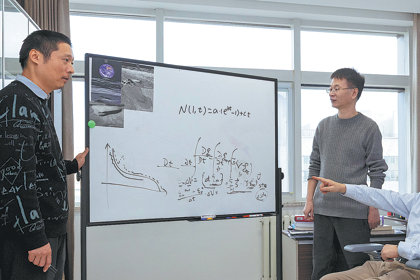
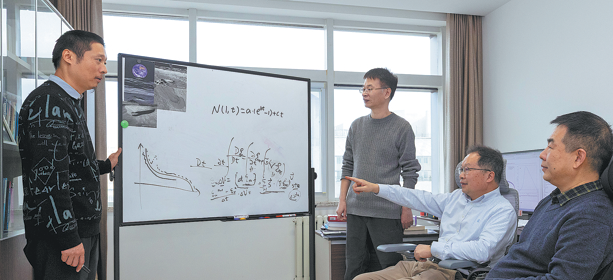
Yue Zongyu (third from right) exchanges ideas with other researchers on the significance of Chang”e 6 samples for the new lunar crater chronology model. Ren Hui/For China Daily
A common belief holds that the moon’s far side is more rugged and cratered because it acted as a “shield”, bearing meteorite impacts originally headed for Earth. However, recent research on soil samples from the Chang’e 6 mission challenges this long-held assumption, suggesting that impacts are essentially the same on both the near and far sides of the moon.
Building on this discovery, Chinese scientists have developed a new lunar crater chronology model. The model allows for precise age estimates of unsampled lunar regions using only crater density measurements. This breakthrough, published on Thursday in the journal Science Advances, provides a universal framework for lunar science study.
“The moon serves as a record of impact processes for planets in the solar system. And the moon’s surface age is key to understanding its evolutionary history,” said Yue Zongyu, first author of the study and a professor at the Chinese Academy of Sciences’ Institute of Geology and Geophysics.
Yue explained that for unsampled lunar areas, scientists mainly rely on crater density to estimate age — the older the surface, the denser the impact craters. The core of this method lies in establishing a correlative relationship between the existing, precise radiometric age of soil samples and their estimated age.
Previous lunar chronology models relied on samples from the moon’s near side, all from surfaces less than 4 billion years old, leading to controversy about their credibility. However, the 1,935 grams of samples brought back from the moon’s far side by Chang’e 6 have changed the situation. These samples included norites dating back 4.25 billion years, likely corresponding to the age of the South Pole-Aitken basin — the largest and oldest crater on the moon.
The research team analyzed the radiometric age of samples from the far side and combined the data with high-resolution remote sensing information. They also incorporated historical data from the United States’ Apollo missions, the Soviet Union’s Luna missions, and China’s Chang’e missions to develop the new lunar chronology model.
The results demonstrated a consistent impact rate between the moon’s near and far sides, indicating that the number of craters formed per unit area and unit time has been essentially the same on both sides during the same period.
Notably, this model challenges the long-debated “Late Heavy Bombardment” hypothesis, which suggests a massive bombardment occurred 3.9 billion years ago, as many Apollo samples cluster around that time. The new model suggests that these may only reflect local events rather than a global cataclysm. Instead, the moon’s early impact record points to a smooth decline in impact frequency.