
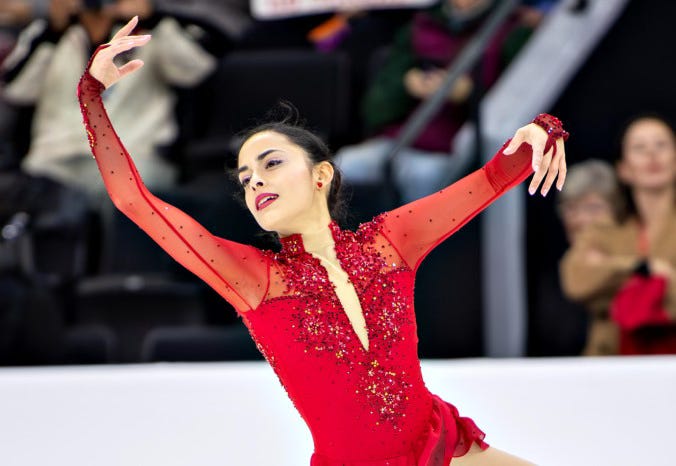
 Maddie Schizas turned in some solid skates in the Team Event at the Milan-Cortina Olympics, but it’s her new found viral fame that will be a memory to take home from Italy (Photo by Tina Weltz).
In the end, Canada took its best shot, pretty much all the way across the board. And still, it wasn’t enough for the country to earn a spot on the podium in the Team Event at the Milan-Cortina Olympics.
And really, that’s about what most observers thought heading into these 2026 Winter Games. Sure, Canada had a chance to contend for a medal in this competition — which it hasn’t won since the 2018 dream team struck gold in PyeongChang, South Korea — but just about everything had the line up perfectly for that to happen.
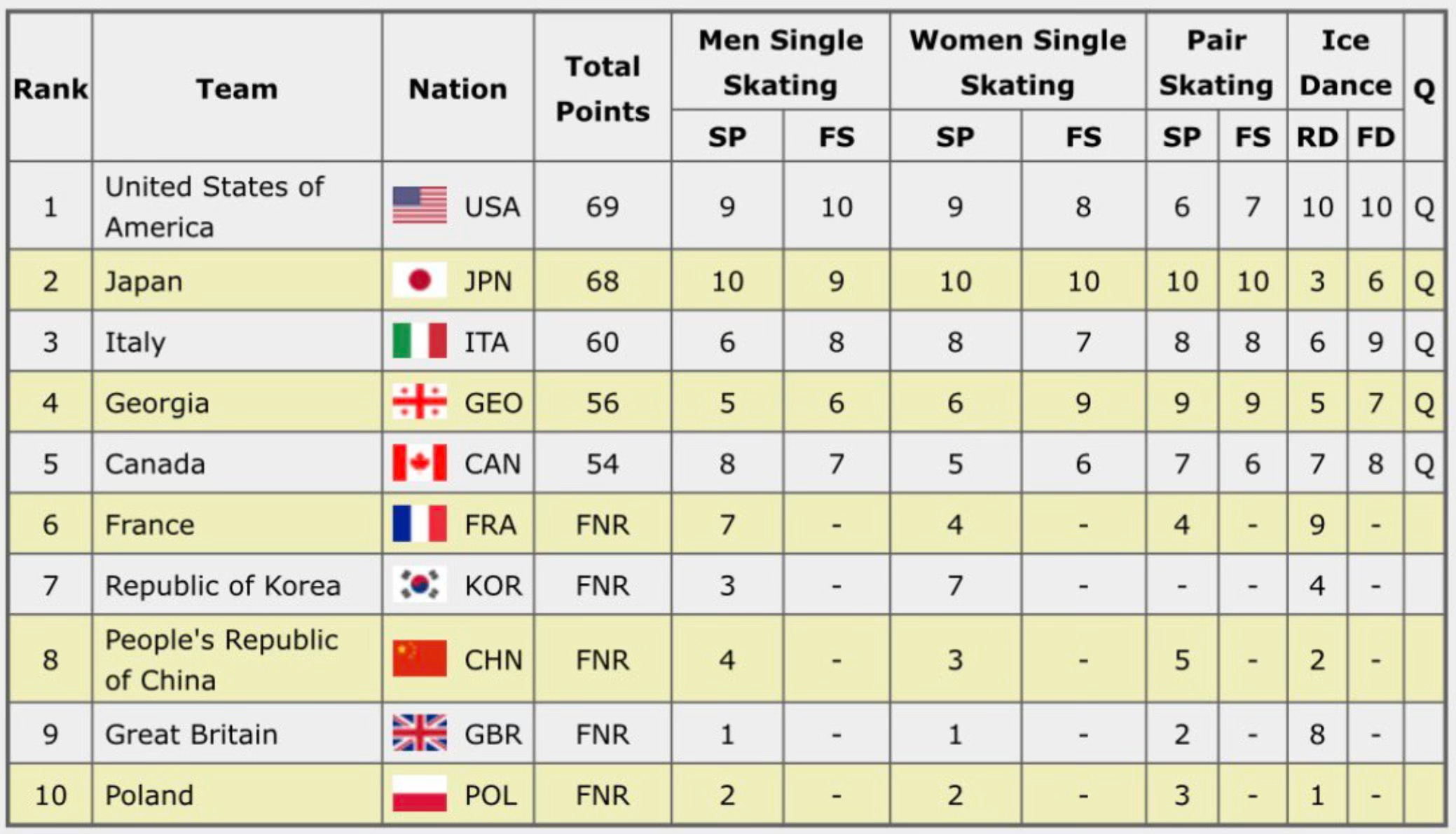
At the end of the day, that simply didn’t happen. And so it was that the red maple leaf fell six points shy of the third podium spot that ending up going to Italy, the first-ever medal of any colour won by the host country in the Team Event. At 54 points, Canada finished fifth overall, two points behind Georgia, which rode a surprise (and richly deserved) second-place finish by Anastasiia Gubanova in the women’s short program to leap past the Canadians in the final standings.
Quite frankly, it’s difficult to point a finger at anyone in particular and call them a weak link on this Canadian squad. Maddie Schizas was the lowest point-getter, but she paid the price for a few mistakes in an overall strongly skated women’s short program and, though she rallied strongly after an early stumble in Sunday’s free skate, again ran up against a high quality field (she was the only skater in the last five not ranked in the top 10 in the current world standings).
There were a raft of season’s best scores recorded by Canadian skaters in the Team Event, and that’s truly as much as Skate Canada could have asked for, in the end. As we said to start off this column, all you can do is take your best swing and hope it’s better than no more than that of two other teams. Bottom line, that didn’t happen. But in any sport, that’s really what the Olympics are all about.
Some final thoughts about the Team Event from a Canadian view:
This was Stephen Gogolev’s true coming out party
For those of you who have been following Gogolev’s career since the very beginning, perhaps you’ll point to his Junior Grand Prix Final triumph in 2018 as the moment that first put him on the map. And that certainly was a historic achievement (he became the youngest ever to win the men’s title, doing it a few weeks before his 14th birthday).
But that was a seven long years ago, and Gogolev virtually disappeared from the spotlight since then, for a variety of reasons that we detailed in yesterday’s dispatch. Now healthier than his been in years, Gogolev has enjoyed his finest season to date in the senior ranks (there really isn’t a close second) which has culminated in his Olympic debut in Milan. And he sure made it count.
Really, there is no brighter spotlight in figure skating than the Olympics, and Gogolev has said getting to Italy was the main motivation that kept him in the sport when the seemingly endless run of back woes had him questioning whether he wanted to keep skating.
You never know what you’ll get from any athlete in his or her Olympic debut, but Gogolev thrived in a major way in the Team Event spotlight. His superb short program on Saturday assured that Canada would quality for the free skate portion of the competition, and he posted the fourth-best score on Sunday when everyone above him turned in top-notch performances.
He also had the unenviable task of skating the wake of Matteo Rizzo, whose terrific free skate locked up the bronze for Italy and earned a huge ovation from the home fans.
“I was quite a bit nervous going into this because, skating after Matteo … I don’t know if it was a very easy task, especially since he was skating in front of Italian crowd, and the crowd was very, very loud,” said Gogolev. “And overall, I think I was able to perform as best as I can, and I’m happy that I was able to fight through it.”
It also says something that his scores for the short program (92.99) and the free (171.93) are new personal bests. Add those two numbers together, and you can see a guy with potential to crack the top 10 when the men’s event begins Tuesday with the short program (as a point of reference, a 264.92 total would have placed him ninth at the 2025 World Championships in Boston).
Surely, after his work on the weekend, Gogolev has to be approaching the men’s event brimming with confidence. It makes him a young man to watch at the Milano Ice Skating Arena in the days ahead. And for that matter, 2026 Worlds in Prague, where more good things could be on the way (and not just for himself, down the road).
A team for everybody to be excited about
The words above are a reference to one of the first features written in this space, way back in June 2023, that served as an introduction of sorts to the relatively new pairs team of Lia Pereira and Trennt Michaud, which had made its Canadian championships debut earlier that year in Oshawa, Ont.
That same line could also apply to Pereira and Michaud’s contributions in the Team Event, which marked their debut on the Olympic stage. The duo came to Milan expecting to skate in the long program only, but that all changed when Deanna Stellato-Dudek’s undisclosed injury in training knocked her and Maxime Deschamps out of the Team Event.
(a decision should be made in the next few days about whether they can compete in the pairs event, which begins next Sunday).
That meant Pereira and Michaud were in for both segments, and they delivered in a big way. The finished fourth in the short program on Friday, giving Canada seven valuable points. While the placement was fifth in Sunday’s free program, their skate to music from the “Gladiator” soundtrack earned a personal best score of 134.42.
In other words, Pereira and Michaud did their job, and then some.
“We are very proud and very happy that we were able to put out a skate like that,” Pereira, 21, said Sunday. “The Americans (Ellie Kam and Danny O’Shea) laid out a really great performance ahead of us. To feel that Olympic spirit in the building was very motivating for us and I think that can kind of go either way for an athlete.
“So I’m really glad that for us we took that as motivation and really helped fuel our performance today.”
Pereira and Michaud finished just 0.94 points behind their American rivals, which would have a rather significant impact on the team standings in the end. Kim and O’Shea’s extra point was especially valuable, given that the U.S. edged Japan 69-68 for the gold.
In the end, the ice dance switch didn’t matter
Turn back the clock to Saturday, and some were questioning Skate Canada’s decision to drop World silver medallists Piper Gilles and Paul Poirier from the free dance and instead sub in its No. 2 team, Marjorie Lajoie and Zachary Lagha. Given that Canada only trailed Italy by a single point at the time, some saw it as giving up a chance to even the score heading into Sunday’s final day.
Not to sound like a Skate Canada apologist here, but in the end, that point didn’t really matter. Italy’s skaters outpointed Canada in all three disciplines on Sunday and widened their margin to six points by the finish (with Georgia sitting in between them in the final standings).
Who knows, maybe SC looked at the mathematics heading into Sunday and decided, much like we wrote above, that the odds of everything going perfectly for Canada to pull out a medal weren’t exactly great. And there was also the matter of protecting Gilles and Poirier’s bid for a medal of their own, which gets underway with Monday’s rhythm dance.
And let’s not forget, Lajoie and Lagha earned a personal best score for their very well-skated “White Crow” free dance. That should be a boost for them heading into Monday’s ice dance competition.
Maddie Schizas got a whole lot more famous
At the end of the day, perhaps this Team Event will be best remembered — at least from a Canadian perspective — as the weekend that Maddie Schizas shot to fame in the Internet world.
First there was the anything but pleased look she displayed when the short program score she was given Friday didn’t exactly sit well with the 22-year-old from Oakville, Ont. Soon enough, Schizas became a meme all over social media land. But that was just the start.
Just for fun, Schizas posted a letter she wrote to a professor at McMaster University, asking for an extension for assignment she forgot to do before she left for Italy (she confused the day on which it was due). The story quickly spread like wildfire, which news outlets beyond Canada’s borders picked up (which was pretty crazy in itself).
It also had many folks on social media begging a certain professor at McMaster to give Schizas a break. In the end, it all worked out in her favour. She posted this to show the extension indeed was granted.

Needless to say, it became a hot topic of discussion in the media mixed zone at Milano Ice Skating Arena. All of which had Schizas — almost universally hailed by her Canadian teammates as the funniest person on the squad — shaking her head about her new found fame.
“I didn’t think anyone would care so much,” said Schizas, who owns a deadpan form of humour. “I thought it would just be my friends and, I don’t know, other students laughing. Then all of a sudden, there were millions of people who had seen this email I sent (it also earned her thousands of new followers on the Gram).
“The Olympics are a big deal. I kind of forgot.”
McMaster itself jumped in on the fun, getting Schizas’ permission to print the response from her professor on its Instagram account.

If anything, it’s a fun memory that Schizas can carry home with her from Italy. And it should be good for a chuckle or two when a pair of her university roommates arrive in Milan next week to watch her skate in the women’s event, on Feb. 17 and 19.
The most exciting Team Event finish ever
Most years, since the Team Event first began in 2014 in Sochi, the Team Event has been largely decided by the final event. The host Russians had the first gold in the bag before then, while Canada had long wrapped up its gold in PyeongChang in 2018 before the finish.
We’d like to say it was a similar story for Russia in 2022 in Beijing, but the doping fiasco surrounding Kamila Valieva turned that into a years-long saga that wasn’t officially done until the Americans were presented their gold medals at the Paris Olympics in July 2024.
(this might be the time for us to bring up, again, the bronze medals that Canada should have received the same day … but we’ve long ago said our piece on that misguided decision).
Anyways, the drama reached a fever pitch on Sunday in Milan, when the U.S. and Japan entered the men’s free program tied with 59 points apiece, with the gold coming down to a skate off between two-time world champion Ilia Malinin and Shun Sato, who carried Japanese hopes after Yuma Kagiyama had won the short with an uber-brilliant skate on Saturday.
While Malinin wasn’t at his absolute finest, he did land a dizzying array of quadruple jumps, including a pair of them in separate combinations in the back half of the program that generated crucial bonus points. While Sato didn’t have quite the same arsenal, he launched a fabulous free skate of his own (including a quad Lutz) to at least make the Americans sweat a little bit.
In the end, Malinin prevailed, and the gold stayed in the hands of the Americans. While Japan was more than a match for its U.S. rivals in three of the four disciplines — Kaori Sakamoto and the pair team of Riku Miura and Ryuichi Kihara each won both segments of their events — it was the wide gap in ice dance that decided this thing.
World champions Madison Chock and Evan Bates outpointed their Japanese rivals Utana Yoshida and Masaya Morita — who have only been to Worlds once (last year in Boston) and didn’t qualify for the free dance — by a 20-9 margin.