
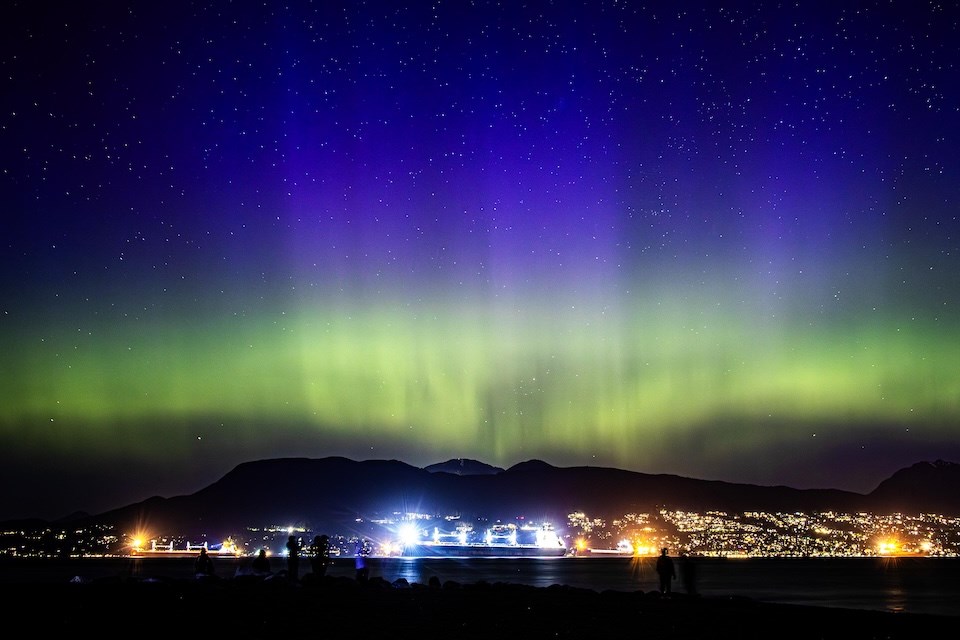
The dancing lights could paint the sky with hues of green, purple and pink.
You might get to see the aurora borealis locally this week, provided the timing works out.
The National Oceanic and Atmospheric Administration’s Space Weather Prediction Center observed an R3 (Strong) solar flare, possibly responsible for causing radio blackouts and other communication disturbances. This means stormy space weather may evolve into a possible northern lights viewing experience this week.
At this time, the department hasn’t issued a geomagnetic storm warning, like the recent one responsible for significant viewing opportunities in the Lower Mainland.

Photo: National Oceanic and Atmospheric Association Space Weather Prediction Center
The University of Alaska Fairbanks (UAF) says “highly active auroral displays” may be visible overhead on Thursday (Feb. 5) in places such as Yellowknife, Iqaluit, Juneau, Edmonton, Winnipeg and Thunder Bay. They may also be “visible low on the horizon from Seattle, Des Moines, Chicago, Cleveland, Boston and Halifax.”
Since the dancing lights may be visible in Seattle, low on the horizon, you might have an even better chance of seeing them in Metro Vancouver.
The university’s online aurora monitor map shows what regions the aurora’s green glow will likely reach, and other areas where it is less likely. And a brief description below the map shows the aurora activity on that particular day.

Photo: University of Alaska Fairbanks
Metro Vancouver weather forecast includes clear nights
While Mother Nature doesn’t always cooperate, it appears the stage will be set for optimal viewing on Thursday.
Environment Canada meteorologist Bobby Sekhon says that a strong ridge of high pressure is building, which will keep the region dry for a few days this week.
Temperatures are expected to climb to highs of 14 C and 13 C, before dropping slightly to 10 C on Friday. The seasonal average for this time of year is 8 C. The clearing skies will allow temperatures to cool significantly overnight to lows of 5 C and 4 C, though they are a few degrees above the seasonal nighttime average of 1 C.
Following a G4 (Severe) geomagnetic storm warning on Jan. 19, locals captured impressive jewel tones in the dark sky overnight, despite the fog advisory working against them.