

As you can imagine, authors are very active in fighting against the AI tools that threaten our livelihoods. Over the past couple of years, various groups and organizations ostensibly serving writers have learned the hard way that their members and customers are generally not enthusiastic about those who serve and support them embracing large language models (LLMs).
The once beloved National Novel Writing Month, which supported writers in an annual sprint to bang out a first draft of a novel in November of each year, shut down in 2025 after anger over its acceptance of AI as a legitimate tool to help authors. To the outrage of many disabled writers, NaNoWriMo framed the use of AI in novel-writing as an accessibility issue, saying that condemning AI has “classist and ableist undertones.” I know quite few disabled writers who were enraged by this, feeling that they were being used to promote technologies they did not support.
On his blog, Terrible Minds, author Chuck Wendig wrote about the controversy:
The privileged viewpoint is the viewpoint in favor of generative AI. The intrusion of generative artificial intelligence into art and writing suits one group and one group only: the fucking tech companies that invented this pernicious, insidious shit. They very much want you to relinquish your power in creating art and telling stories to them and their software, none of which are essential or even useful in the process of telling stories or making art but that they really, really want you to believe are essential. It’s a lie, a scam, a con. Generative AI empowers not the artist, not the writer, but the tech industry…
Though the industry is often unfair (and classist, and ableist, and privileged) the act of telling stories is universal, and has existed as long as we have.
Then, last year, the Nebula Awards, presented by the Science Fiction & Fantasy Writers Association (SFWA) announced new rules that would open the door to works created in part with the help of LLMs. The SFWA board quickly backtracked, releasing a statement that explicitly banned LLM use for nominated works. The new rules stated:
Works that are written, either wholly or partially, by generative large language model (LLM) tools are not eligible.
“Works that used LLMs at any point during the writing process must disclose this upon acceptance of the nomination, and those works will be disqualified.”
Yesterday, many writers were up in arms over a story in the New York Times by Alexandra Alter, called “The New Fabio Is Claude: The romance industry, always at the vanguard of technological change, is rapidly adapting to A.I. Not everyone is on board.”
The model Fabio was a staple of romance novel covers for years; Claude is an LLM developed by Anthropic, which recently settled a lawsuit over using millions of works to train its model, without permission.
The New York Times story focuses on romance writer Coral Hart, who used to write 10-12 novels a year, but has now massively increased her output:
Last year, she produced more than 200 romance novels in a range of subgenres, from dark mafia romances to sweet teen stories, and self-published them on Amazon. None were huge blockbusters, but collectively, they sold around 50,000 copies, earning Ms. Hart six figures…
While we spoke over Zoom, an A.I. program she was running ingested her prompts and outline and produced a full novel, about a rancher who falls for a city girl running away from her past. It took about 45 minutes…
The way Ms. Hart sees it, romance writers must either embrace artificial intelligence, or get left behind.
“If I can generate a book in a day, and you need six months to write a book, who’s going to win the race?” she said.
Coral Hart is a pseudonym. She also produces books under a variety of other pseudonyms, none of which she discloses in the story, because she thinks it will piss off her readers. She remains anonymous in the New York Times story, because she thinks here revelations will hurt the writing and coaching she does under her real name. That seems somewhat telling.
Also, there is a big photo of her at the top of the story, so I don’t know how she plans on remaining anonymous.
A few thoughts.
First, six figures is not an enormous amount of money. Given the figures in the story, she’s making $500 per book. Most of those books are likely not purchased individually. Thanks to subscription plans like Kobo Plus and Kindle Unlimited, readers can download as many eligible books as they want, for a monthly fee. Many of these are self-published genre books.
Second, writing is not a race, goddammit! Did J.D. Salinger lose the race, for producing such a paltry body of work? OK, let’s say we’re just talking romance novelists though. I know romance writers who care deeply about their work and who have no interest whatsoever in winning a race based on how many books they can churn out with no effort.
Finally, I don’t think Hart’s pitch is actually about writing books at all.
One of the recurring themes of the If Books Could Kill podcast, hosted by Michael Hobbes and Peter Shamshiri, is that “it’s all the same book.” Or, as they occasionally put it, “It’s all the same fucking book.”
The podcast picks apart popular non-fiction books, often of the self-help variety. Many, many of these books, no matter what they are ostensibly about, wind up telling readers that the way to succeed is to sell their own system, become their own coach, create their own program, or whatever.
Spend any amount of time on Instagram, for instance, and you’ll see tons of AI-generated garbage shared by people who will be happy to sell you their system for how to make money (like them!) by creating your own AI-generated garbage. Only, if they were doing so well, why would they be selling their shitty system, described in a pdf they used AI to generate?
This brings me back to Coral Hart. The real money surely is not in the $500 she is making per AI-generated book. From the New York Times story:
Through her author-coaching business… she’s taught more than 1,600 people how to produce a novel with artificial intelligence, she said. She’s rolling out her proprietary A.I. writing program, which can generate a book based on an outline in less than an hour, and costs between $80 and $250 a month.
So, this is the grift. The books could make no money at all, and it wouldn’t matter. The money is in the coaching and the proprietary LLM.
Of course, once thousands of writers start producing hundreds of novels a year, wading through new releases will be even more like sifting through all the junk on every other platform.
(To send or post this item, copy the website address at the top of this page.)
RECENTLY IN THE HALIFAX EXAMINER:
1. Former residents sue province for ‘segregation-like conditions’ at Nova Scotia’s only secure treatment facility for youth in care
 The $3.5 million dollar secure treatment facility for children in care, opened in 2003 in Truro, N.S. Taken on Feb. 5, 2026. Credit: Molly MacNaughton
The Examiner has published part one of a two-part investigative series by Molly MacNaughton, on alleged abuse of young people at Wood Street Centre Secure Treatment in Truro. Three former residents have filed a lawsuit against the Attorney General of Nova Scotia, over the allegedly abusive and harmful treatment they received at Wood Street.
McNaughton writes:
From the outside, Wood Street Secure Treatment looks like a typical one-storey elementary school situated in a small rural town — modern, sturdy with fortified windows. But instead of arriving by bus, youth arrive in the custody of police, handcuffed and, according to former residents and social workers, sometimes shackled.
“They’re treated as though they’re in a jail, and yet they’re not in jail, they’re just in a care home,” says Halpern.
Gabe Leblanc was brought to Wood Street by police in early 2021. He says officers handcuffed him in the hospital where he was recovering from serious injuries, including two broken legs after jumping out of a window. He spent roughly six weeks in a wheelchair.
Leblanc says the new world he entered terrified him. He remembers hearing horror stories that Wood Street was worse than jail. Upon arrival, youth pass through a metal detector and interview room. Personal belongings are confiscated, including phones, and they’re issued basic necessities such as sweatpants and underwear. Beds are located on two co-ed units (washrooms are segregated by gender) with a recreation room and an outdoor caged-in basketball court so youth can’t escape.
This is not an easy story to read, but it is an important one. I look forward to part two of the series.
Click or tap here to read “Former residents sue province for ‘segregation-like conditions’ at Nova Scotia’s only secure treatment facility for youth in care.”
(Send this item: right click and copy this link)
2. Andy Fillmore wants bus-only lanes turned into high-occupancy vehicle lanes
 A high-occupancy vehicle (HOV) lane on Highway 404 in Ontario. Credit: Wikpedia
Suzanne Rent reports on Halifax mayor Andy Fillmore’s plan to pilot using bus lanes as high-vehicle occupancy (HOV) lanes.
From the story:
According to Fillmore’s motion, which will go to Halifax regional council’s meeting on Tuesday, those HOV lanes should be “prioritized based on impacts to transit, effectiveness, and feasibility on congested corridors in HRM.”…
The federal government has this report on HOVs that says the first HOVs were created in the U.S. in the 1970s. The first HOVs were built in Toronto and Greater Vancouver in the 1990s. There are now HOVs in other Canadian cities, including Ottawa, Gatineau, Montreal, and Calgary.
That report said some of the challenges with understanding HOVs in Canada include the so-called “empty lane syndrome.” That is, a well-used and functioning HOV will appear less full of congestion than a general traffic lane, so detractors of HOVs say those lanes aren’t working.
The same, of course, is true of bike lanes, multi-use paths, and bus lanes. If there is no traffic in the bus lane, that’s a good thing. Buses don’t go by every 30 seconds, but when they do, they get to zip past private vehicles. This is also a good thing. A bus moves a lot more people than a car. If you fill the lane with cars, and if you don’t have a good mechanism for enforcing high occupancy, you’re just adding another lane of gridlock.
Funnily, I never hear arguments that train tracks are useless because they are sitting there empty most of the time.
Click or tap here to read “Andy Fillmore wants bus-only lanes turned into high-occupancy vehicle lanes.”
(Send this item: right click and copy this link)
3. More Nova Scotia Power customers behind on their bills
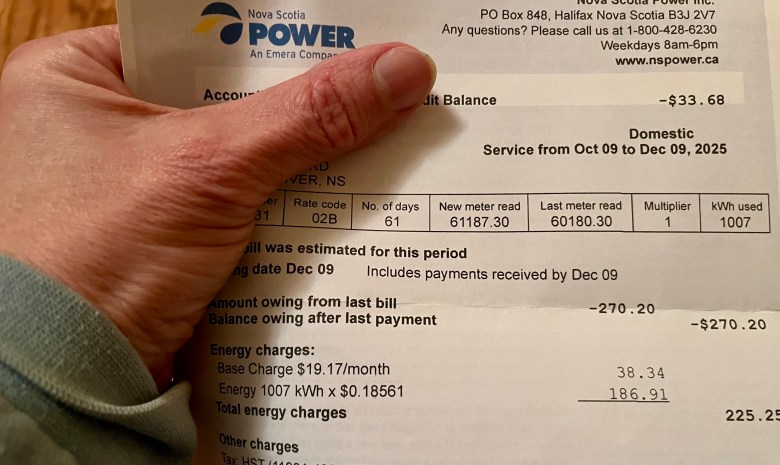 A Nova Scotia Power bill issued for December, 2025. Credit: Halifax Examiner
For months, up to half of all Nova Scotia Power customers have been receiving estimated bills that do not reflect their actual power use. Many customers have complained about bills that seem wildly inflated. The utility has told customers that it was waiving interest charges and not charging any late fees to customers, as a result.
Now, Jennifer Henderson reports, the number of customers in arrears on their bills has jumped, and some might face a nasty surprise when their meters finally get read.
From her story:
Unsurprisingly, the number of accounts in arrears has now doubled from the usual 4% to 8%. In some cases, customers are discovering they owe more money than expected if the interval between the cyberattack and their actual meter reading was four to five months.
Chris Lanteigne, Nova Scotia Power’s director of customer care, said the company is responding by encouraging people with outstanding balances to sign up for its equal billing payment program. Those who sign up will pay no interest for 12 months on the amount of energy billed since April. You can find more information on that here…
Unfortunately, because of the opaque way energy use is described and presented on the power bill, customers will remain mystified as to how their bill was actually calculated. Essentially, you have to trust Nova Scotia Power with the math because you can’t see the work.
Click or tap here to read “More Nova Scotia Power customers behind on their bills.”
Meanwhile, the Nova Scotia Energy Board has announced a public hearing on the subject of the “impact of the cyber incident on NOVA SCOTIA POWER INCORPORATED’s collection and retention of customer information, customer service and communications, billing processes and regulatory matter.” (Capitals in original.) The hearing takes place July 27, 2026, and anyone who wants to speak at the hearing must register by July 8.
(Send this item: right click and copy this link)
4. Report suggests Halifax consider microtransit pilot project for Lucasville
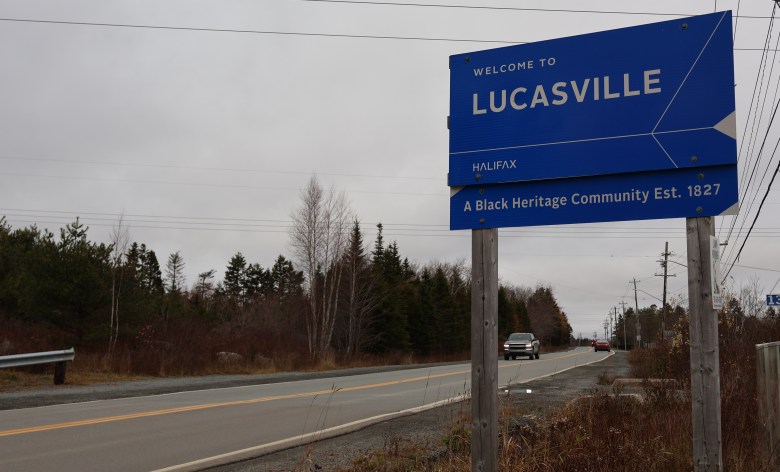 Lucasville, N.S. Credit: Suzanne Rent
Suzanne Rent has a new story on a report suggesting that Halifax consider running a microtransit pilot project in Lucasville. Microtransit is defined as ““technology-enabled, shared-ride transit service that uses dynamic routing, within defined zones, to meet local passenger needs.”
From the story:
The microtransit plan would use a van or bus for the service and would offer curb-to-curb service that takes residents to areas within their communities and connects them to other transit routes…
According to the report, the cost for microtransit is expected to be greater than $100 per hour of service.
“In addition, capital costs, estimated at over $650,000 for launching in one community, or over $2.4M for all five priority areas, would be required initially with an in-house implementation, although they could be postponed with a turnkey solution,” the report says. [The five priority areas are Fall River, Sambro Loop, Cow Bay, Eastern Passage, and Lucasville, but the report suggests piloting in just the latter to start.]
The report explains that “turnkey” means using a private vendor that has an existing fleet of buses, call centres, and recruitment staff that can be extended into HRM quickly and reduce the capital requirement from the municipality. In contrast, an in-house system would require more upfront expense but give the municipality complete control of operations.
Click or tap here to read “Report suggests Halifax consider microtransit pilot project for Lucasville.”
(Send this item: right click and copy this link)
IN OTHER NEWS
1. Ongoing doubts about future of grain elevator
 Halifax Grain Elevator, photographed on June 11, 2016 Credit: Dennis Jarvis / Flickr
Agathe Boucart reports for Radio-Canada on the latest in the uncertainty surrounding the future of the Halifax grain elevator — which is threatened by the Port of Halifax’s expansion plans. The facility is operated by Halifax Grain Elevator Limited, whose lease is up at the end of this year.
According to the story, Halifax Grain Elevator president and CEO Kim Batherson says there is an agreement in principle on an extension, but nothing has been signed, and none of the details have been confirmed, leading to continued uncertainty. She says she hopes negotiations with the port will be fruitful, and that the lease can be extended to 2028. In addition to grain, the elevator also stores wood pellets for export.
(Send this item: right click and copy this link)
2. Fishing boats to install DFO trackers for ocean research
 A fishing boat off Terence Bay, N.S. Credit: Suzanne Rent
Giuliana Grillo de Lambarri reports for CBC on a federal Department of Fisheries and Oceans (DFO) plan to expand its ability to monitor ocean conditions by installing trackers on fishing gear:
The two-year pilot project will see wireless data loggers installed directly on trawls and cages that will record temperature and depth.
Ocean temperatures impact how fish behave. In warmer waters, for example, lobster becomes more active and thus easier to catch. But warmer waters also mean some species move north, looking for colder waters…
Kris Vascotto, executive director of the Nova Scotia Seafood Alliance, said… “The advantage to employing gear directly applied to harvesters is that they’re on the water all of the time so that you have a much more continuous flow of information.”
DFO has its own research vessels, but their time on the water is much more limited.
(Send this item: right click and copy this link)
3. Union files complaint over federal return to office mandate
 Representatives with the Public Service Alliance of Canada (PSAC) at the May Day rally. To the right is Christine Saulnier, director of Canadian Centre for Policy Alternatives-Nova Scotia. Credit: Suzanne Rent
The federal government is insisting that some public servants return to the office up to four days a week. At Global News, Prisha Dev reports that, in response, the Public Service Alliance of Canada has filed an unfair labour practice complaint with the Federal Public Service Labour Relations and Employment Board.
From the story:
“It was shocking to find out that deputy heads would be letting employers know that they would be mandated in office for four days,” said PSAC national president Sharon DeSousa…
She cited Statistics Canada data from 2019 to 2023 that found remote-capable federal workers were more productive and that hybrid work could save the government an estimated $6 billion by getting rid of lease holds and buildings that should have been decommisioned.
“It doesn’t make any sense,” she said. “It actually works, and it’s actually cheaper.”
In a story for CBC, Priscilla Ki Sun Hwang speaks with experts who are also skeptical of the plan:
Shawn S. Hamilton, principal at Proveras Commercial Realty, said the government needs a “demonstrable strategy” to prove that it can accommodate all those workers.
“You can’t just bring people back for the sake of bringing them back. You’ve got to bring them back and locate them with their teams and … create opportunities for collaboration,” he said…
“We haven’t been hearing anything on the street [about plans for the government to increase available office space],” he said. “We’re questioning the math of where people will go.”
I do some freelance work for the National Film Board, and in 2024 I was invited to the opening of their new shared office space with Telefilm Canada, another federal government agency. The NFB office is in a building on Spring Garden Road, and had reduced the size of its space there over the years. Telefilm was housed in a separate office. My understanding, from the event, was that most local employees of both agencies were working remotely most of the time, so it made sense for them to share space. (This was not the only argument for the shared office, but it was one of them.) If you have two dozen workers (I am pulling this number out of the air) and only eight are in the office on any given day, you don’t need 24 workspaces. So you downsize and save money. But if those 24 workers now need to be in the office most days, how is that supposed to work?
I am trying to imagine this scenario playing out across the federal government. It sounds like a nightmare.
(Send this item: right click and copy this link)
4. Jean Laroche on retirement
 Jean Laroche Credit: Contributed
Longtime CBC political reporter Jean Laroche is enjoying his retirement. But it was a bit of a rough transition. He writes:
Weariness, more than anything else, drove me to retire but I felt guilty about leaving an audience hungry for the kind of context and analysis I was able to provide because of my time in the political trenches. I also felt I was abandoning my colleagues, despite their assurances they could soldier on without me.
Those who stopped me in a grocery store aisle or mall parking lot to thank me for my work and to wish me well in retirement only exacerbated the feeling I had abandoned my post and left my community to the wolves.
Perhaps arrogantly, I felt I had been doing my small part to safeguard democracy.
This makes me think of one of my dad’s repeated axioms: that nobody is indispensable. He would also cite the Charles de Gaulle quote: “The cemeteries of the world are full of indispensable men.” (Although I think he might have misattributed it.) If you knew my dad, you would be struck by a bit of irony: he was not a chill person at all, and even though he may have known he was not indispensable, there was no way in hell he was going to slow down or retire.
Laroche writes that a six-week road trip across Canada helped him understand he had made the right decision:
It’s not particularly comforting to realize after a long, moderately successful but very enjoyable career that you can be replaced. But it’s also freeing.
Happy trails, Jean.
(Send this item: right click and copy this link)
Government
City
Monday
Transportation Standing Committee (Monday, 1pm, details)
Suburban Plan Kick Off (Monday, 2pm, 5:30pm, Lakeside Fire Hall)
Harbour East – Marine Drive Community Council (Monday, 6pm, details)
North West Community Council (Monday, 6pm, details)
Tuesday
Halifax Regional Council (Tuesday, 10am, details)
Province
Monday
No meetings
Tuesday
Health (Tuesday, 1pm, details) — Early years Programs from Public Health; with representatives from Nova Scotia Health
On campus
Dalhousie
Monday
Memorial Event for Axel Becke (Monday, 4:30pm, details)
Tuesday
Pharmacology seminar (Tuesday, 9:30am, details) — Adam Johnston presents “The contribution of nerve-derived cells to tissue repair and regeneration – from basic biology to clinical translation”
NSCAD
Reception (Monday, 5:30pm, Anna Leonowens Gallery) — exhibitions by Adia Sisson, Tiana Ciammaichella
In the harbour
Halifax
06:30: Atlantic Sky, ro-ro container ship, sails from Fairview Cove for Hamburg, Germany
08:00: FS Bretagne, French naval frigate, arrives at Dockyard from sea
12:30: Atlantic Sun, container ship, sails from Fairview Cove for New York
15:30: Theban, car carrier, sails from Pier 9 for New York
15:30: Morning Pride, car carrier, sails from Autoport for sea
Cape Breton
05:30: AlgoScotia, oil tanker, arrives at Government Wharf (Sydney) from Halifax
12:15: Epic Salina, oil tanker, sails from EverWind for sea
15:00: CSL Tacoma, bulker, sails from Coal Pier (Sydney) for sea
16:00: AlgoScotia sails for sea
Footnotes
Happy Parks Canada camping reservation season to all those who celebrate.