
For a decade, maybe more, the animated look and aesthetic established by “Toy Story” in 1995 gave the Pixar movies their eye-popping surface wonder. What we quickly came to think of as the Pixar house style totally ruled — as digitally animated artistry, and as commerce. So it was no big surprise to see that it spread. In essence, the Pixar style, that tactile bubble sheen of reality, became the mode of all mainstream Hollywood studio animation. And when then happened, it ceased to be exciting. There were still many good animated features, but the look and feel of them became standard, comparable to how the hand-drawn animated aesthetic of Walt Disney, so glorious in the era of “Snow White and the Seven Dwarfs” and “Pinocchio” and “Fantasia” and “Bambi,” came to seem less magical in the age of “Cinderella” and “Peter Pan.”
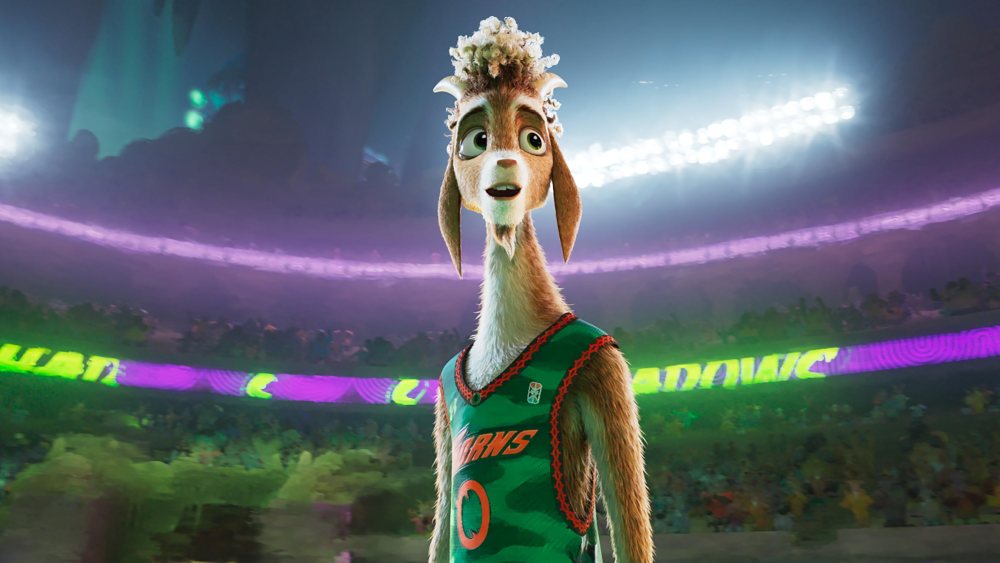
All of which makes “GOAT” a vibrant surprise. It’s a highly original and rousing animated feature — a sports fable with a hip-hop vibe and an off-kilter cosmology. It doesn’t look or move like other animated features. I liked “Zootopia 2” just fine, but in tone and visual imagination it was the definition of standard. “GOAT,” however, takes place in a demimonde of its own devising, a city called Vineland that’s envisioned with a painterly sensuality that lures the audience in. It’s almost a dystopia — a crumbling animal kingdom populated by critters of every stripe, with vines hanging in unruly abundance, often draped over the infrastructure. And that image of life poking up between the cracks of decay extends to the settings: the dingy living rooms, or a basketball court surrounded by a ratty chain-link face, with rusty backboards and metal nets (it’s known as the Cage, and treated as the neighborhood Thunderdome). At the same time, the film’s backdrops are vibrant in a nearly Impressionist way. Some of them look like they could have been painted by Cézanne.
The lush laidback dystopia of “GOAT” is bracing because it feels so novel, and inviting because it feels like home. And that’s part of what makes the movie, directed by Tyree Dillihay (with Adam Rosette as co-director), a go-for-your-dream fairy tale that we haven’t seen before. The game played in these settings isn’t basketball — it’s called roarball, and it’s a mangy, brutal, hyper-fast version of basketball, a reckless high-flying team gladiator match with hoops. We meet the film’s hero, Will Harris (Caleb McLaughlin), when he’s a young Boer goat, a junior sports fanatic who gets taken by his single mother to see the Vineland team, the Thorns, at the Green House, the local roarball colosseum. Will and his mom don’t have much money, but he manages to get in to watch his idol, Jett Fillmore, a towering panther voiced by Gabrielle Union is the most vivid piece of animation acting I’ve encountered in quite some time. Her Jett is a champion, full of bluster, always throwing shade, like Caitlin Clark infused with the spirit of RuPaul. But she’s got vulnerabilities that round the character right out to three dimensions.
Ten years after the prologue, we meet Will as a grown-up goat doing deliveries for the Whisker Diner, but he’s on the verge of being evicted from his apartment. He still dreams of being a roarball star (he’s an ace shooter who can drop a swish at 50 feet), but he’s…a goat. Which means that he’s a “small,” according to the Vineland caste system. How can a small compete in a world of oversize jock beasts?
The members of the Thorns are all gigantic, and when Will goes to shoot hoops by himself at the Cage, he runs into Mane Attraction (Aaron Pierre), a dredlocked Andalusion horse from a rival team who’s pure gangsta. Mane challenges Will to a round of one-and-one and basically smashes him. But Will gets off a few good shots, which are captured on a phone camera, and when his buddy creates a viral video, making it look like Will trounced Mane in the duel, it attracts the attention of Flo (voiced by a super-sly Jenifer Lewis), the warthog hustler owner of the Thorns, who needs something to revitalize her team. Jett, her veteran superstar, is getting old; the other players are dispirited. Maybe an injection of goat energy is just what they need.
In outline, “GOAT” doesn’t do anything terribly unorthodox, but the joy of the film lies in its dreamscape design, in the funky cut and thrust of its patter, and in its touching off-center sincerity. The different roarball stadiums are like fantasy landscapes (in one the game floor is built over bubbling magma, in another it’s made of ice), and though Will’s teammates may sound like the usual menagerie of animated critters, Tyree Dillihay, directing his first feature, gives each of them little curlicues of insanity that pop, whether it’s Olivia (Nicola Coughlan), the ostrich, burying her head in the earth to express her despair, or the way that Modo (Nick Kroll), the team’s anarchic Komodo dragon, with his pierced nose and tongue and Cookie Monster-on-fire personality, has jaws drenched in saliva.
Will starts off on the sidelines, but part of what’s cool about the film is that even when he comes off the bench, he isn’t transformed into some unreal champion. Despite the pun of the title, this goat doesn’t become the GOAT. What he does do is bring the team back its soul. (So does Lenny the giraffe’s delicate cover version of “Don’t Dream It’s Over.”) Caleb McLaughlin, from “Stranger Things,” plays Will with the kind of quick-witted empathic vocal performance that recalls Shameik Moore’s vibrance in the “Spider-Verse” films. And while “GOAT,” as a movie, isn’t as inventive as they are, it has a touch of that “Spider-Verse” DNA — the flash and eagerness and talent to elevate digital entertainment into a form of re-animation.