
First of a Three-Part series takes an in-depth look at the motivations driving Alberta sovereignty
February 9, 2026 – They’ve made headlines for months, but Alberta separatists have apparently convinced few beyond a reasonable doubt that their path is the right one.
New data from the non-profit Angus Reid Institute finds determined and decided opposition to separation vastly outpaces this sentiment on the other side. There are, however, many minds that are not made up. This report is the first of a three-part series exploring the two separatist movements tugging at the strings of confederation.
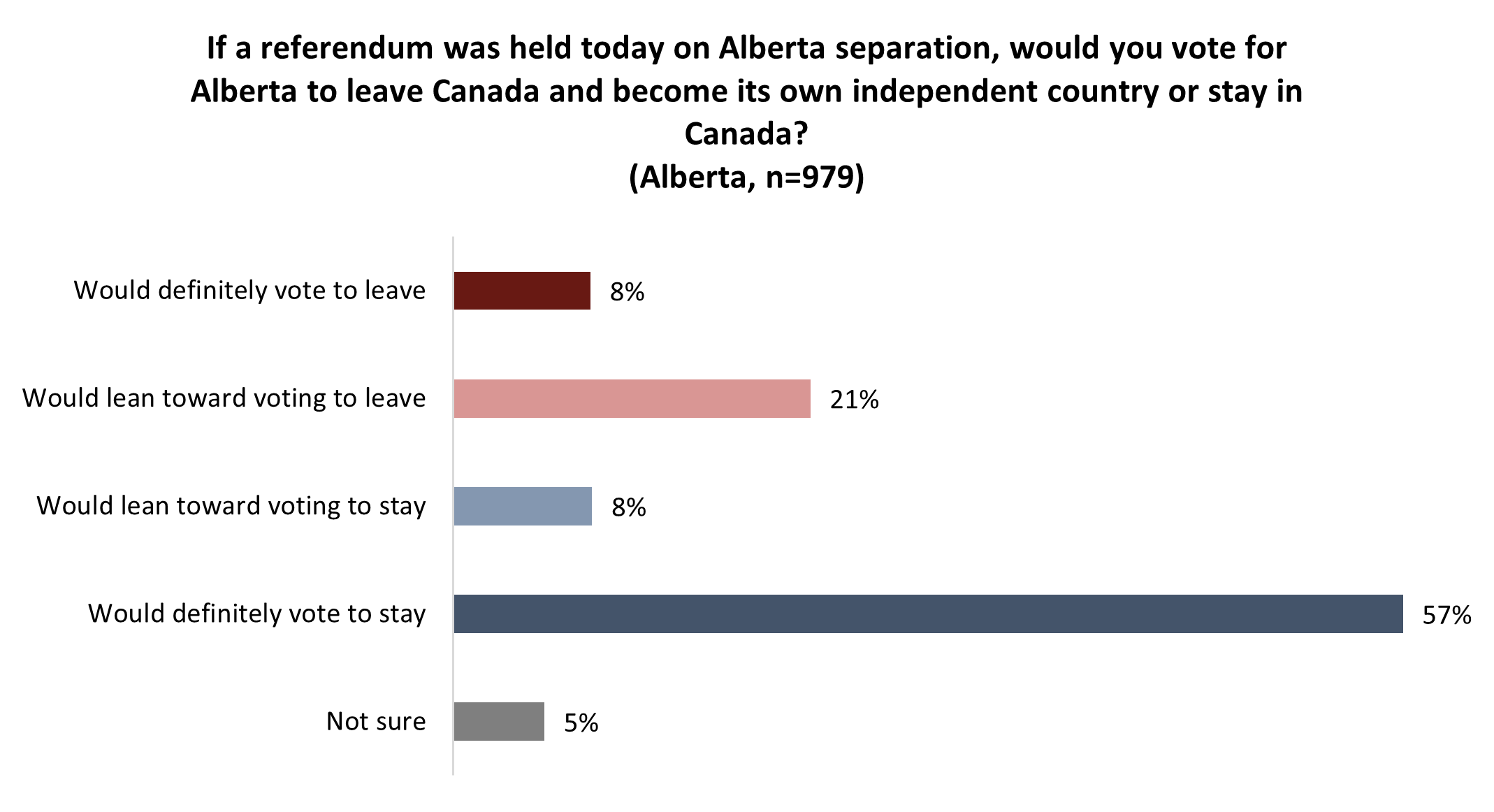
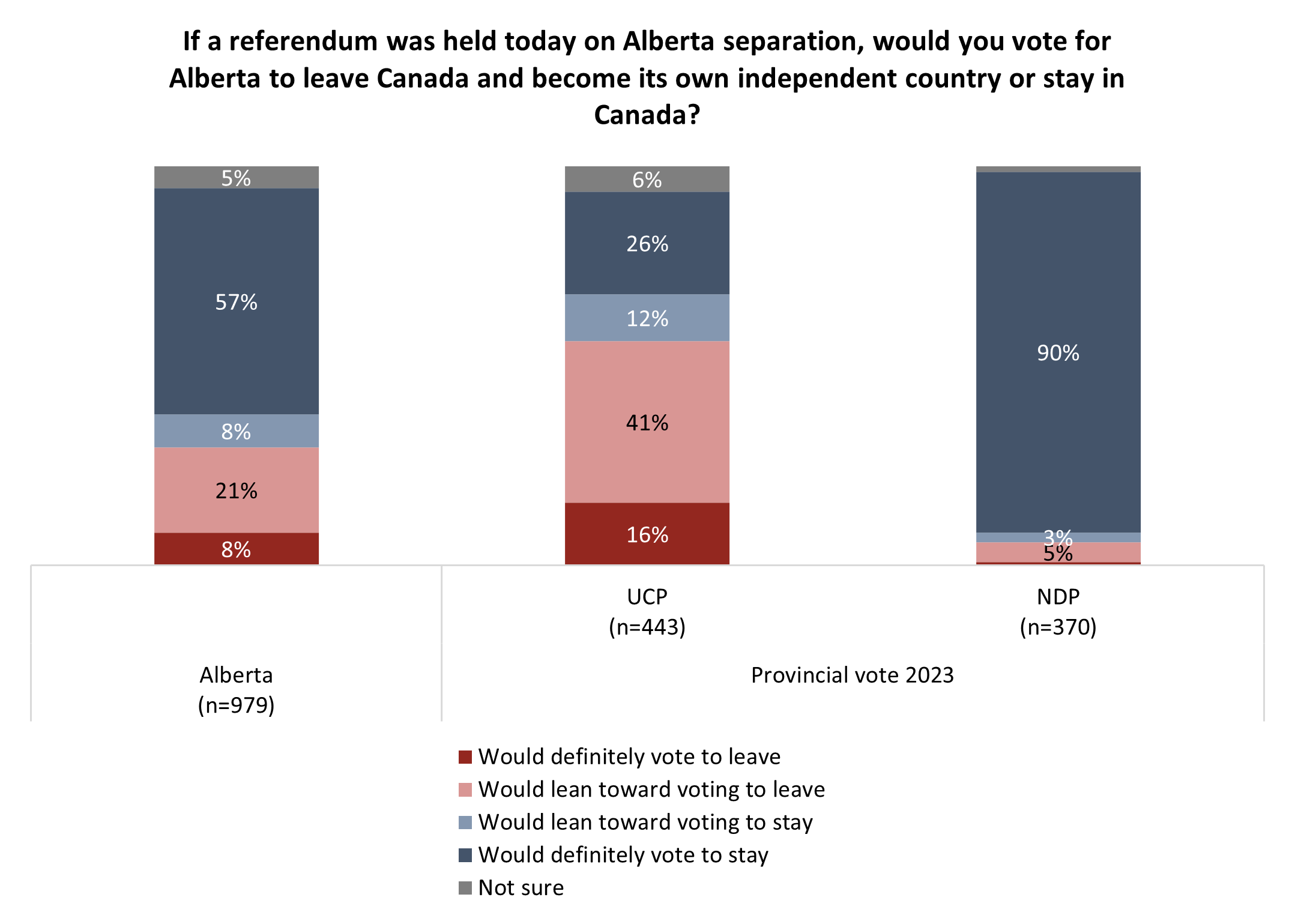
Fewer than three-in-10 (29%) Albertans say they would vote for their province to leave Canada if there were a referendum today and most in that group (21%) say they are leaning that way rather than definite (8%) in their choice. On the other side, two-thirds (65%) say they would vote to stay, and the larger proportion of that group are solidified in their vote (57% definitely vote to stay).
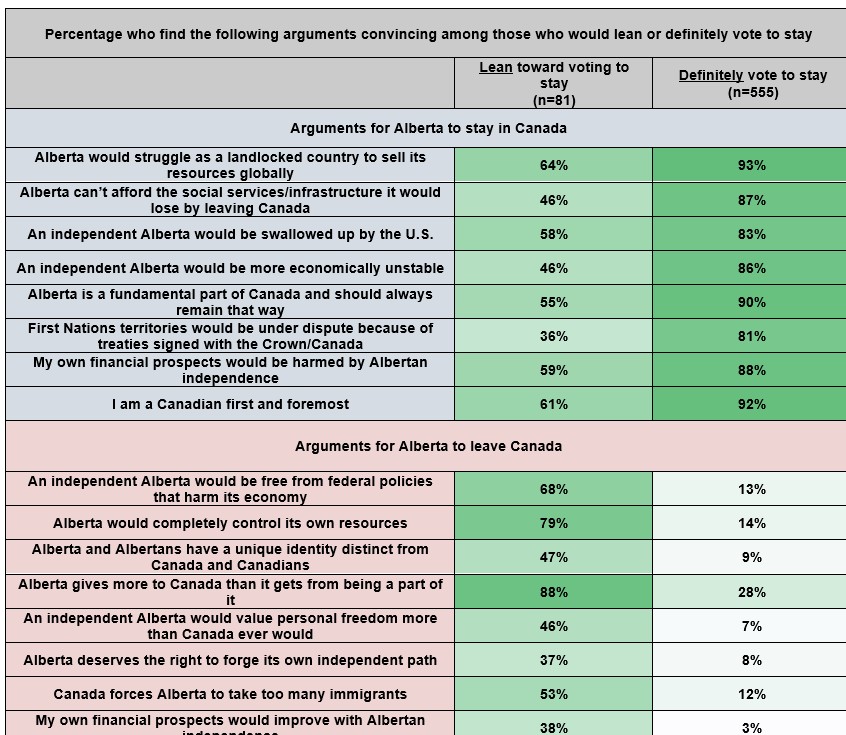
To further explore the ideas pushing and pulling Albertans on the issue of separation, the Angus Reid Institute put to respondents the common arguments for staying in Canada or leaving and asked if respondents found those arguments convincing or not. For the “definite stay” voters, nearly all find their own Canadian identity (92%), Alberta’s fundamental place as a part of Canada (90%) and the prospect of an independent Alberta struggling to get its resources out of its landlocked state (93%) as convincing arguments.
The “lean stay” voters agree, but not nearly at the same rate (61%, 55%, 64% respectively). And those same “lean stay” voters say they are swayed by some of the key arguments to leave, including that Alberta gives more than it gets in confederation (88%) and the prospect of Alberta controlling all of its own resources (79%).
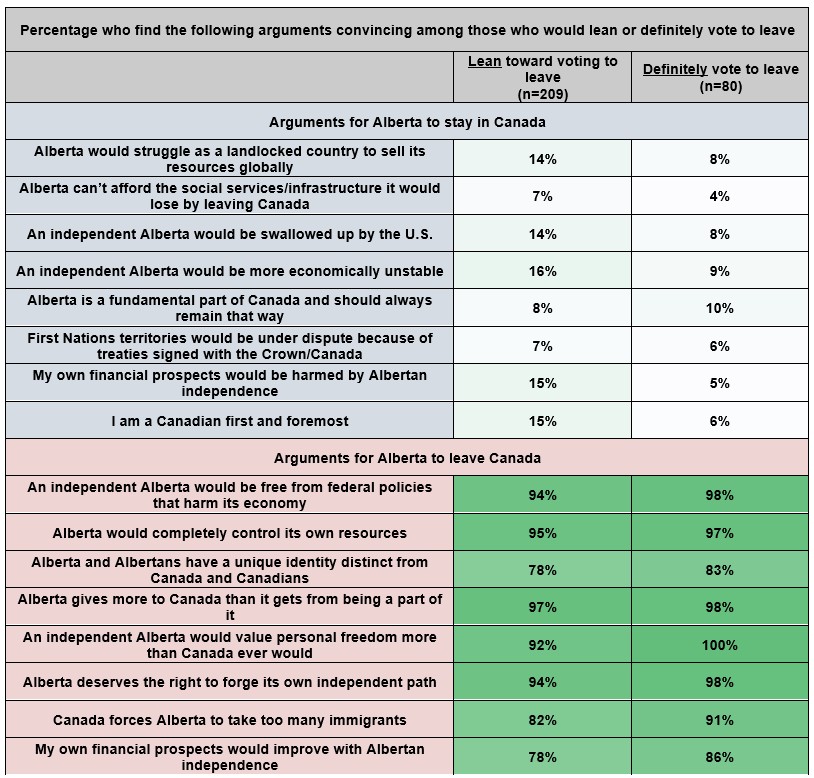
The “definite leave” and “lean leave” voters find little convincing about the stay arguments, including the potential issues of lack of tidewater access (8% and 14% convinced respectively) and the cost of replicating lost federal social services and infrastructure (7% and 4%). Instead, the “leave” voters are nearly unanimous in finding the arguments to leave as persuasive, including Alberta freeing itself from “harmful federal policies” (98%, 94%) and complete control of provincial resources (97%, 95%).
More Key Findings:
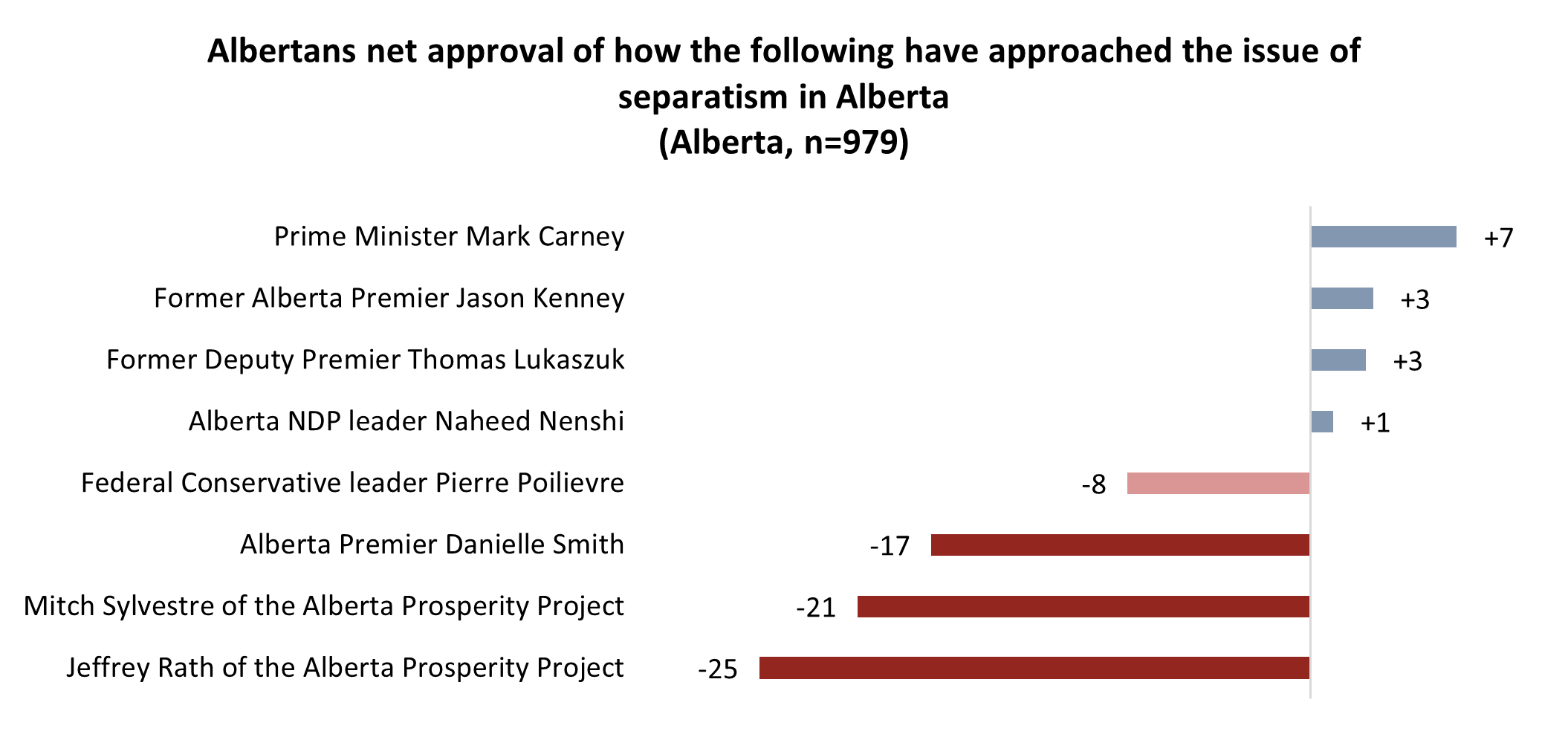
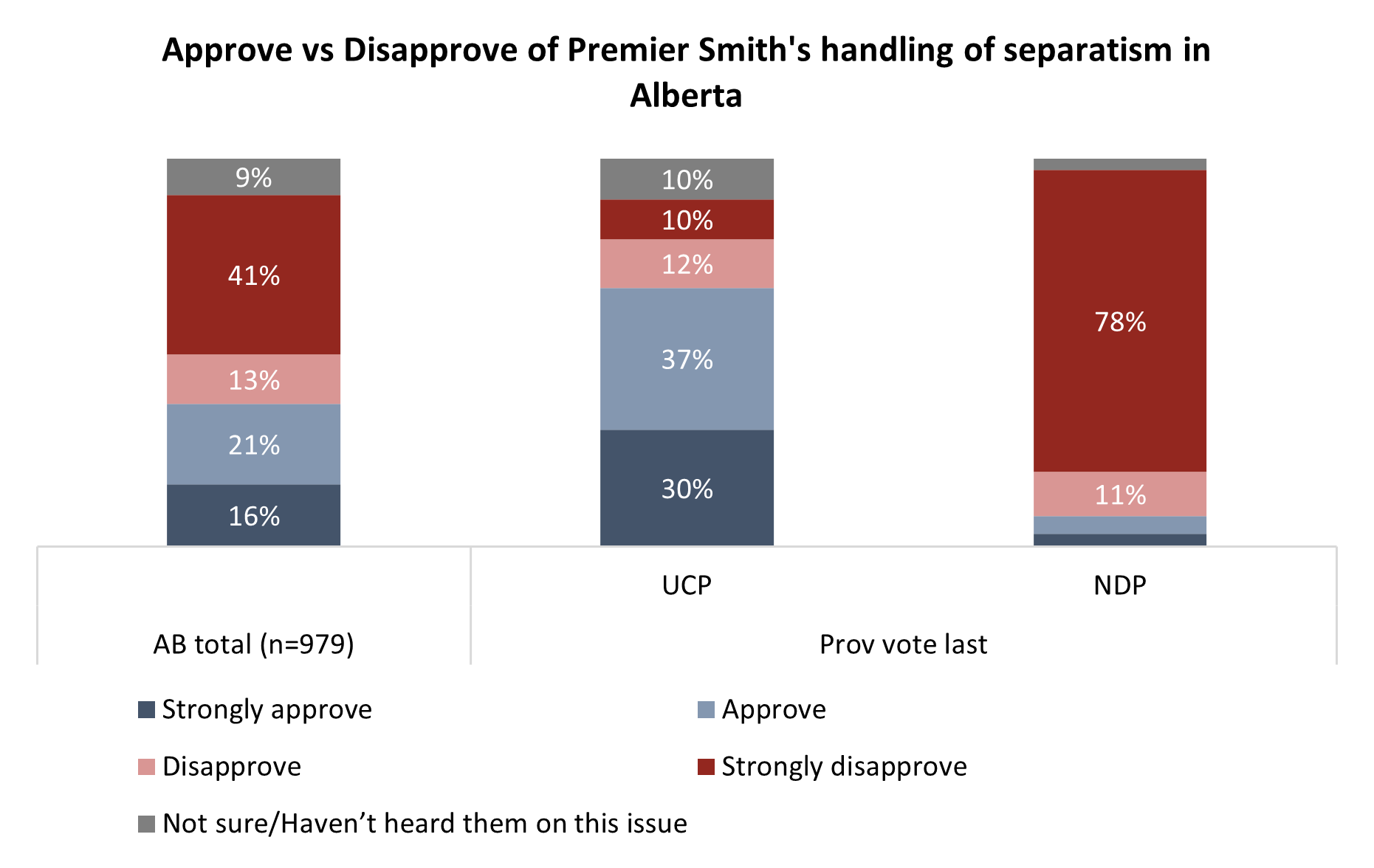
A majority (54%) of Albertans disapprove of how Premier Danielle Smith has handled the issue of separatism in Alberta. More than two-in-five (44%) approve of how Prime Minister Mark Carney has approached it.
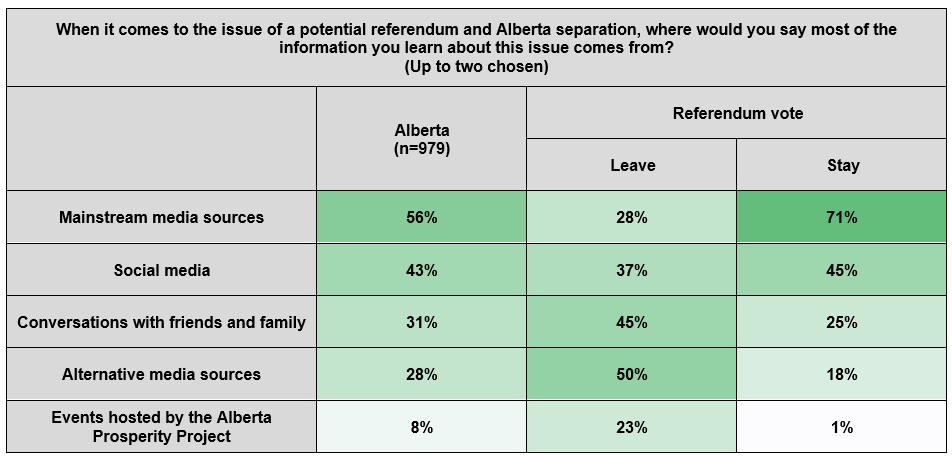
The “leave” and “stay” voters are apparently occupying completely different information environments. The top sources of information about separatism for those who would vote stay are mainstream media (71%) and social media (45%). Those who would vote leave are getting their information from alternative media sources (50%) and conversations with friends and family (45%).
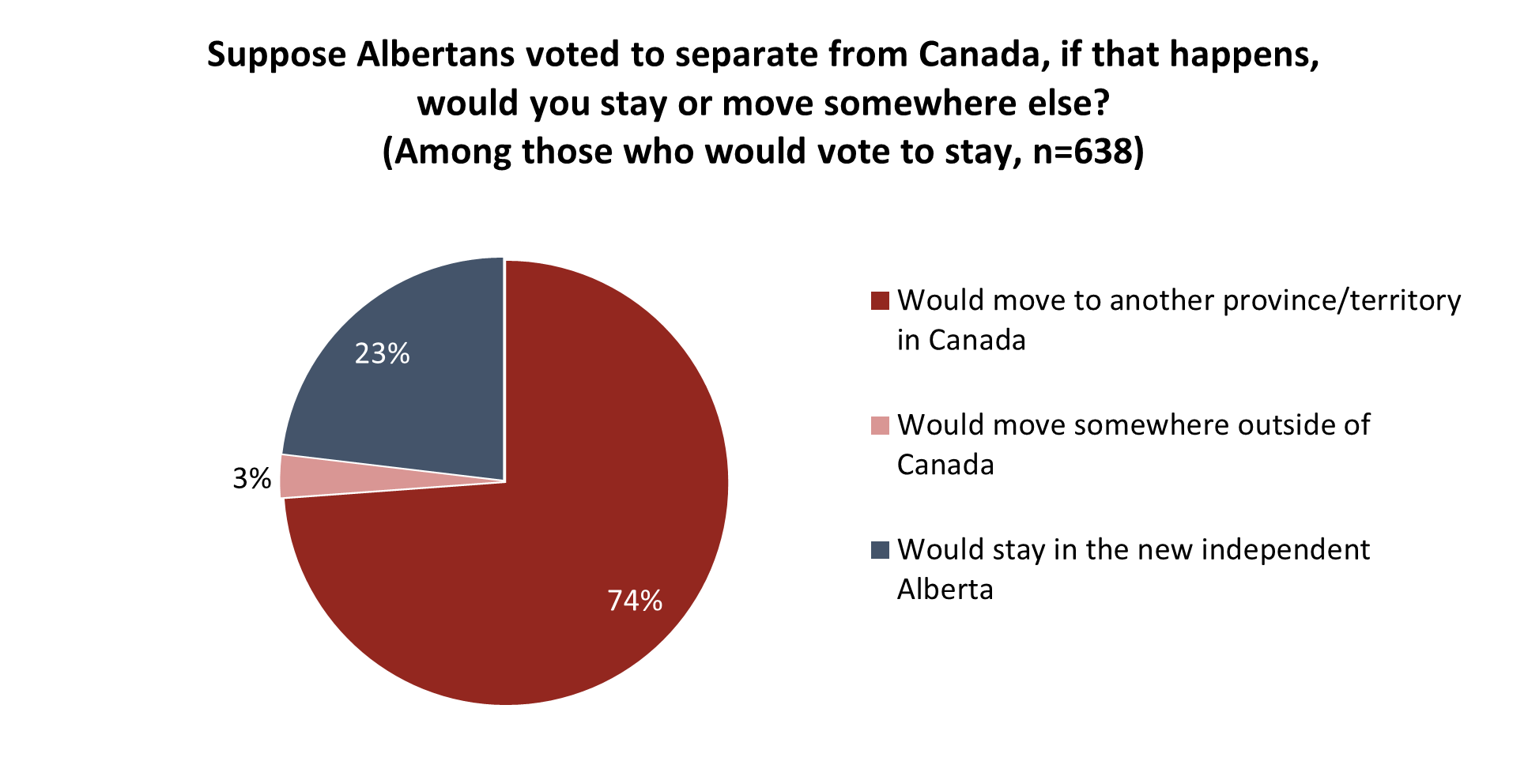
Three-quarters (74%) of “stay” voters say they would leave Alberta and move elsewhere in Canada if Alberta separated. Fewer than a quarter (23%) say they would stay in a newly independent Alberta.
INDEX
Part One: Lay of the land
Who’s following and where are they getting their information?
Just one-in-10 would ‘definitely’ vote to leave
But a plurality of UCP voters ‘lean’ that way
On this issue, Carney receives most approval, Smith most disapproval
Part Two: Separation debates
Which arguments are convincing?
For the Stay Group…
For the Leave Group…
Part Three: What if?
If Alberta did separate, many say they would move
Most expect U.S. would pressure AB to join them
Little appetite among Albertans to become American
Part One: Lay of the land
Frustration over federal energy and environmental policy, perceptions of economic imbalance, and a broader sense of alienation from Ottawa are not new sentiments in Alberta, but have bubbled up in recent months, giving rise to renewed discussion about whether the province’s interests are best served within Confederation or outside it. Against this backdrop, this release examines how many Albertans actually support the idea of leaving Canada, how firmly those views are held, and the underlying motivations and concerns shaping public opinion in the province today.
Who’s following and where are they getting their information?
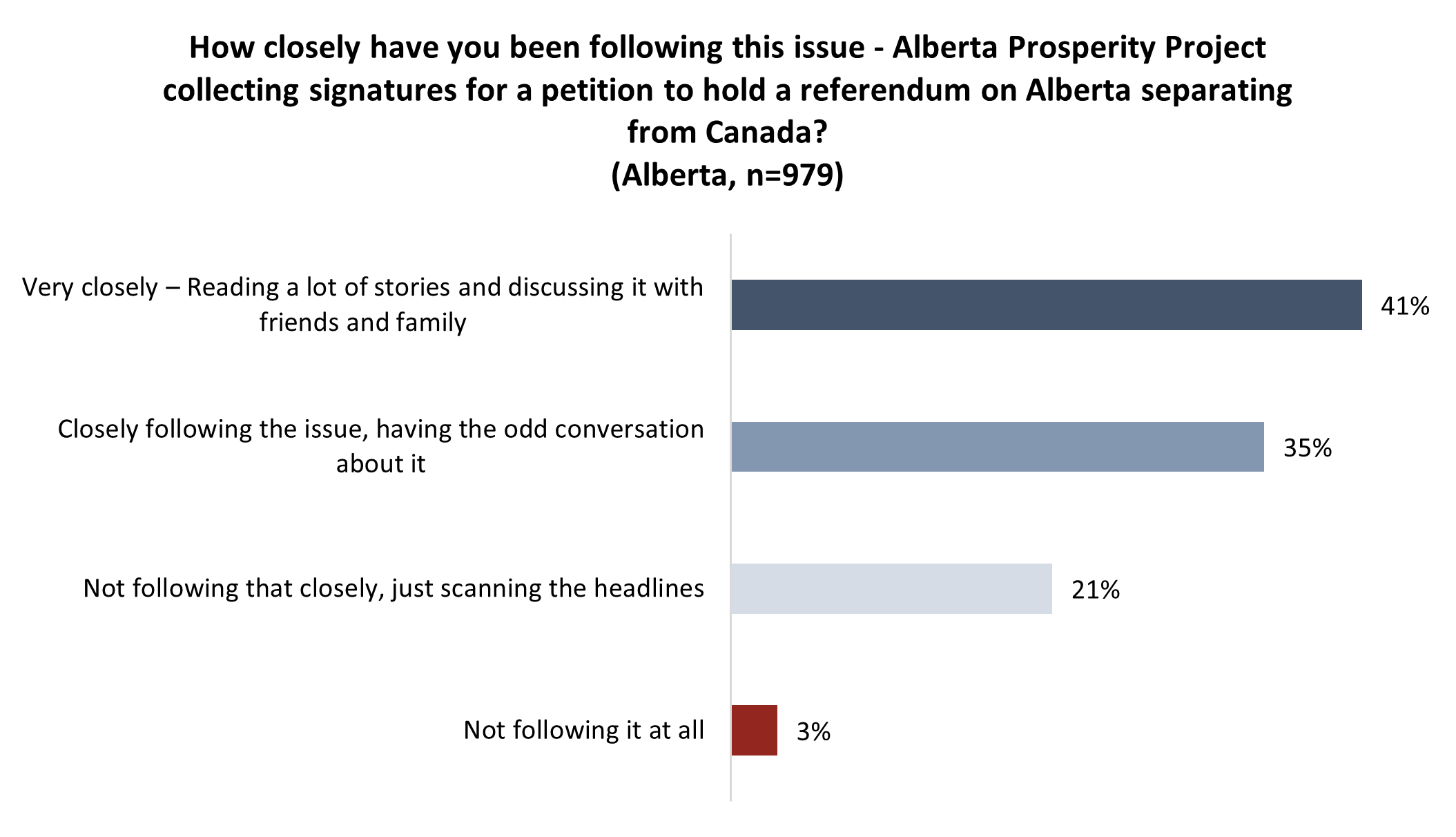
This issue is now ubiquitous in the public discourse, with three-quarters of Albertans (76%) saying they have been following news and events closely in recent months, and only three per cent saying they’ve heard nothing about it.
News and news sources, however, vary widely. Mainstream media remains the top choice for information, but this is only a vehicle used by a slight majority. Others rely on social media and alternative sources. Perhaps most notable here, are the divisions among stay supporters and leave supporters, for whom the media environments are hardly similar:
Just one-in-10 would ‘definitely’ vote to leave
On both sides of the debate, the conversation is no longer just theoretical. Groups advocating for Alberta to remain within Canada and those pushing for independence have begun to organize more formally, launching petitions, hosting town halls, and mobilizing supporters online and in person. Among the most prominent is the Alberta Prosperity Project, which has framed separation as a pathway to greater economic control and political autonomy. Members of the APP have met with United States federal government representatives in recent weeks, something B.C. Premier David Eby described as “treasonous.”
Despite the efforts of this group, still just one-in-10 Albertans (8%) say they would definitely vote to leave Canada if a referendum were held. There are many more people, however, in the “leaning” camp, who say they would certainly be inclined that way if this vote were to materialize (21%).
But a plurality of UCP voters ‘lean’ that way
Alberta Premier Danielle Smith has hesitated to distance herself from separation advocates. In fact, Smith’s government has eased the path toward a referendum by lowering the threshold for citizen-led referendums and expanding the petition period. While she has been criticized by both sides in the debate, her own party’s voters show significant support for leaving confederation. One-in-six (16%) UCP voters say they would definitely vote to leave, while another two-in-five (41%) lean this way. This highlights the political challenge Smith faces:
On this issue, Carney receives most approval, Smith most disapproval
Smith does face more criticism than others on this issue. The Angus Reid Institute asked Albertans about a number of leaders and whether or not they approved or disapproved of how each has handled the separation debate, with Smith receiving the most disapproval. Prime Minister Mark Carney, who has made a concerted effort to appeal to Albertans about the positive action that can be taken within Canada, receives the highest levels of approval:
Within her own party supporters, Smith faces disapproval from more than one-in-five in terms of her specific handling of separatism talk. Three-times as many approve of how she has navigated the issue:
Part Two: Separation debates
Which arguments are convincing?
With the players now defined, it is worth considering the common arguments in this debate. Notably, four-in-five say that their mind is mostly made up on this issue, but some are still weighing the talking points (see detailed tables).
For the Stay Group…
The appeal to those who would vote to stay is built largely on patriotism and practicality. Indeed, the top arguments that Albertans find “convincing” are that they they’re Canadians, and they don’t want that to change, and that Alberta would be landlocked without coastal access as an independent nation.
There are, however, a few points made by the “leave” side that this group finds compelling. The idea that Alberta gives more than it gets as a part of Canada, the potential for greater resource development, freedom from federal regulation, and immigration control, are all convincing to a majority of those who lean toward staying, but are not definite.
For the Leave Group…
What about those who want to leave, or those who lean that way? Those who lean toward wanting to leave are amenable to all of the arguments made by that side to a near-unanimous level and few are moved by arguments to stay. Approximately one-in-six (15%) do agree that there could be risks to their own financial wellbeing if Alberta separated, and that Alberta’s financial stability could be jeopardized.
Part Three: What if?
If Alberta did separate, many say they would move
Consider the thought experiment where Albertans do vote to leave. Negotiations with the federal government and First Nations would then begin to sort out myriad legal issues and constitutional amendment. In the meantime, Alberta would risk losing a significant portion of its population. Of the two-thirds who say they would vote in a referendum to stay, the vast majority say they would not live in an independent Alberta. Three-quarters say they would move to another part of Canada, while a handful would move elsewhere. Just one-quarter (23%) say they would stay after separation:
Most expect U.S. would pressure AB to join them
As detailed above, many who are on the “stay” side say that a convincing reason to vote stay is because of the threat of an independent Alberta’s annexation by the United States. The Alberta Prosperity Project, who have been gathering signatures for the separation referendum, has met with U.S. officials and have approached the U.S. about the possibility of a line of credit to help bankroll the new independent Alberta should the referendum be successful. U.S. Treasury Secretary Scott Bessent has suggested the U.S. would work with a separated Alberta, saying he thinks “we should let them come down into the U.S.”
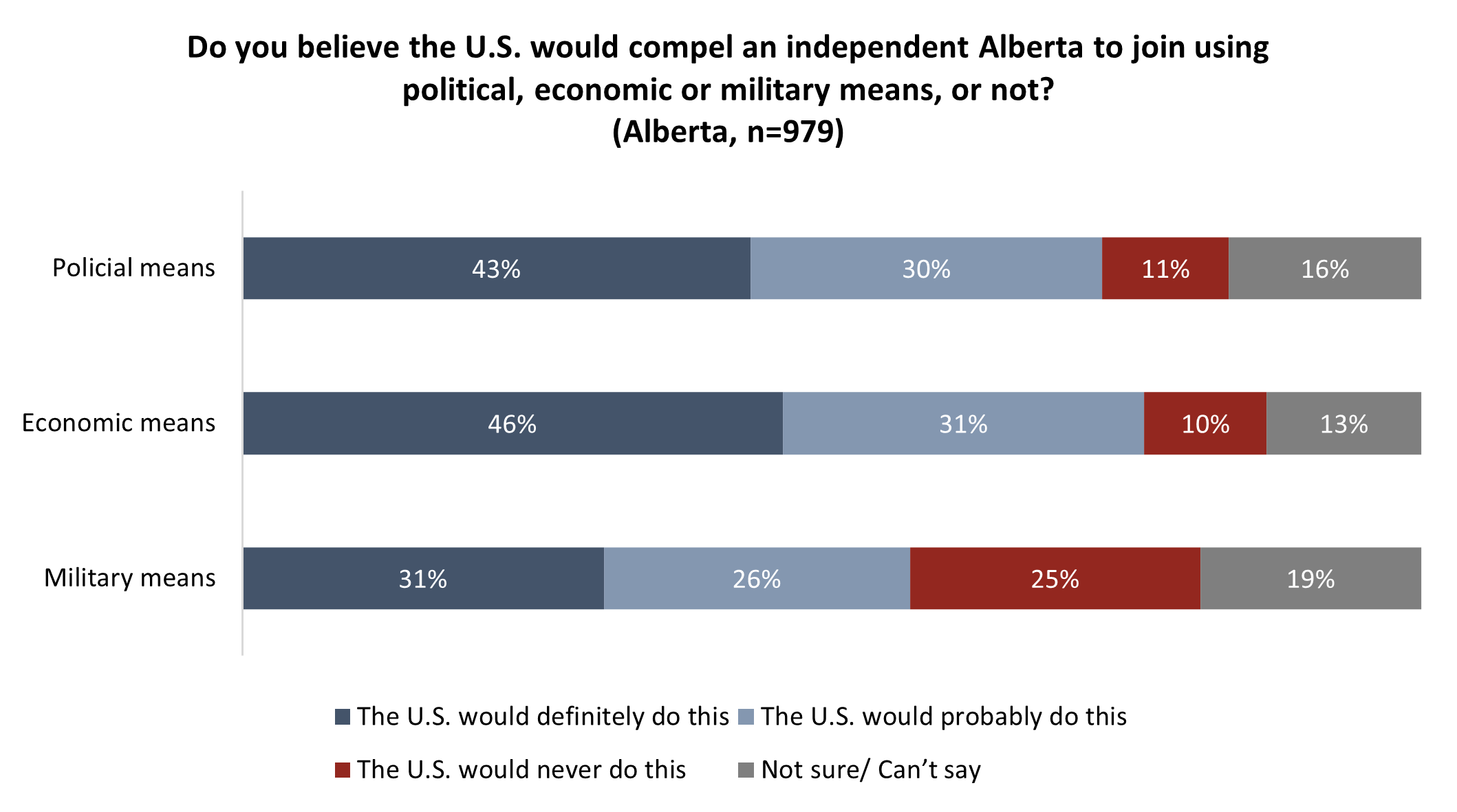
Most Albertans believe that the U.S. would definitely or probably compel Alberta to join by political means (73%), economic means (77%) or even military means (57%), though more are uncertain about the latter:
Little appetite among Albertans to become American
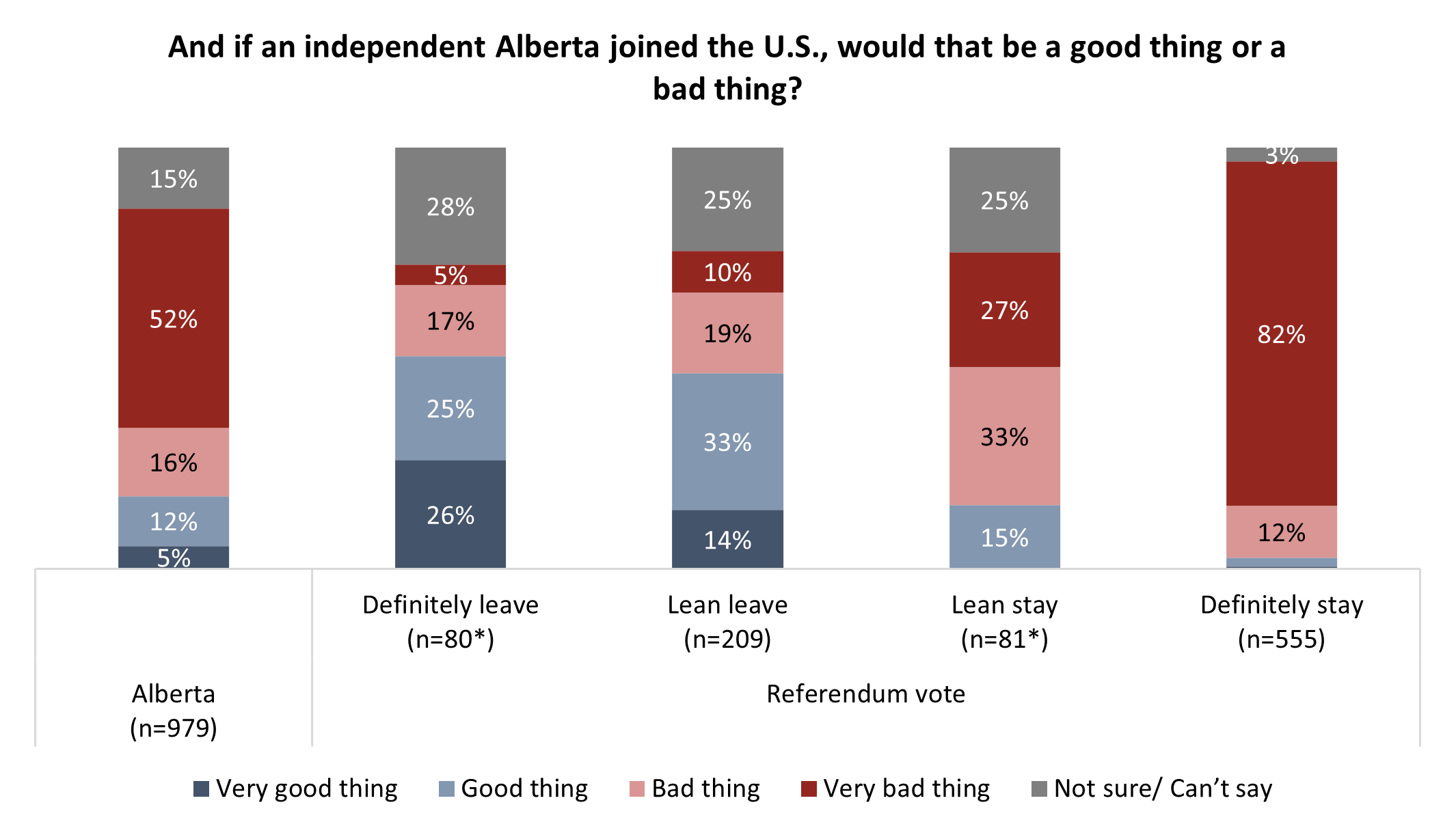
Taking the thought experiment to its natural conclusion, respondents were asked if an independent Alberta joined the U.S. whether it would be a good thing or a bad thing. Those on the “stay” side of a potential referendum are strongly of the belief that it would be a bad thing. Those on the “leave” side are more likely to see positives out of a potential joining between Alberta and the U.S.:
*Smaller sample size, interpret with caution
METHODOLOGY
The Angus Reid Institute conducted an online survey from Feb. 2-6, 2026, among a randomized sample of 979 Canadian adults who live in Alberta. Respondents are drawn from the Angus Reid Forum, a large-scale online panel developed to include Canadian residents in each of the 343 federal ridings in Canada and representative of the Canadian population by age, gender, family income, ethnic status and education. The sample was weighted to be representative of adults nationwide according to region, gender, age, household income, and education, based on the Canadian census. For comparison purposes only, a probability sample of this size would carry a margin of error of +/- 3 percentage points, 19 times out of 20. Discrepancies in or between totals are due to rounding. The survey was self-commissioned and paid for by ARI. Detailed tables are found at the end of this release.
For detailed results by age, gender, region, education, and other demographics, click here.
For PDF of full release, click here.
MEDIA CONTACT:
Shachi Kurl, President: 604.908.1693 shachi.kurl@angusreid.org @shachikurl
Dave Korzinski, Research Director: 250.899.0821 dave.korzinski@angusreid.org