
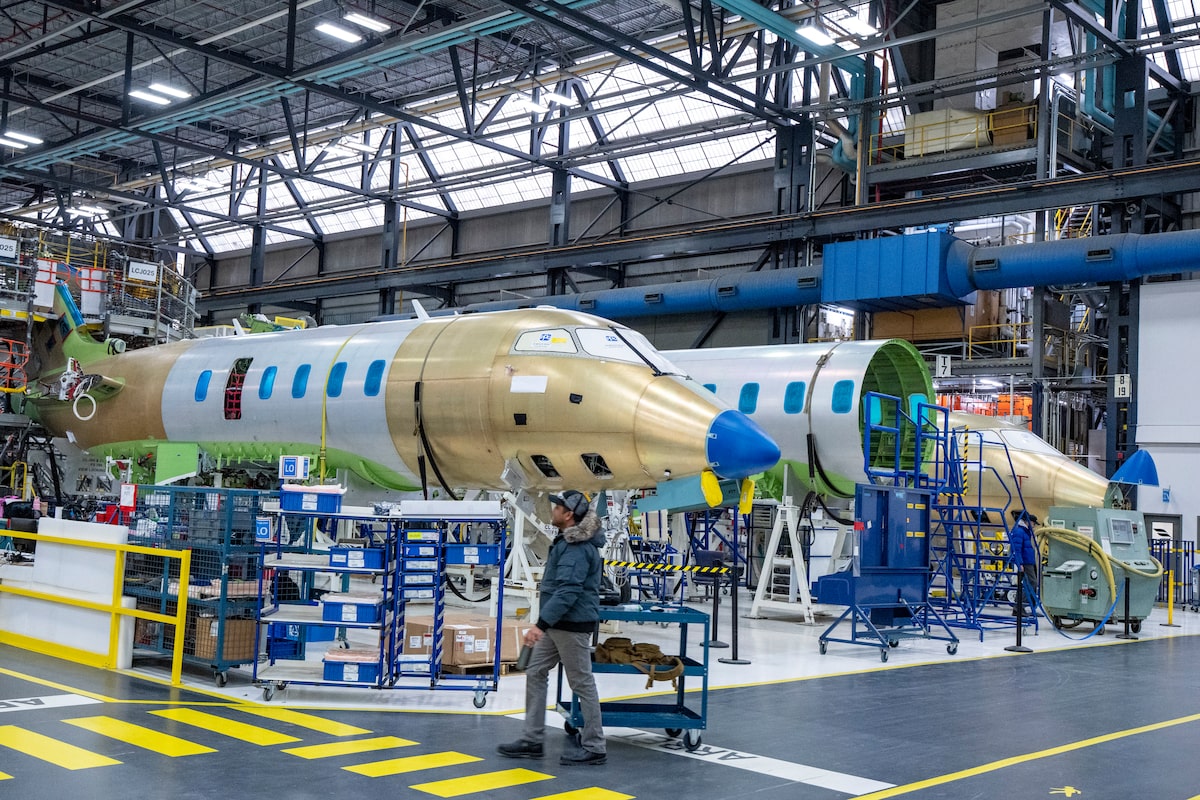
Bombardier’s Challenger jet manufacturing facility in Dorval, Que. The Canadian jet maker will acquire U.S.-based Velocity’s hangar and fleet of mobile repair trucks.Christinne Muschi/The Canadian Press
Bombardier Inc. BBD-B-T has struck a deal to buy jet service provider Velocity Maintenance Solutions, expanding its footprint in the United States despite threats from the White House that would cripple its business south of the border if they materialized.
The Canadian maker of private jets said Monday it will buy Velocity, which has a 35,000 square-foot hangar in Wilmington, Del., as well as a fleet of 14 mobile repair trucks across the United States. No purchase price was disclosed, suggesting it is not a material transaction.
Bombardier chief executive Éric Martel hatched a five-year blueprint for recovery in 2021 that hinged on cementing the company’s global share of new aircraft sales, cutting costs, paying down debt and dramatically increasing its aircraft service capability. Bombardier tallied revenue of US$590-million from its services business in its most recent quarter, about 26 per cent of its total revenue of US$2.3-billion.
The progress achieved so far has opened talks internally about merger and acquisition opportunities, including building out the company’s network of service centres by buying tooling, hangars or maintenance operators. In 2021, for example, Bombardier gained full ownership of an aircraft service centre in Berlin by buying shares from Lufthansa Technik and ExecuJet Aviation.
Recent comments from U.S. President Donald Trump threaten to undermine Bombardier’s business prospects, however. The president startled Canada’s aerospace industry last month with a social-media post saying the United States is decertifying Bombardier’s Global Express jets and “all Aircraft made in Canada” until Canada approves the new business jets made by Savannah, Ga.-based Gulfstream.
He said Canada has “wrongfully, illegally and steadfastly refused” to certify four Gulfstream jet models, and he threatened a 50-per-cent import tariff on Canadian aircraft sold into the U.S. if the situation was not immediately addressed. Gulfstream is Bombardier’s main rival.
The declaration sparked alarm and confusion among aviation sector leaders in both Canada and the U.S., with some commentators saying Mr. Trump was using his power to undermine the safety functions of regulators. The President has no authority to arbitrarily decertify aircraft, aerospace experts have said.
Bryan Bedford, a Trump nominee who now heads the Federal Aviation Administration as its chief administrator, has declined to say whether the agency would pull the certifications for planes made in Canada, which include Bombardier Global and Challenger business jets as well as Airbus SA’s A220 and De Havilland turboprops. No tariffs on Canadian aircraft have been implemented.
Steven MacKinnon, Canada’s Transport Minister, has said he has been in touch with “a number of people” on the issue but cautioned he does not interfere with Transport Canada’s aircraft certification process.
“We’re communicating with both of the manufacturers and all the people in the industry to make sure that everyone understands the timeline,” Mr. MacKinnon told reporters in Ottawa last week. “To the extent that any ambiguities or misunderstandings may have existed, I think they’ve been dissipated,” he said.
Bombardier reports financial results for its fourth quarter on Thursday.
The plane maker announced plans last August to launch a major expansion of the jet services business across multiple U.S. states over the coming years, starting with a new service point in Fort Wayne, Ind. The unit already has a significant presence in the U.S., anchored by service centres in Dallas, Tucson, Hartford, Wichita, and Miami.