
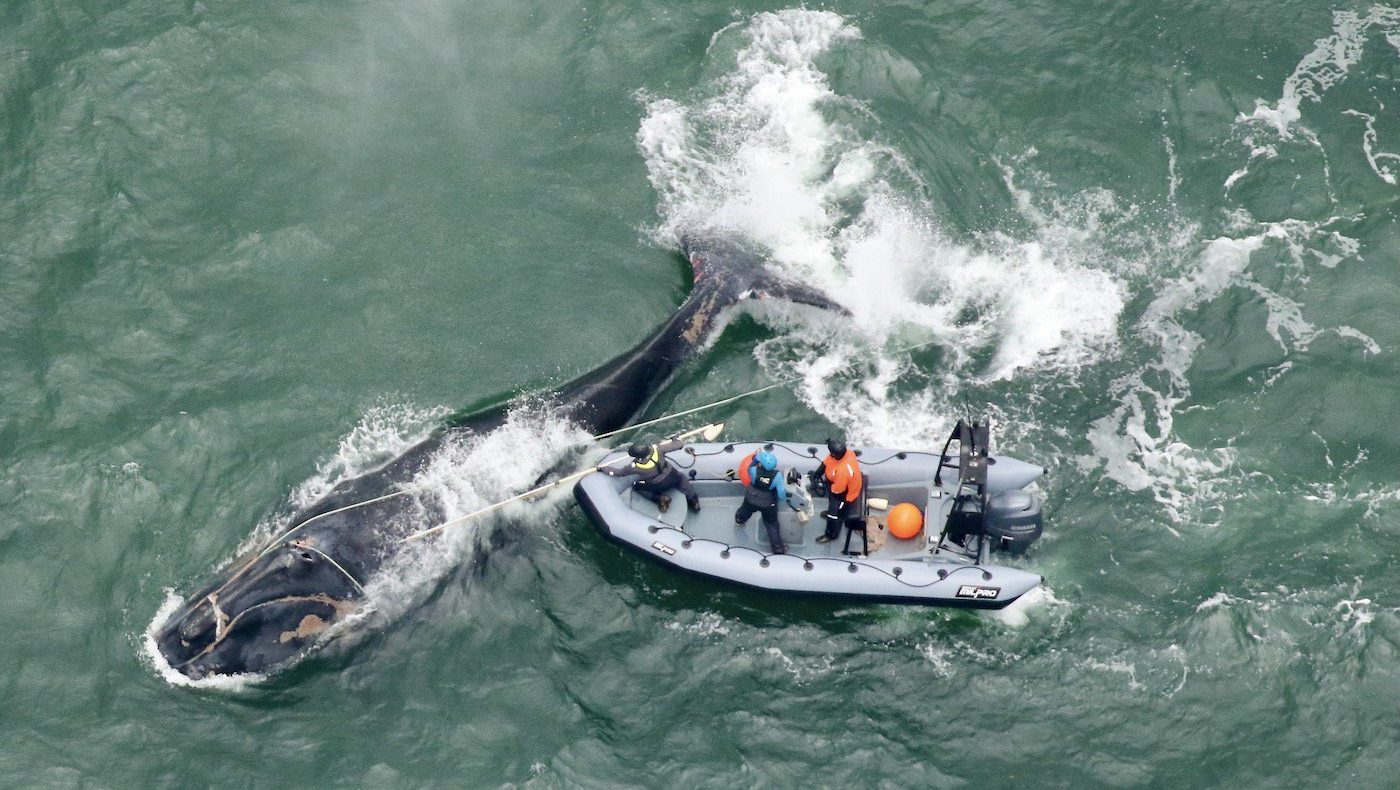
Canada has rolled out its overdue whale-safe fishing gear strategy days after an endangered North Atlantic right whale, known as Division, died from entanglement after more than a month of suffering.
The four-year old male, which had been spotted in Canadian waters during the summer, was next sighted off the Georgia coast in early December severely ensnared by fishing lines cutting across his head and blowhole. Rescue crews were able to remove some of the gear and continued efforts to track and intercept the whale — but its health continued to decline before being confirmed dead on Jan. 27.
Division’s death underscores the urgency and need for the federal government’s strategy released Tuesday, said Hanna Vatcher, North Atlantic right whale campaigner at Oceana Canada.
“It’s always really sad to see a death in a critically endangered population,” Vatcher said.
“It’s definitely a stark reminder for all of us that human activities are still a persistent threat to the species.”
Canada’s new strategy, originally slated to be released in the spring of 2025, was spurred by vulnerable right whales, she said, but entanglement is a top threat — along with vessel strikes — for all large baleen whales on Canada’s coasts, including humpbacks, minke, blue and fin whales.
North Atlantic right whales that frequent the east coast of both Canada and the US are vulnerable to extinction with a population of approximately 380 individuals, which includes only 70 reproductive females.
Canada’s gear strategy is a five-year plan to develop more sustainable fisheries that can reduce the threat to whale populations through the use of new and innovative equipment, such as on-demand “ropeless” gear, as well as other tools to reduce the threats whales face. A primary cause of entanglement are the long, vertical lines running from the ocean’s surface to the seabed, where they are attached to other gear like crab, lobster or prawn traps.
At first glance, the plan appears to be a “really great strategy” and “great next step,” Vatcher said.
The strategy is a five-year plan to identify the highest-risk fisheries and pilot and implement the use of whale-safe gear when endangered right whales and other vulnerable species are concentrated in the same area, she said. That way, commercial fish harvesters can continue fishing despite the presence of whales rather than facing closures.
“That doesn’t mean we want to see it implemented in all fisheries everywhere, because that just wouldn’t be practical,” she said.
Given there are still some data gaps and technical details to be ironed out with different gear and fisheries, Vatcher said the five-year timeline to put the strategy in place is reasonable.
Whale-safe gear strategy concerns and caveats
The strategy is more than a year late already. That’s giving Vatcher reason for concern over whether Fisheries and Oceans Canada (DFO) will adhere to that timeline.
Additionally, she’s worried DFO will get locked into an experimental stage rather than actually implementing the use of whale-safe gear for fisheries.
The department isn’t starting from scratch. There have been gear testing programs on the East Coast in both Canada and the United States for seven years, she said. “I think we’ve just sort of been stuck in a pilot phase with it for many years. Now it needs to go a step further,” Vatcher said.
The federal government’s release of the strategy doesn’t suggest there is any funding for the plan, Vatcher noted. That’s a concern, she said, pointing out the gear is “very expensive.”
“There has to be funding and incentives from the government for fishers to adopt it and to be able to afford it,” she said.
The last federal budget entails cuts of up to $450 million to DFO over the next four years.
“We’re also seeing some cutbacks to how many hours of surveillance are being dedicated to finding right whales,” Vatcher said.
Staff and monitoring cuts increase the risk for the endangered whales as it weakens efforts to detect the whales and trigger protection measures like fisheries closures or vessel slowdowns, she said.
DFO: market forces encourage gear uptake
Funding was provided in the past for existing gear programs still underway and “market forces” are driving the uptake of gear, said Brett Gilchrist, DFO’s director of national programs. But he declined to provide any further information on whether the department would provide funding for the strategy or to increase the uptake of the newer, safer gear.
Canadian crab and lobster fisheries — for example, the snow crab fishery in the Gulf of St Lawrence — are adopting whale-safe gear to access the massive US market — which under the Marine Mammal Protection Act (MMPA) bans seafood caught with gear that injure marine mammals, particularly the North Atlantic right whale.
“Fish harvesters can’t really wait for DFO to figure out the path forward. They needed to chip away at this, and they’ve established some of these pilots in years past,” Gilchrist said.
“They need to deliver this so that they can export their products and meet eco-certifications.”
Beyond piloting alternative gear, DFO has introduced gear marking requirements for fisheries to track what gear and locations are causing the most harm to whales, as well as seasonal or flexible fishery closures triggered when right whales are present.
The North Atlantic right whale population has been in an emergency situation since 2017, but it has stabilized somewhat, and encouragingly, 22 new calves have been born this year, Gilchrist noted.
Some key milestones in the strategy’s five-year timeline are the completion of an entanglement risk assessment for North Atlantic right whales by 2027. The following year, whale-safe gear will be required in some key fisheries while risk assessments will start for other whale species.
By 2030, a network of fishing areas will be required to employ the gear and reviews of the strategy will take place to make improvements, he said.
It won’t “disappear” after five years, but aims to establish a permanent path forward that allows fisheries and whales to co-exist, Gilchrist said.
The strategy is really figuring out what tool will work safely in different fisheries, but the expectation is that protections are in place after five years, he added.
He said the goal is to find a balance for the industry that doesn’t compromise harvesters’ ability to catch fish too much.
“It can’t bankrupt them and lastly, obviously, it needs to protect whales.”
Rochelle Baker / Local Journalism Initiative / Canada’s National Observer