
The future of Eddie Bauer’s Canadian stores is hinging on whether the company can find a buyer.
The apparel retailer announced Monday that it is looking to sell the 220 stores it has across Canada and the U.S. after filing for bankruptcy protection south of the border. It said a similar filing was impending in Canada, where its website listed 31 stores, predominantly in Ontario.
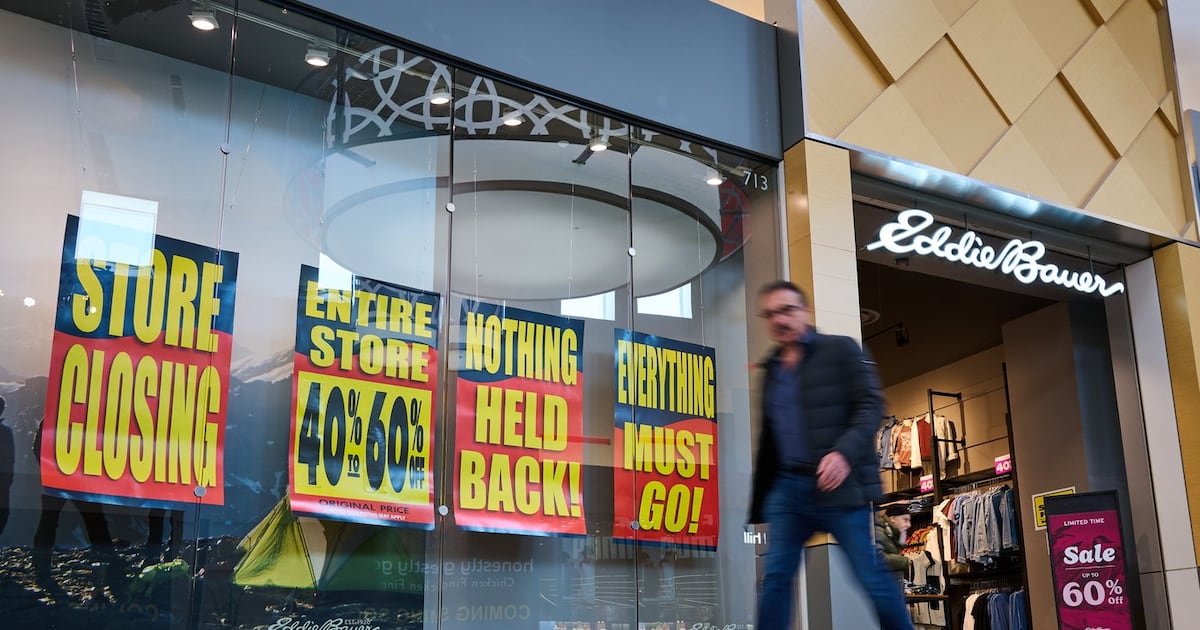
Eddie Bauer LLC said locations on both sides of the border will remain open, but host liquidation sales as the court processes get underway and the company seeks a potential buyer.
If the 106-year-old retailer can’t find someone to purchase the business, its owner Catalyst Brands will begin a wind down of Eddie Bauer’s Canadian and U.S. operations.
Catalyst Brands was formed last year through a merger between U.S. department store JCPenney and SPARC Group, a retail holding company that acquired the Eddie Bauer brand in May 2021.
Before Catalyst Brands was conceived, CEO Marc Rosen said Monday that Eddie Bauer was already “in a challenged situation, with declining sales, supply chain challenges and other issues.”
“Over the past year, these challenges have been exacerbated by various headwinds, including increased costs of doing business due to inflation, ongoing tariff uncertainty, and other factors,” he said in a news release.
“While the leadership team at Catalyst was able to make significant strides in the brand, including rapid improvements in product development and marketing, those changes could not be implemented fast enough to fully address the challenges created over several years.”
The retailer was founded in 1920 by Eddie Bauer, a Seattle native who grew up hunting and fishing in the Pacific Northwest and wanted to develop a place for people to congregate and buy gear they’d use for outdoor pastimes.
It blossomed when the first American to climb Mount Everest accomplished the feat in Eddie Bauer apparel and when the company outfitted the country’s military with down jackets and sleeping bags.
Its more recent history, however, has been one of struggles. It has filed for creditor protection twice before and while it has rebounded under new ownership several times, it has not been able to garner the same appeal as hit brands like Patagonia and The North Face.
“From a consumer perspective, it is nowhere near as exciting as some of the fast-growing players like Fjallraven and Arc’teryx. And for many younger shoppers, the brand is seen as somewhat old-fashioned and a bit irrelevant,” Neil Saunders, managing director and retail analyst at market research firm GlobalData, said in an statement last week.
“There are also issues with quality deteriorating, which, for an outdoor brand measured by the performance of its products, is very problematic.”
Saunders feels these issues have depleted sales and thus, profitability of stores.
While the company has tried to turn things around by giving some locations a revamp, he said many of the older stores “are a bit of a jumble of product without sufficient emphasis on things like education and storytelling — both of which customers want in the outdoor products category.”
In Canada, Eddie Bauer has a much more limited footprint than in the U.S. Aside from the 15 stores it has in Ontario, Eddie Bauer has six each in Alberta and B.C. and one each in Manitoba, New Brunswick, Nova Scotia and Saskatchewan.
Some started marking down inventory by up to 60 per cent last week.
In U.S. court documents filed Monday, the company said a legal proceeding it will soon launch in Canada will aim to protect Eddie Bauer’s assets in the country and ensure any sale agreement will be enforceable on both sides of the border.
Eddie Bauer’s stores outside of the U.S. and Canada are run by other licensees, are not included in the bankruptcy filings and will continue operating.
Its e-commerce and wholesale operations are also not impacted by the filings because they are owned by Authentic Brands Group subsidiary Outdoor 5, which can keep licensing the Eddie Bauer name to manufacturers.
This report by The Canadian Press was first published Feb. 9, 2026
Tara Deschamps, The Canadian Press