
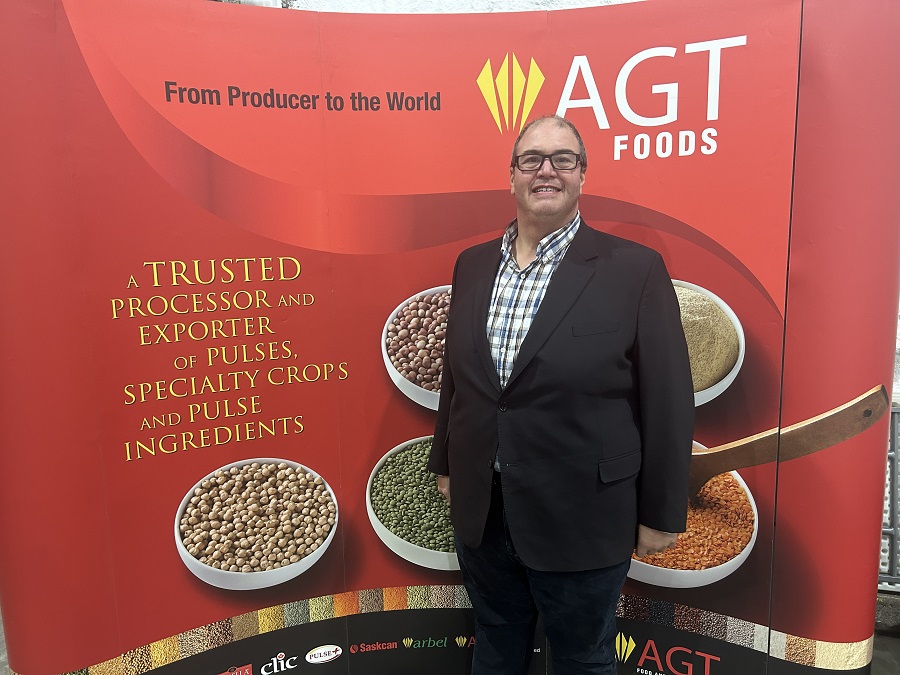
As global food demand surges and climate pressures reshape agricultural production, Canada is emerging as a critical supplier in the decades ahead.
Murad Al-Katib, President and CEO of AGT Food and Ingredients says the world is entering an era where stable, reliable growing regions will define global food security, and Canada is poised to lead.
“The Southern Hemisphere is going to continue to be very affected by climate change. So droughts are more prevalent, populations in the emerging markets are growing. We’re going to have 10 billion people by 2050.”
He pointed to a striking statistic from the UN’s Food and Agriculture Organization: “In the next 40 years, the world has to produce the same amount of food that we produced in the last 10,000 years of civilization.”
Canada’s Role as a Reliable Production Region
Despite drought-prone conditions in parts of the Prairies, Canada remains a remarkably consistent producer on the world stage.
“A drought in Canada isn’t the same as a drought around the world. We are a reliable production region,” Al-Katib said. “In 2025, we produced 85 million tons in Canada for the first time in the history of this country.”
He argues that Canada has become a “societal solution” to rising food prices and increased global protein demand.
“Northern Hemisphere countries like Canada are going to punch above their weight geopolitically in the world. The agricultural renaissance is here… and it’s going to pay for generations to come.”
Global Trade, U.S. Tariffs, and Canada’s Strategic Future
Al-Katib said Canadian exporters should prepare for a long-term world where tariffs are a constant reality.
“Tariffs are a new market reality.” Tariffs are not going to go away in the near term.
He expects future renegotiation of the Canada-U.S.-Mexico Agreement (CUSMA), but does not foresee a return to full tariffs
“I’m an optimist that the U.S.-Canada side will get a deal. We are economically interdependent – 31 U.S. states have us as their largest trading partner.”
He also highlighted new and emerging opportunities in Asia and Latin America.
“Japan, Korea, Indonesia, Thailand, Malaysia, Vietnam, the Philippines – these are all important markets with tremendous runway for us to increase exports.”
Canada’s Growing Role
Al-Katib says Canada should focus on expanding growth worldwide, not replacing partners.
“We shouldn’t have the mentality that we’re trading less with the U.S., but that we’re trading more of our growth with other nations.”
He sees a future where Canada plays a central role in a more integrated North-South trading corridor across the Americas.
“Nations like Argentina, Brazil, Peru, Colombia hold great promise for exports from Canada. Building a North-South corridor to complement our East-West trade is an important part of the prosperity agenda for Canada.”
Concerns Over Federal Research Cuts
When asked about recent federal budget pressures and reductions in agricultural research spending, Al-Katib says now is the time to double down on research, not cut.
He noted that Canadian producers have long been leaders in soil conservation and sustainable practices ” long before the term ‘regenerative agriculture’ entered the global vocabulary. Southwest Saskatchewan and Canadian producers have been practicing regenerative agriculture my entire life – zero till, minimum till, soil conservation, rotational farming”.
A Quarter Century of Global Growth – Rooted in Saskatchewan
As AGT Foods marks its 25th anniversary, Al-Katib reflected on the company’s beginnings.
“I started in the basement of my house” with a vision of building a company that could take pulses from producer to the world.
Today, AGT has 4,500 employees and $3 billion in revenue, but remains headquartered in Saskatchewan.
“I’m still here, still proud to be in Saskatchewan.”
Murad Al-Katib was the keynote speaker for the Swift Current Chamber of Commerce Agriculture Appreciation Night.