
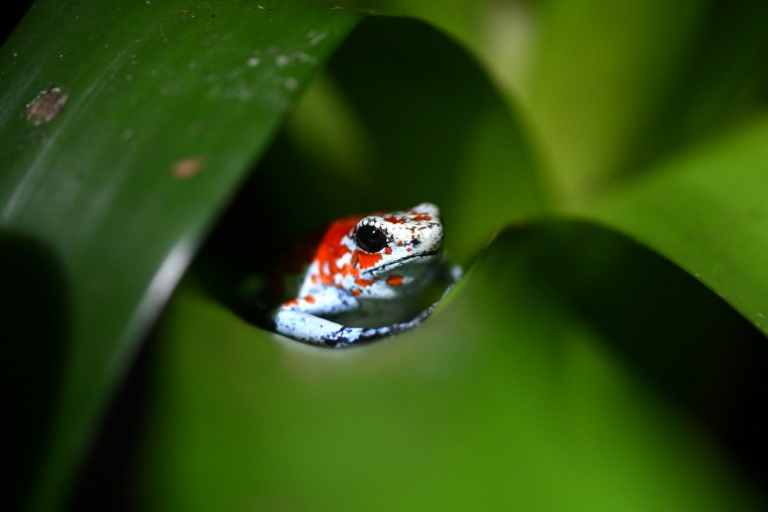
A harlequin poison dart frog (Oophaga sylvatica) is pictured at the Tesoros de Colombia (Treasures of Colombia) sustainable farm in Nocaima, Cundinamarca department, Colombia, on July 9, 2024. Hundreds of exotic frogs are bred in a sustainable farm to then be sold to foreign collectors as a “practical solution” against their illegal trafficking. – Copyright AFP/File Jean-Christophe VERHAEGEN
New research from the University of St Andrews (Scotland) has discovered an important piece in the puzzle of how all vertebrate animals (with a spine) – including all mammals, fish, reptiles and amphibians – evolved.
Here, the researchers found an intriguing pattern of gene evolution which appears to be significant for the origin and diversification of vertebrates.
Signalling pathways
All animals have major signalling pathways that their cells use to communicate with each other, which control things like how their embryos and organs develop. These signalling pathways are fundamental to animal development and are major targets in disease-causing mutations and for the development of pharmaceuticals. Proteins at the base of these signalling pathways are key as they control the final output from them, like a traffic system, directing cells into specific responses and gene expression.
Gene sequencing
The researchers created new gene sequencing data in sea squirts, a lamprey and a type of frog. Through the analysis, they found the genes that make these signalling output proteins have evolved in a distinctive way.
The sea squirt is an invertebrate that helped to distinguish the change when moving from invertebrates to vertebrates.
Lampreys are an early branch in the vertebrate group, which pinpoints that this change happened at the invertebrate-to-vertebrate transition.
Frogs will be well known to readers: Carnivorous amphibians characterised by smooth, moist skin, long hind legs for leaping, and a reliance on damp habitats. They are crucial to ecosystems, feeding on invertebrates like snails and worms.
Researchers used long-molecule DNA sequencing, which allowed them to distinguish the different transcripts from each gene. Long-molecule sequencing had never been done on the genes expressed in these particular animals before. Therefore, researchers were able to characterise the real range of the transcripts and proteins produced from these genes in vertebrate development for the first time ever.
Unlike the invertebrate sea squirt, the lamprey and frog made higher numbers of different forms of proteins from the individual signalling output genes, compared to all sorts of other types of genes.
This significant change with the evolution of vertebrates is very striking. Given the importance of these pathways in how animals decide what types of cells, tissues and organs to make, it is highly likely these proteins have had a major role in making vertebrates (animals with backbones) different and more complex than invertebrates.
The researchers were surprised how a small selection of very particular genes stood out in the way that they are behaving compared to any other sort of gene examined. These diverse protein variations not only shed light on the origins of how humans, and most other animals with backbones, have evolved.
The research will also be important for understanding how these proteins and pathways could be manipulated in disease management.
The findings appear in the journal BMC Biology. research paper is titled “Long read sequencing reveals increased isoform diversity in key transcription factor effectors of intercellular signalling at the invertebrate vertebrate transition.”