
NEED TO KNOW
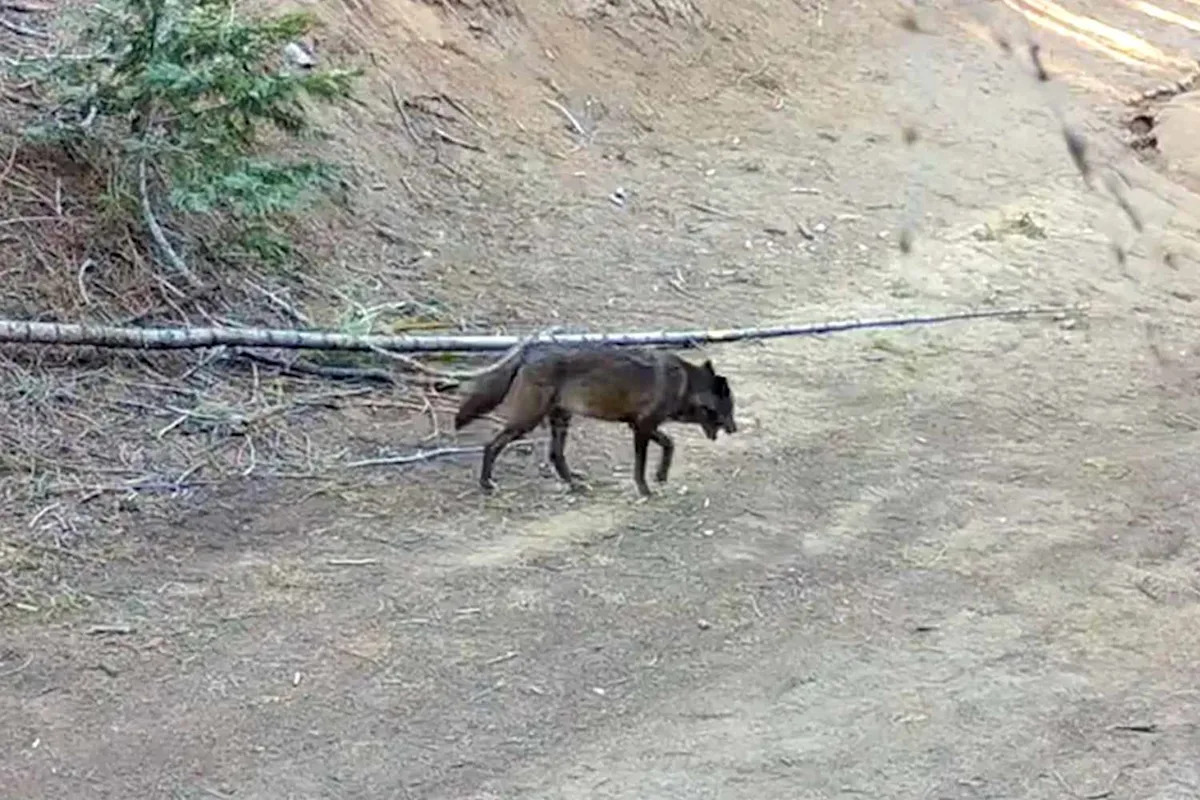
A female gray wolf was spotted in Los Angeles for the first time in over 100 years.
“The fact that she is still on the move is an indication that she has not found a mate and suitable habitat,” said Axel Hunnicutt, a gray wolf coordinator for the California Department of Fish and Wildlife
The species, eradicated from Southern California in the 1920s, is protected by the state’s Endangered Species Act and monitored by the Department of Fish and Wildlife
A wolf was spotted in Los Angeles County for the first time in over a century.
On Saturday, Feb. 7, a 3-year-old gray wolf — known as BEY03F, per her GPS collar — was documented just north of Santa Clarita, Axel Hunnicutt, a gray wolf coordinator for the California Department of Fish and Wildlife, confirmed to the Los Angeles Times.
The female animal was first tagged with a GPS collar last May while spending time with the Yowlumni Pack in Tulare County. But approximately a week ago, she began making her way south, trekking over 375 miles through the desert in Kern County toward Los Angeles County.
“Her journey isn’t over,” Hunnicutt told the outlet, noting that BEY03F is likely in search of a mate. “The fact that she is still on the move is an indication that she has not found a mate and suitable habitat.”
“The one thing that we do know is the more that she moves, the more that she has to encounter human infrastructure, and particularly highways,” he continued. “And we know that in California, the highest known cause of mortality for wolves is vehicle strikes.”
Never miss a story — sign up for PEOPLE’s free daily newsletter to stay up-to-date on the best of what PEOPLE has to offer, from celebrity news to compelling human interest stories.
Around a century ago, hunters and trappers eradicated the gray wolf population in Southern California. Before BEY03F’s L.A. sighting, the last documented wild wolf in the L.A. area was an animal shot in 1924, and the last gray wolf seen in all of Southern California was spotted in 2021 in Ventura County. It is now believed that at least 60 wolves call California their home, according to the Los Angeles Times.
“This signifies a historic moment in the return of wolves for California,” John Marchwick, a writer for the nonprofit California Wolf Watch, told the outlet about the recent sighting. He also noted that the Department of Fish and Wildlife‘s monitoring efforts and implementation of the state’s Endangered Species Act played a major role in allowing for “this individual’s dispersal to be documented, but also for it to be realistically feasible.”
According to the California Wolf Center, wolves serve an important role as a “keystone species,” meaning that their presence as a dominant predator is essential to maintaining balance in the food chain and establishing a healthy ecosystem rich in biodiversity.
“The wolf is a keystone species,” Yellowstone biologist Douglas Smith explained. “You remove it, and the effects cascade down to the grasses.”
Read the original article on People