
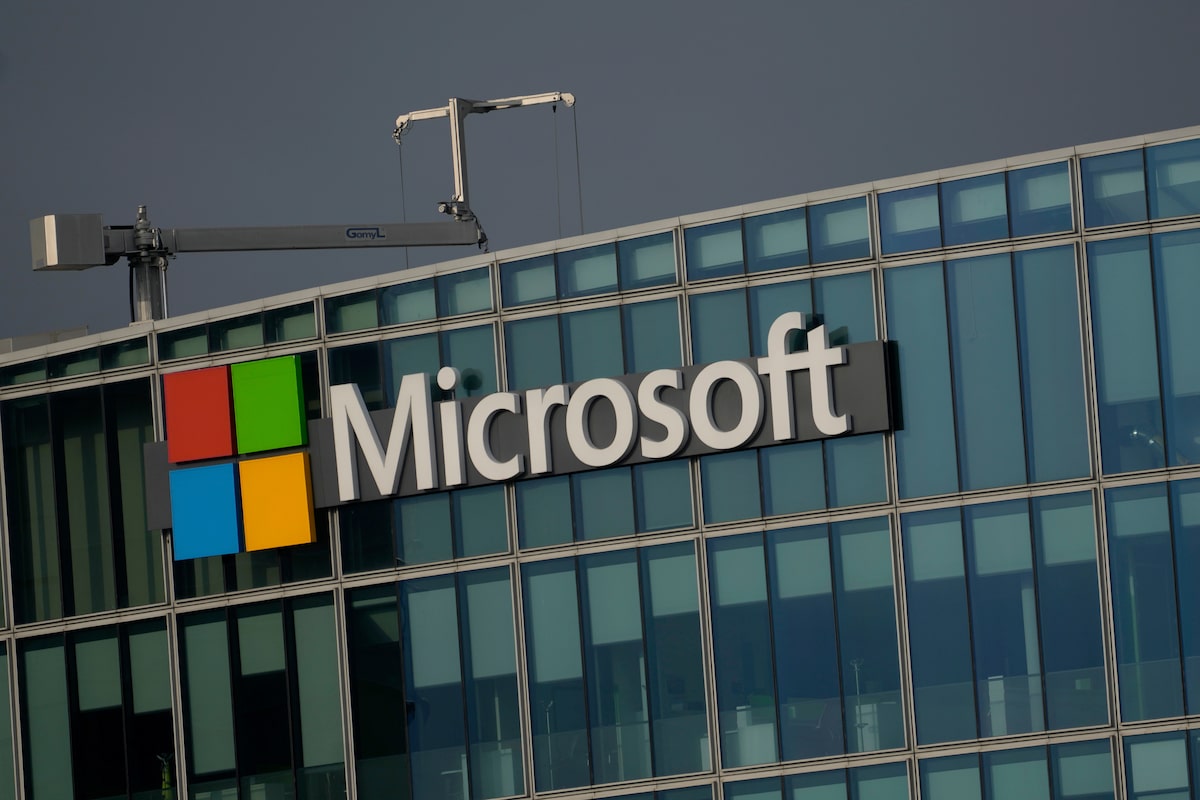
Microsoft’s French headquarters in Issy-les-Moulineaux, outside Paris in May, 2024.Thibault Camus/The Associated Press
The technology bubble hasn’t really popped. It’s just slowly losing air.
As of the close of trading on Feb. 6, the S&P 500 Information Technology Index was down 3 per cent year-to-date. That’s a slump, but it’s a long way from a correction (a drop of at least 10 per cent) and a longer way from a bear market (down 20 per cent or more). Yet some investors are reacting as if the tech crash of 2000-02 has risen from the grave and is about to devour our savings again.
I doubt that will happen, but if you’re overweight in tech you might want to consider doing some portfolio rebalancing. My view is that a bust on the level of the 2000 crash is unlikely because today’s tech giants are highly profitable and well-financed. We’re not dealing with concept startups.
There are several theories as to why tech stocks are selling off at this point. Profit-taking is almost certainly contributing. A lot of people have made huge gains from their investments in Apple, Alphabet, Amazon, and the like.
Then there’s artificial intelligence. Companies are making mind-boggling investments in AI with no assurance as to when, or even if, they’ll pay off financially.
Stocks advance as tech bounces further off of recent losses
This uncertainty, combined with the unpredictability of geopolitical trends, creates nervousness. The knee-jerk reaction is to sell, pushing prices lower and reinforcing the cycle.
I see it more as a buying opportunity, especially if you missed out on the tech boom we’ve experienced over the past three years. During that time, the S&P 500 Technology Index gained about 120 per cent.
It’s interesting to note that some tech heavyweights are being hit harder than others in this downturn. Microsoft and Alphabet are examples. Let’s take a closer look at two of the recommendations from my Internet Wealth Builder newsletter.
Originally recommended on April 9/18 at $90.77. Closed Friday at $401.14. (All figures in U.S. dollars.)
Background: Microsoft is the largest software company on the planet. Its Windows operating system runs on about 90 per cent of the world’s personal computers. Microsoft also owns LinkedIn and markets the Xbox gaming system. It is a leader in the evolving generative applications of artificial intelligence.
Performance: Microsoft shares hit a high of $555.45 in October, but it’s been mainly downhill since. The net effect is that over the past 12 months the stock has barely broken even. That said, we are up 342 per cent from its 2018 recommended price.
Recent developments: The company reported strong second-quarter revenue and earnings – and the shares proceeded to drop by about 11 per cent.
For the three months ending Dec. 31, Microsoft reported revenue of $81.3-billion, up 17 per cent from the prior year. Net income on a GAAP basis was $38.5-billion, or $5.16 per share, up 60 per cent. On an adjusted basis, net income was $30.6-billion, or $4.14 per share.
“We are only at the beginning phases of AI diffusion and already Microsoft has built an AI business that is larger than some of our biggest franchises,” said CEO Satya Nadella. “We are pushing the frontier across our entire AI stack to drive new value for our customers and partners.”
Dividend: Microsoft raised its quarterly dividend by 9.6 per cent to 91 cents per share ($3.64 a year) effective with the November payment. The stock yields 0.9 per cent.
Comments: At first glance, the quarterly numbers look fine. So why did investors dump the stock?
Basically, because they were looking forward, not back, and they weren’t happy about what they see. A major concern was Microsoft’s huge jump in capital expenditures, primarily for AI infrastructure and data centres. Capex increased about 66 per cent year-over-year to $37.5-billion in the latest quarter. While this supports long-term AI objectives, it puts pressure on margins and free cash flow in the near term, which concerns investors.
The growth of the company’s cloud business has been a major factor in driving revenue and profit growth.
“Microsoft Cloud revenue crossed $50-billion this quarter, reflecting the strong demand for our portfolio of services,” said Amy Hood, executive vice-president and chief financial officer. “We exceeded expectations across revenue, operating income, and earnings per share.”
But the company indicated in its guidance that gross margins for its booming cloud business may be affected by heavy AI capex spending, reducing the pace of cloud growth.
Action now: Hold. New investors should consider opening a position and adding to it if the price weakens further.
Alphabet Inc. (GOOGL-Q)
Originally recommended on June 16/14 at $30.37 (split-adjusted). Closed Friday at $322.86. (All figures in U.S. dollars.)
Background: Alphabet is the umbrella company that owns Google (which includes Android, Chrome, and YouTube), Nest (home automation), Calico (anti-aging research), Google Fiber (high-speed Internet), Google Ventures (new company investments), Sidewalk Labs (city infrastructure), and Waymo (driverless cars). Other services include Google Maps, Google Play, AI, and cloud computing.
Performance: Alphabet announced fourth-quarter and fiscal 2025 year-end results after the close on Feb. 4. The shares retreated on the news although market reaction was far more muted than was the case with Microsoft.
Recent developments: Financial results showed strong continued growth. Consolidated revenue was up 18 per cent to $113.8-million, reflecting strong momentum across the business and acceleration in growth in both Google Services and Google Cloud. Google Cloud saw a continued increase in customer demand as revenues increased 48 per cent to $17.7-billion, led by an increase in Google Cloud Platform (GCP) across enterprise AI Infrastructure and enterprise AI Solutions, as well as core GCP products.
CEO Sunder Pichel said that investments made in AI are paying off. “We’re seeing our AI investments and infrastructure drive revenue and growth across the board,” he said. “To meet customer demand and capitalize on the growing opportunities we have ahead of us, our 2026 capex investments are anticipated to be in the range of $175- to $185-billion.”
Alphabet’s annual revenue topped $400-billion for the first time in history, coming in at $403-billion for the year. The company did not disclose how much of its record revenue is tied to AI.
Net income was $132.2-billion ($10.81 per diluted share), compared with $100.1-billion ($8.04 per share) in fiscal 2024.
Dividend: The stock pays a quarterly dividend of 21 cents per share.
Comments: Microsoft stock is trading down 3.5 per cent from this time last year while Alphabet is up almost 70 per cent. Both companies are showing strong revenue and profit gains, and both are investing heavily in AI. So why the big difference in the stock performance? There are no clear answers but here are some theories.
Momentum: Investors see Alphabet as a stronger, or at least more exciting, AI story and have been impressed with its AI releases, such as Gemini 2.5/3.
Market leadership: Alphabet was one of the few Magnificent Seven stocks that outpaced the S&P 500 last year.
Growth expectations: Some analysts see Alphabet’s growth trajectory (especially in AI-enhanced search, advertising, and cloud gains) as offering a better risk-reward narrative compared with Microsoft’s broader but more mature business.
Action now: Buy.
Gordon Pape is editor and publisher of the Internet Wealth Builder and Income Investor newsletters.