
CUPE officials are advocating for the province to bolster hospital funding as service cuts loom
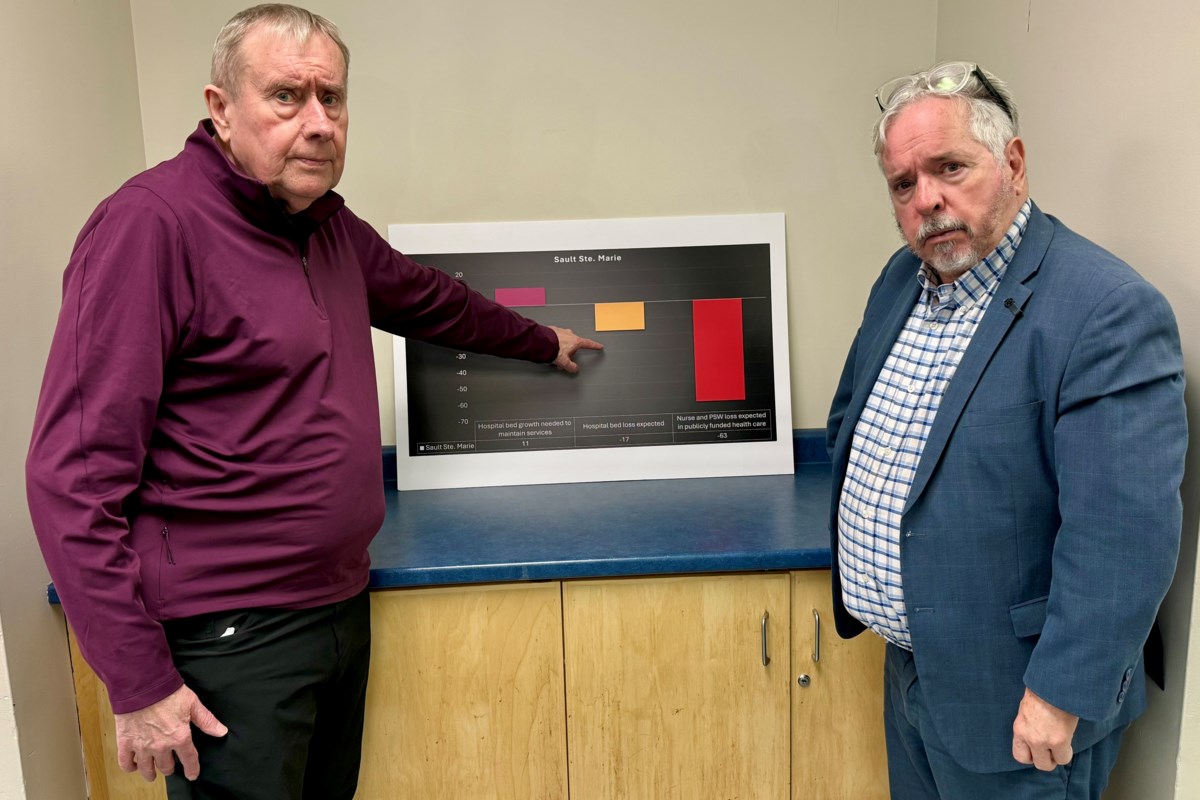
Amid a province wide funding crunch over the next few years, Sault Area Hospital could lose beds and dozens of health-care workers.
After steadily rising between 2021 and 2024, hospital funding for the 2025-26 fiscal year is projected to drop $500 million below the $91.6 billion shelled out by the province last year — with impacts already being felt far and wide.
According to a new report, hospitals around Ontario have been driven to the brink, and flat funding over the next three years promises little help.
“I had a nurse tell me that she was thinking of quitting. She’d had a horrible day,” said Michael Hurley, president of the Canadian Union of Public Employees and the Ontario Council of Hospital Unions.
“She said, ‘I should have four palliative care patients, and I had eight people who were sick,’ and then she described to me how these are people who are dying and so they have complex emotional needs and spiritual needs, which she can’t fulfill.”
The CUPE and OCHU report, Driven to the Brink: Projected Cuts to Intensify Hospital Crisis, lays out a concerning picture of the next few years should the provincial government stay its current course, both in Sault Ste. Marie and around the province.
Between 2025-26 and 2027-28, Sault Area Hospital could effectively lose up to 17 hospital beds, and the city could lose 63 publicly funded nurse and personal support worker positions, officials say.
“What we have found is that rural, small and northern hospitals are the hardest hit,” said Doug Allan, senior researcher with CUPE.
“Over the last few years, there was a big explosion in terms of hospitals closing — sometimes just for a night or a couple of days, sometimes more permanently — but that has happened almost exclusively at small, rural and northern hospitals.”
With this year’s funding cut — and relatively modest bumps of $1.3 billion and $1.2 billion in 2026-27 and 2027-28 — the situation doesn’t look any better elsewhere.
“That will mean the closure of about 2,400 hospital beds, the loss of 7,500 nursing positions and about 1,800 personal support worker positions, and in fact, we’re already seeing these job eliminations and layoffs across the province,” Hurley said.
It will also mean continued “hallway” health care, where overburdened hospitals are forced to treat patients in unconventional spaces like hallways, closets, cafeterias and even bathrooms.
That’s a measure the Ford government once vowed it would end, but has recently decided to stop disclosing figures for instead.
“There’s about 2,000 people waiting for beds on stretchers on any given day, so many that the government’s just announced they’re not going to report that item anymore to the public … which is one way of dealing with the problem,” Hurley said.
With months still remaining before the province’s budget, as well as the end of the current fiscal year, officials hope additional funding will be announced to bolster health care in places like the Sault and beyond.
“The budget is coming up, but we don’t have to wait to the budget,” Allan said. “We still have this fiscal year, and this fiscal year needs a funding bump.”
To get hospitals up to proper staffing levels, add needed beds and clear backlogs for surgeries — there are 75,000 of those — around $3.2 billion in additional funding is needed, Hurley said, adding that the annual increase in funding should be closer to six per cent than two per cent.
About 1,777 additional beds are needed to get the province back up to 2015 service levels, and more than 48,000 staff are needed to get Ontario to the equivalent level of staffing patients have in other Canadian provinces.
“Canada is an outlier compared to the rest of the developed nations, but on staffing, Ontario is a particular outlier in Canada,” Allan said.
To meet demand, Allan said the province will need a 4.6-per-cent increase in capacity, but “the actual funded reality is for seven per cent fewer beds” — an 11.6-per-cent discrepancy.
Moving forward, Allan and Hurley said they have 15 rallies planned in communities around the province in the coming weeks — including one slated for North Bay next week.
“We’re hoping, we’re pushing,” Hurley said.
“I guess the question we’re asking Mr. Ford is that surely a wealthy province like this, in a wealthy country like this, can afford to have a higher quality of care for its people than we’re currently providing in our hospitals.”