
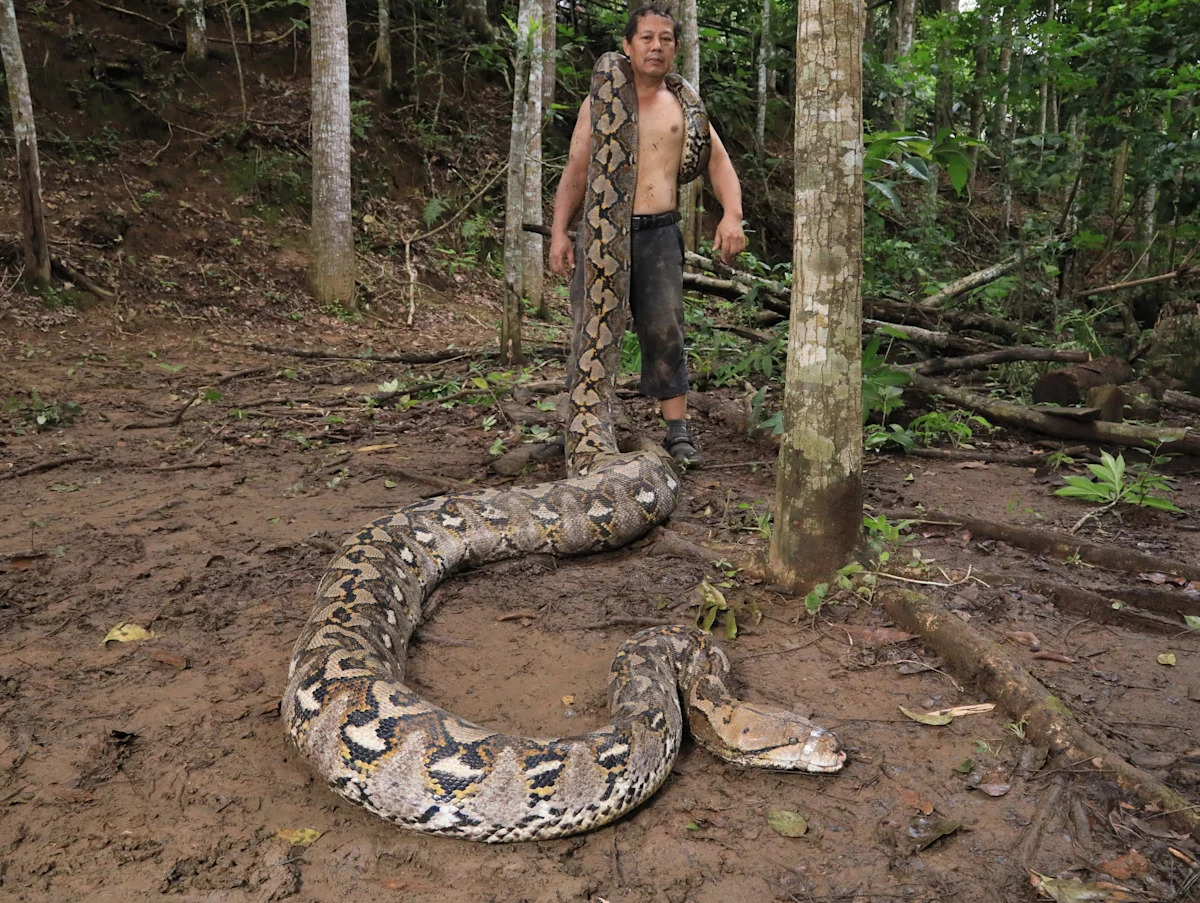
Nothing could have prepared Radu Frentiu for meeting the snake known as Ibu Baron, which means “The Baroness” in Indonesian.
“I had never seen a snake this big,” says Frentiu. “This snake could easily swallow at least a calf, if not an adult cow.”
Frentiu, an explorer and natural history photographer who has lived in Bali, Indonesia, for two decades, has encountered his share of big snakes. But Ibu Baron deserved a record-breaking distinction.
Guinness World Records recently confirmed that Ibu Baron, a reticulated python (Malayopython reticulatus), is believed to be the longest verifiably measured wild snake in the world. She was first discovered in the Maros region of South Sulawesi, Indonesia, in late 2025.
Frentiu learned about the giant python from Diaz Nugraha, a wildlife guide, rescuer, and licensed snake handler from Borneo. Together, they traveled to Sulawesi to see the animal firsthand and measure her.
On January 18, Frentiu and Nugraha weighed and measured Ibu Baron, documenting the process with photographs and video to be as transparent as possible. Using a surveyor’s tape that followed the snake’s natural curves, they recorded a total length of 23 feet and 8 inches from head to tail tip. The python also weighed in at 213 pounds—and that was on an empty stomach.
Frentiu says the snake’s true length could be even longer, since she was not sedated when the measurements were taken. Under anesthesia, a snake’s muscles fully relax, potentially adding another 10 to 15 percent to her length.
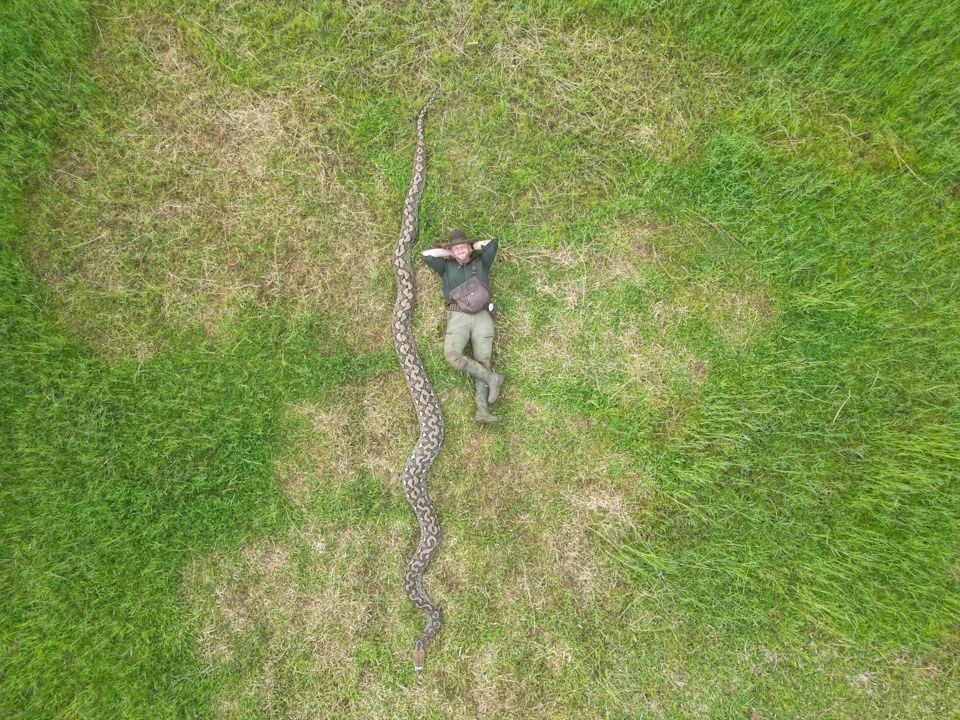
Photographer Radu Frentiu documented, weighed and measured the giant snake Ibu Baron. For this photo of himself with Ibu Baron, he used a drone for better perspective due to the snake’s enormous size. Radu Frentiu, Diaz Nugraha
A snake to be celebrated
Reticulated pythons are already the world’s longest snake species, typically reaching lengths between 10 to 19 feet. Larger individuals have been reported throughout history, but most claims rely on secondhand accounts or animals that were killed shortly after discovery. In many cases, the snakes vanish before their size can ever be verified. “These giant animals attract attention as status symbols,” Frentiu says. “They tend to disappear, or something bad happens to them.” Ibu Baron’s continued survival is what makes her exceptional.
Local conservationist Budi Purwanto, who acted quickly when word of the snake spread, has played an important role in Ibu Baron’s longevity. Rather than allowing her to be sold or killed, he acquired her and constructed a makeshift shelter on his property, where she now lives alongside several other rescued snakes. Releasing her into the local area would be risky. Large prey animals, such as babirusa and other wild pigs, are scarce, while human settlements are numerous.
“A python this big will probably be drawn toward a village,” Frentiu explains. “And once that happens, it will almost certainly be killed.”
Across Indonesia, habitat loss and declining prey have pushed large snakes into closer contact with humans. Reticulated pythons are non-venomous, but their size and strength make them lethal predators capable of killing livestock and, in rare cases, people. Human fear is often fatal for the snakes, which are also hunted for bushmeat and targeted by the illegal wildlife trade.
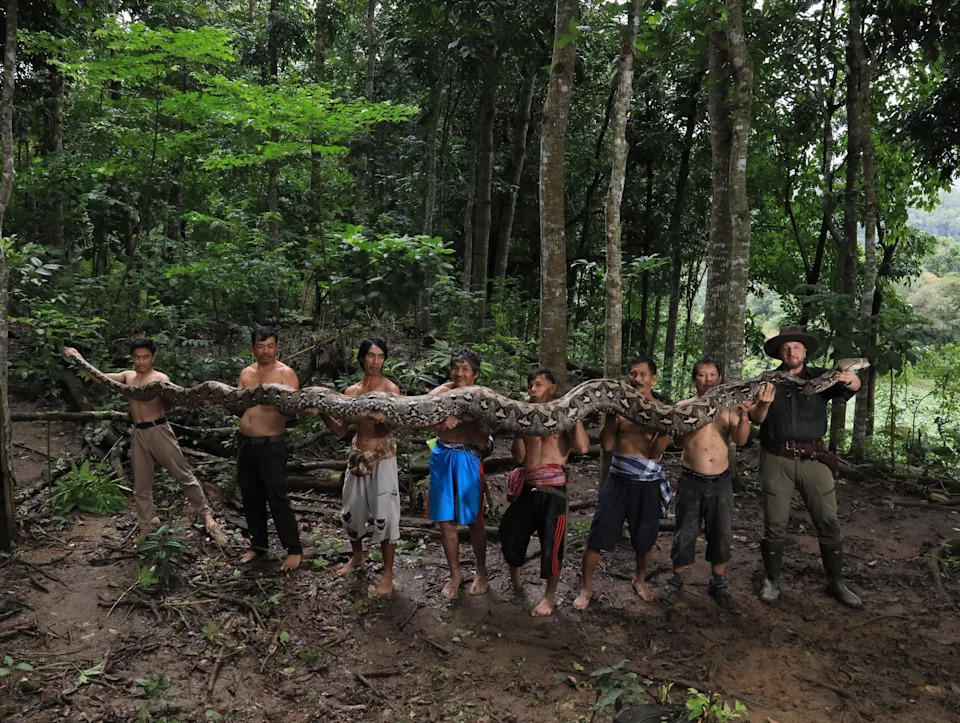
Radu Frentiu, Budi Purwanto and villagers from south Sulawesi, Indonesia, lift “The Baroness” for a group photo after her measurements were taken. At least eight people were needed to safely handle the snake at any one time. Radu Frentiu, Diaz Nugraha
For Frentiu, Nugraha, and Purwanto, Ibu Baron represents a chance to change that dynamic. By protecting her and keeping her visible, including through recognition by Guinness World Records, they hope to show that giant snakes can be worth more alive than dead. “It can give this animal importance and hopefully value,” Frentiu says. “It can empower local communities to look after these animals and view them as a resource for the long-term.” He points to a growing niche of herpetological tourism—wildlife tours focused on spotting reptiles and amphibians—as one possible path forward.
Frentiu is careful not to frame Ibu Baron as the record-holder for all time—there could be even bigger snakes out there. “I do not believe in the slightest that this is the largest wild snake. I got lucky,” he says.
“There are still wonders out there. This is one of them—and I don’t think it’s the last.”