
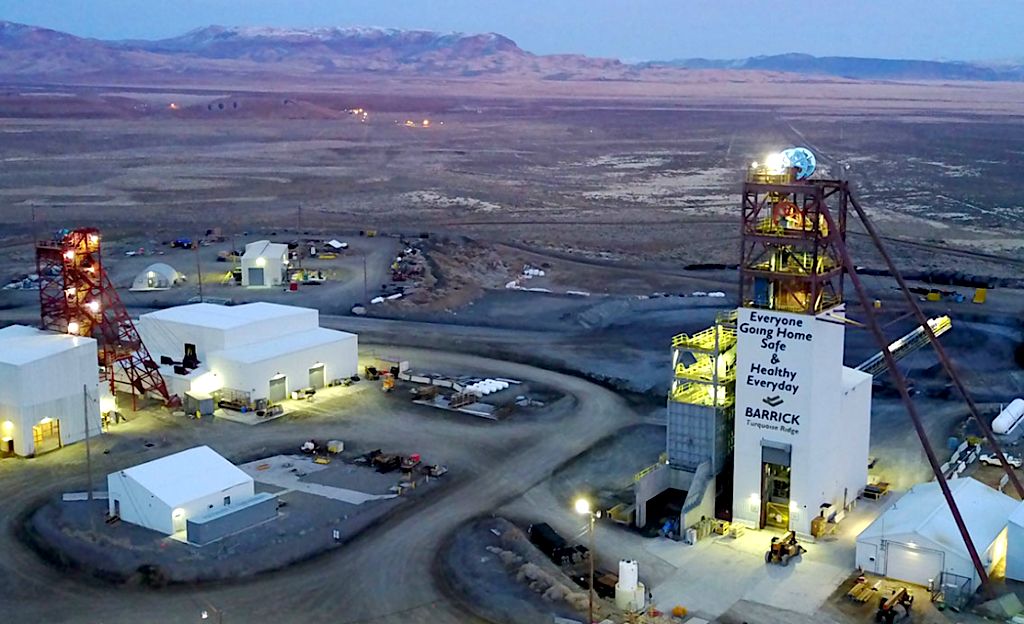
Newmont Corp. wants Barrick Mining Corp. to address what it says is underperformance at their joint venture mining operations in Nevada before its partner proceeds with an initial public offering of its North American assets.
The world’s top gold miner has been critical of Barrick’s management in Nevada after years of production declines and rising costs, according to people familiar with the matter. Newmont — which has shown interest in acquiring the Canadian producer’s Nevada assets in the past — believes the IPO needs its approval, said the people, who asked not to be named as the matter is private.
Newmont’s primary concern is the Nevada Gold Mines joint venture, “which has suffered a degradation in performance and subsequent asset value over the past six years, the company said Monday in a statement. “Newmont is taking appropriate steps to address these issues with Barrick, with the goal of reversing this decline in performance and ensuring these assets generate the value they are capable of delivering,” it said.
Any transaction involving the Nevada operations “must respect the protections” in the joint venture agreements, including the “transfer restriction requirements,” the statement added.
An intervention by Newmont could create a potential snag in Barrick’s plans to separate its North American assets and sell a 10% to 15% stake in the new company later this year. The sale would include its interest in the prized Nevada Gold Mines venture — of which Barrick owns 61.5% and Newmont 38.5% — along with its promising wholly owned Fourmile development and a mine in the Dominican Republic, which is another joint venture with Newmont.
Shares of Barrick rose 2.5% as of 2:33 p.m. in New York while Newmont rose 3.9%.
A spokesperson for Barrick didn’t respond to a request for comment.
The Nevada joint venture dates back to 2019, after Barrick made a hostile takeover bid for Newmont — which at the time was the smaller of the two companies — before eventually dropping the offer and instead agreeing to pool together their nearby projects in the US state.
“Nevada is core to Newmont and they eventually have to do a transaction on Fourmile — but the process starts with getting up to speed on the state of the asset through improved collaboration,” BMO Capital Markets analyst Matthew Murphy said in an interview. “For both sides, you could create a lot of value by improving the performance. So maybe what Newmont is saying is focus on that — not on listing the asset.”
Barrick’s plans to sale North American assets that could be worth more than $60 billion as part of a strategic reset. Breaking up the company — by splitting off operations in riskier jurisdictions in Africa, Pakistan and Papua New Guinea — could also make the new unit a more appealing takeover target.
Bloomberg News reported in October that Newmont was examining a potential deal to gain control of Barrick’s Nevada assets.
Barrick may structure its IPO to avoid triggering a change of control, with the objective of ensuring that Newmont’s contractual right of first refusal is not exercised, RBC Capital Markets analyst Josh Wolfson said in an interview.
“This is the game that the two companies are playing,” Wolfson said. Nevada Gold Mines is “the crown jewel of the company — it’s roughly 60% of the market value of Barrick — so without that asset, it’s unclear as to what the value proposition is or whether investors would be interested in the company.”
Barrick posted a sixth straight year of declining output in 2025, with production hitting the lowest levels in at least 25 years. The company expects volumes to fall further this year, including at its Nevada venture.
The dramatic slump underscores long-running challenges at Barrick that have tested investor patience as the metals producer fails to keep pace with a record-breaking gold rally. Geopolitical instability at key mines outside North America have led to significant operational disruptions, weighing on production.
In response to questions on an investor call last week, Barrick executives declined to say whether the company has held talks with Newmont over right-of-first-refusal provisions in the Nevada joint-venture agreement.
(By Sybilla Gross and Thomas Biesheuvel)