
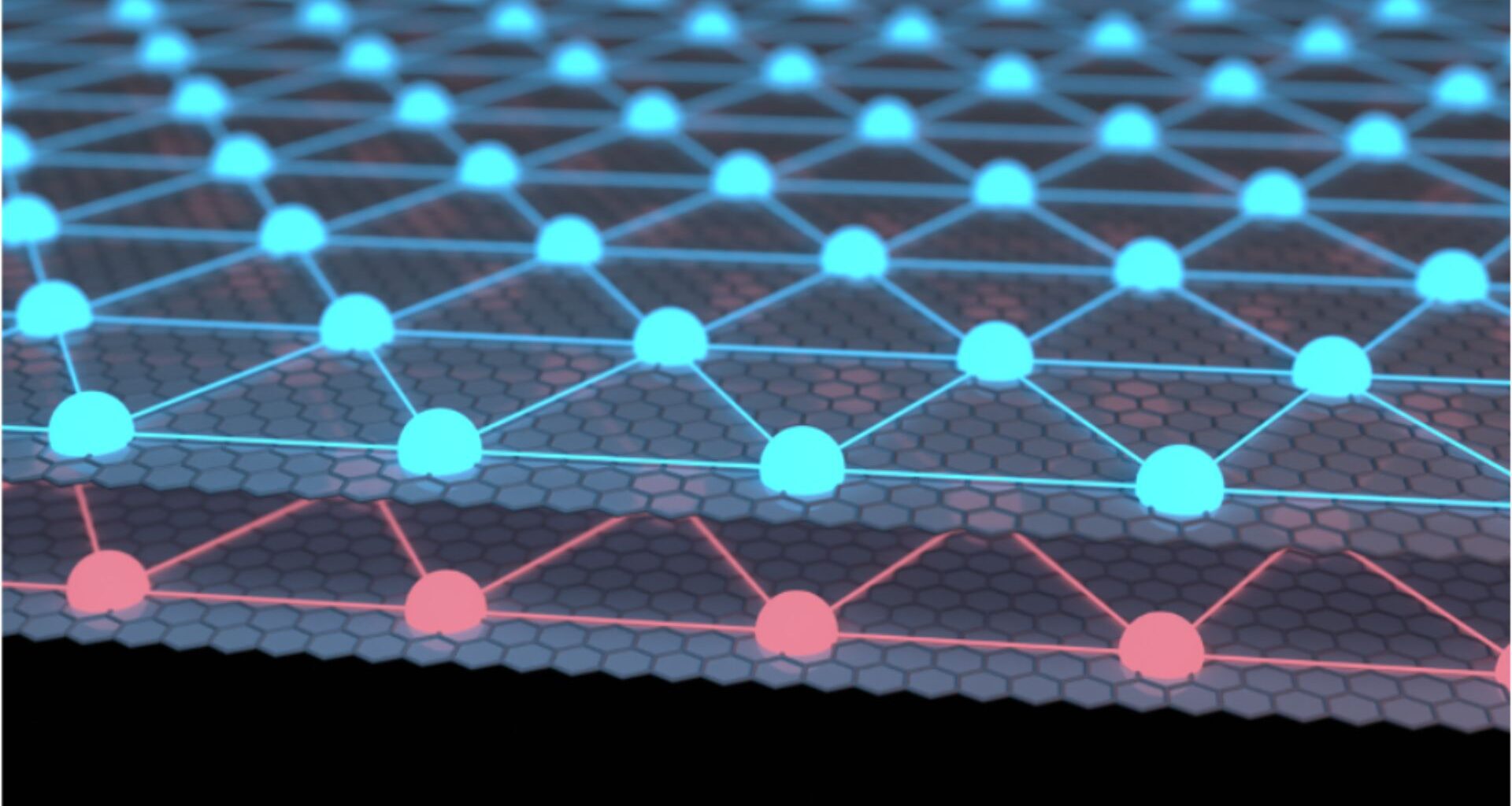
In a first, scientists at Columbia University in New York and the University of Texas in Austin turned superfluids into a supersolid state using only excitons.
Doing so stopped the flow of superfluids that are known to be in constant motion, much like turning flowing water into ice, but at a quantum level.
The three states of matter – solid, liquid, and gas are well known and understood. But physicists are more interested in understanding the many other states of matter, such as superfluids and supersolids, that exist at the quantum level.
Superfluid state occurs when particles are cooled to temperatures above absolute zero. At these temperatures, there is no heat, allowing the fluid to flow without friction. If stirred, a superfluid can form tiny tornadoes that continue eternally, also known as quantum vortices.
Superfluid to supersolid
Supersolids are a state of matter where the zero viscosity of the superfluid is maintained, but the particles do not move around. Instead, they form an orderly structure like a crystal lattice, while still maintaining the ability to form quantum vortices.
Scientists have previously succeeded in making supersolids in the laboratory. This was, however, achieved using extra equipment and an energy field that forced the particles to maintain the orderly structure. However, in a first, researchers at Columbia and Texas universities achieved a natural transition between these states, without any external instrumentation.
“For the first time, we’ve seen a superfluid undergo a phase transition to become what appears to be a supersolid,” said Cory Dean, a physicist at Columbia University who was involved in the work in a press release.
How did they do it?
In their experiments, the researchers worked with two pieces of graphene, which are thinner than paper sheets of carbon atoms bound in a hexagonal honeycomb lattice. They then added a strong magnetic field to the system and cooled it to generate an exciton soup.
Excitons are quasiparticles formed when a light particle excites an electron from the valence band, leaving an electron hole. Together, the electron and the electron form a neutral particle capable of transporting energy.
When the excitons were cooled to temperatures 2.7 and 7.2 degrees Fahrenheit (1.5 to 4 degrees Celsius) above absolute zero, they formed a superfluid. When the researchers cooled it further, the superfluid simply turned into a supersolid.
“Superfluidity is generally regarded as the low-temperature ground state,” added Jia Li, a physicist at the University of Texas at Austin in the press release. “Observing an insulating phase that melts into a superfluid is unprecedented. This strongly suggests that the low-temperature phase is a highly unusual exciton solid.”
For now, the researchers are exploring the boundaries of the insulating state and building new tools to measure it. since the material does not conduct any current. Additionally, the material needs a strong magnetic field to achieve a supersolid and superfluid state. So, the team is looking for other materials that could be used in their studies without requiring a magnetic field.
Using excitons in research is better because they are much lighter than helium and can form supersolids and superfluids at relatively higher temperatures. While the advantages of using supersolids remain unknown, scientists are keen to understand this quantum state of matter.
The research findings were published in the journal Nature.