
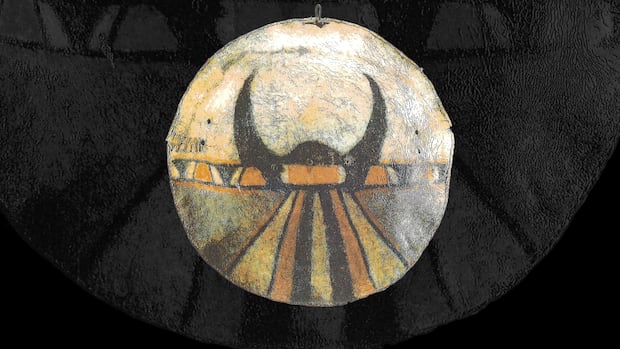
A New Mexico tribe believes a sacred war shield stolen from the Santa Ana Pueblo more than four decades ago may have ended up in Canada.
The pueblo — a 79,000-acre reservation north of Albuquerque, N.M., home to some 800 tribal members — was devastated by a series of burglaries between August 1984 and May 1985, during which 150 items were stolen from private homes and tribal society houses.
Among them was a war shield made of hide and painted with red and yellow lines to represent sun rays under black buffalo horns.
Thomas Armijo, a cultural resource technician for the Santa Ana Tribal Historic Preservation Office, says the design is unique to the Santa Ana Pueblo.
“When it was taken, it was just like another member of that family went missing,” he said.
Armijo says the Pueblo people see the war shields as living beings.
Determined to bring the artifacts home, the Tribal Historic Preservation Office formed a task force and started pouring over sales records and social media posts, digging deep into the internet for traces of the missing items.
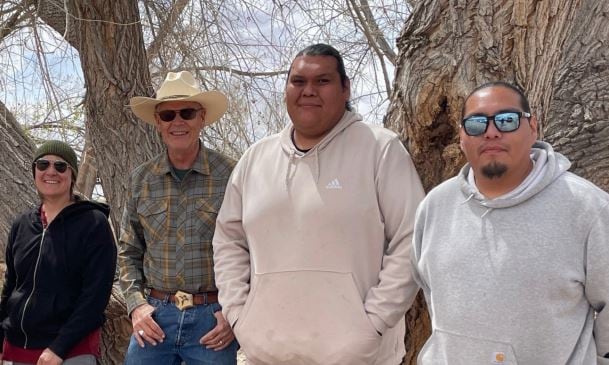 Members of the Santa Ana Pueblo task force looking for stolen artifacts, Monica Murrell (left), William Woody, Thomas Armijo and Jarrett Lujan. (Submitted by Santa Ana Pueblo )
They tracked the shield to the Donald Ellis Gallery in New York, owned by prominent Canadian art dealer Donald Ellis, who is based in Vancouver.
The shield is featured in a 2021 Instagram post from the gallery. The caption describes it as, “constructed by a double thickness of buffalo hide with pierced hide straps” and says it was acquired by a “Canadian private collector.”
In a phone call with CBC News, Ellis confirmed he purchased the shield in 2005 from a New Mexico antique dealer, Larry Frank.
But Ellis said that while the shield was posted to his gallery’s Instagram page likely by an employee in March 2021, his gallery sold the piece decades earlier, shortly after his original purchase from Frank.
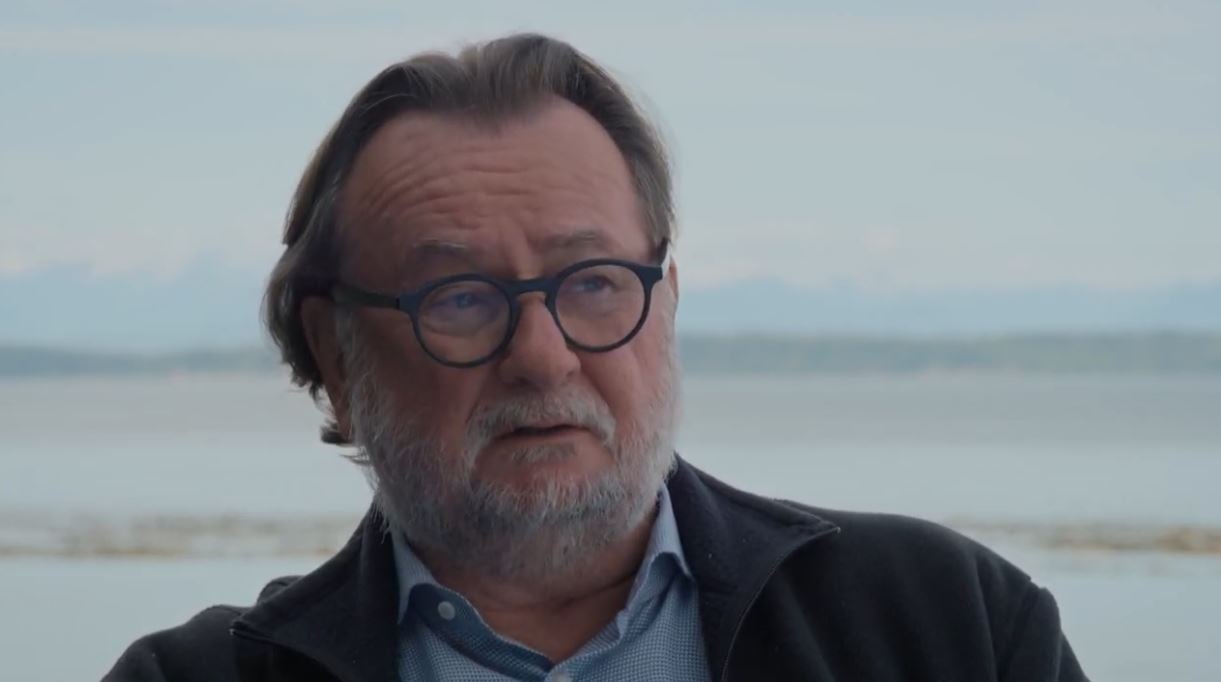 A screenshot of Donald Ellis from the documentary So Surreal: Behind the Masks, by Cree filmmaker Neil Diamond. Ellis is helping with the repatriation of of a ceremonial Kwakwa̱ka̱’wakw mask in the film. (So Surreal: Behind the Masks)
Ellis has been involved in repatriation work for years, providing assistance in the return of culturally significant art pieces. In 2019, he helped negotiate the return of the sun mask to the Kwakwa̱ka̱’wakw in Alert Bay, about 300 kilometres northwest of Vancouver.
But Ellis said he has been unable to assist with the return of the shield, telling CBC News that because gallery records are destroyed every seven years, he has no record of who made that purchase so many years ago.
Ellis said he feels unfairly accused of not sharing the shield’s whereabouts, despite it not being in his possession for over 20 years.
Trail runs cold
Documents given to the task force from the Frank family show that Larry Frank purchased the shield for $2,700 US, along with three other stolen items from the woman who allegedly masterminded the robberies.
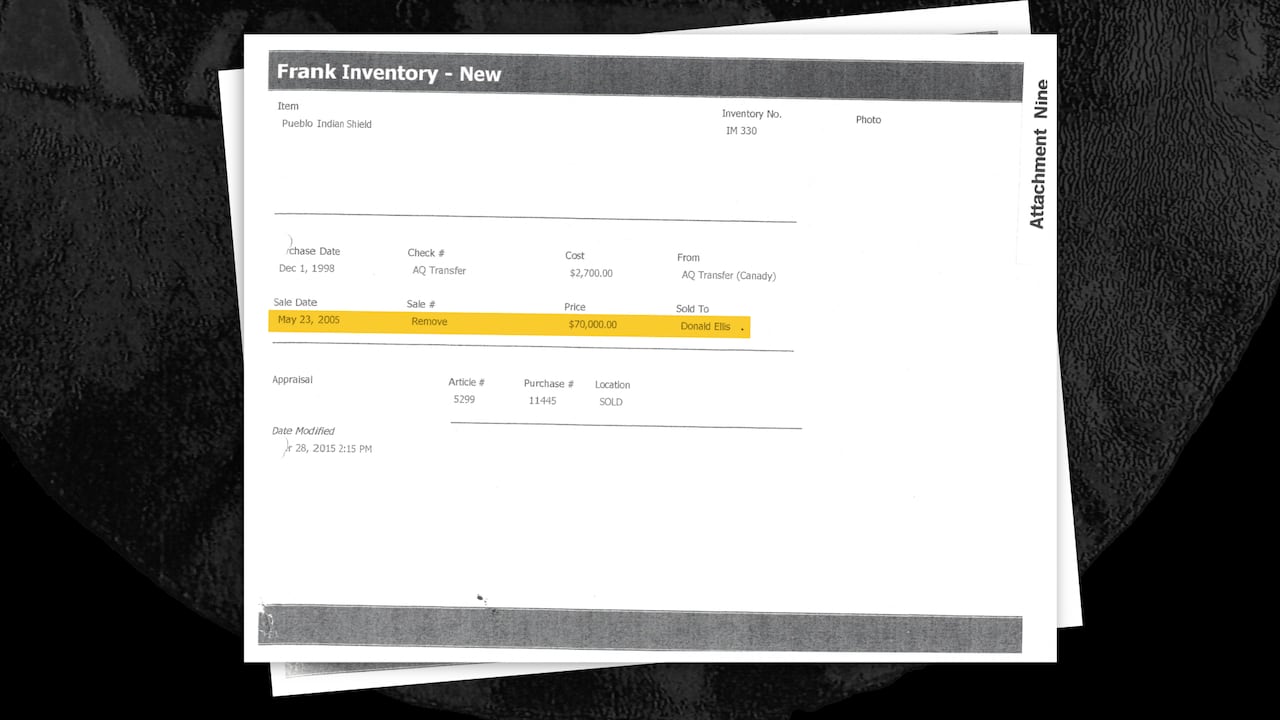 A copy of the Larry Frank ledger released to the task force by the family shows the shield was sold to Donald Ellis for $70,000 US. (Graphic: CBC; Photo: Submitted by Santa Ana Pueblo)
There is no evidence that Frank would have known any of the items were stolen when he purchased them.
In Frank’s inventory, there is another receipt that shows the shield was then sold to Donald Ellis in 2005 for $70,000 US, about $97,000 Cdn.
CBC News obtained a copy of an investigative subpoena filed in the Santa Ana Pueblo Tribal Court to Ellis, requesting any purchases and sales documents be handed over to the Pueblo of Santa Ana Department of Natural Resources.
The document contains email correspondence between William Woody, a member of the tribal task force since 2023 and a retired director of law enforcement for the Bureau of Land Management, and Ellis.
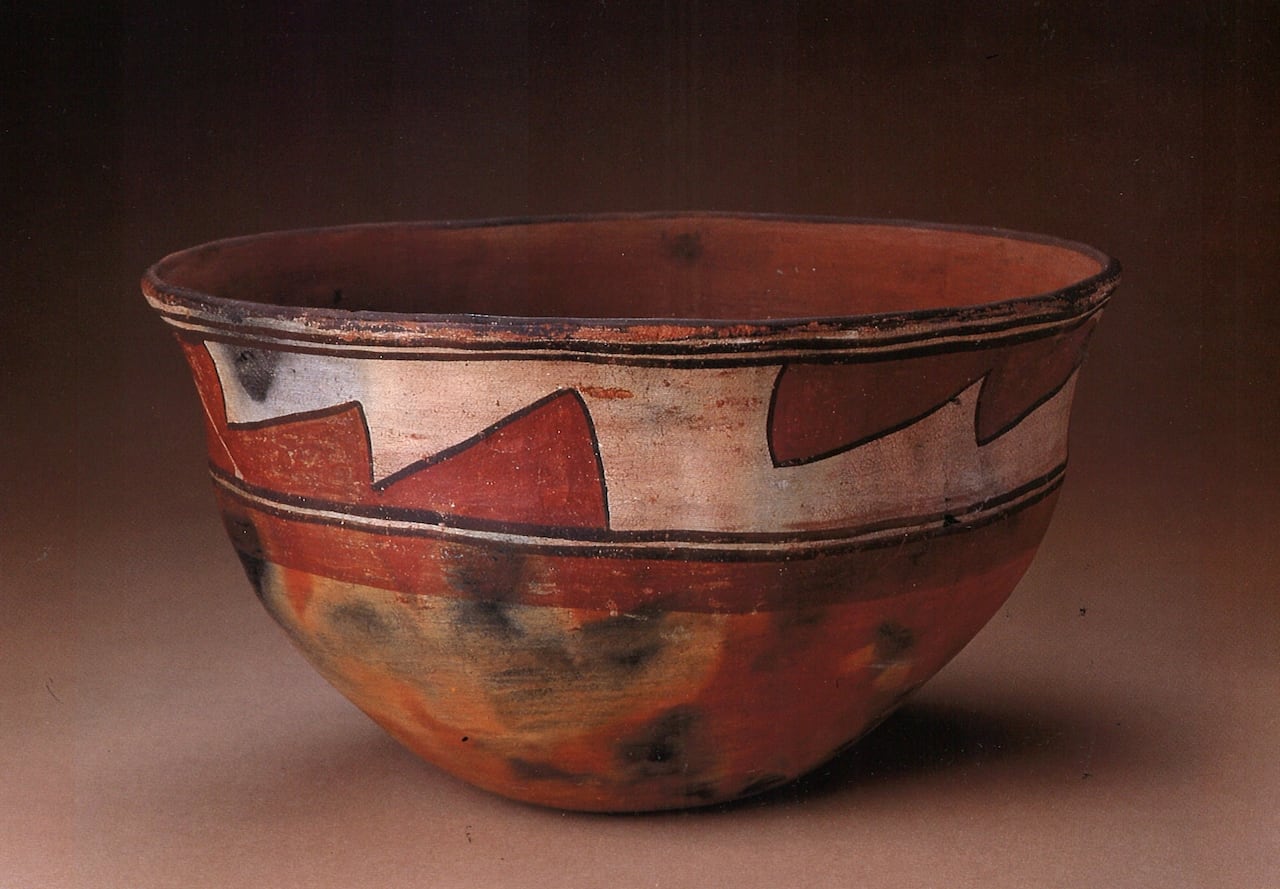 A dough bowl that was stolen during the 1980s burglaries was repatriated to the Santa Ana Pueblo. It was identified through investigations in the Gallegos Collection in Santa Fe, N.M. (Submitted by Santa Ana Pueblo )
An email from Ellis says it is common practice for businesses in Canada to keep records for seven years before destroying them.
“Every year, upon receipt of income tax filing documents from our accountants for the latest fiscal year, relevant past records are shredded. Most if not all businesses in Canada do so,” reads the email, in part.
“Consequently I currently have records going back to my 2017/2018 fiscal year. Should you wish to have a subpoena recognized by a Canadian court I will make the records that I have available to you.”
The Pueblo of Santa Ana has not filed a subpoena for the records in a Canadian court.
Woody said he spoke to Ellis over the phone about the shield, but since then, the search for the shield has reached a dead end.
“Ellis has maintained that he destroys his records after seven years, he just simply does that,” Woody told CBC News.
Images of the shield appear
Like the 2021 Instagram post from Donald Ellis gallery, other seemingly promising clues hinting at the potential location of the shield have proven to be riddled with inaccuracies.
For example, the task force found a photo of the shield in a 2019 copy of Tribal Art Magazine.
The description says it was offered by Donald Ellis Gallery at Frieze Masters — a prestigious annual art fair in London — in October 2019.
However, a spokesperson for the Frieze said in a statement, “the work referenced did not appear at the fair.”
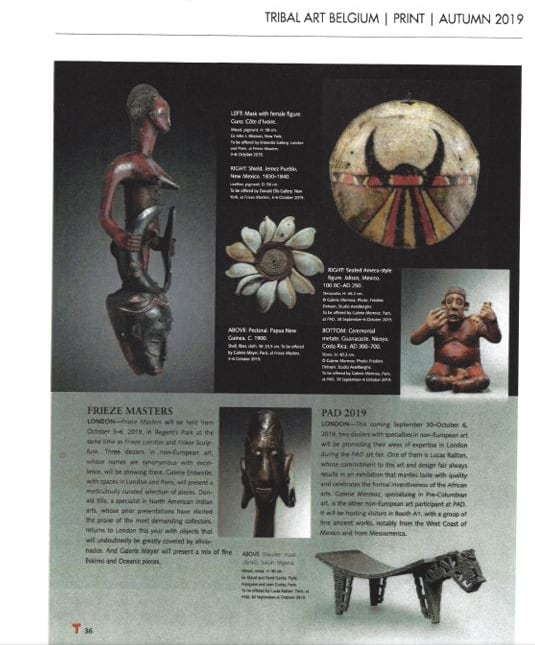 A photo of the shield was found in a 2019 copy of Tribal Art Magazine that stated the art was offered at Frieze Masters. However, a spokesperson for the fair said the shield never appeared there. (Submitted by Santa Ana Pueblo)
CBC News reached out to Tribal Art Magazine but did not hear back.
Experts say the issue of stolen artifacts is a complex one that the art world — from private collectors to renowned galleries — continues to grapple with.
“I don’t think anybody really wants to have stolen art in their home,” said Sharon Fortney, senior curator of Indigenous collections engagement and repatriation at the Museum of Vancouver.
“I don’t think anybody’s blaming the collector in this scenario or even the gallery who was operating in good faith, but it’s the right thing to do, I think, to let the community know where it is and that it’s at least safe and being cared for” she said.
Fortney, a member of the Klahoose First Nation located about 162 kilometers north of Vancouver, said Indigenous objects can lose their histories for many reasons, particularly when they are older.
She said asking questions about where objects come from, why they are for sale and who made them are important, and that buyers should consider if they’re the best person to care for them.
“Older belongings sometimes have special care requirements, there’s also spiritual care requirements, you know, depending on what type of belonging it is,” said Fortney.
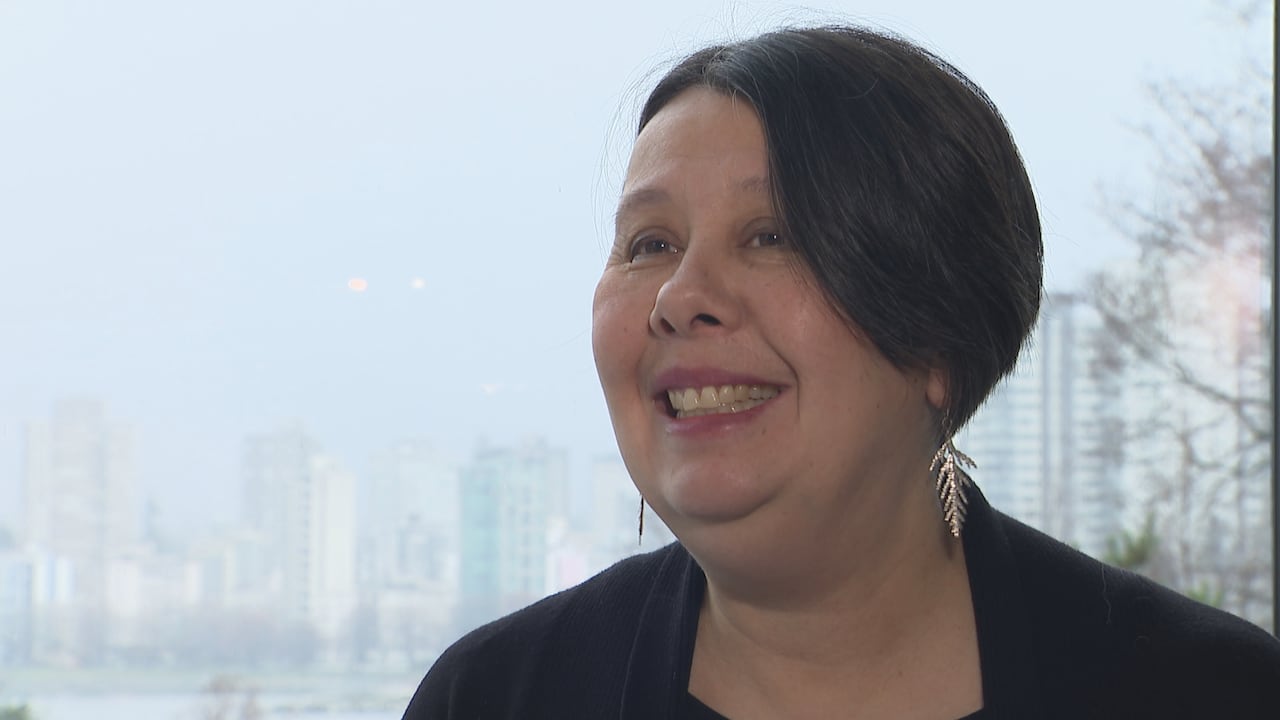 Sharon Fortney, senior curator of Indigenous collections engagement and repatriation at the Museum of Vancouver, says Indigenous artifacts require spiritual care as well as physical care. (Gord Loverin/CBC)
Armijo said the stolen items from the pueblo are intertwined with Santa Ana identity and are used for ceremonial purposes.
“Whether it’s the shield, the pottery, the regalia, they’re all priceless,” said Armijo.
“No amount of money will change that.”
Canada has no laws that would require a personal collector or a museum to return objects, said Fortney. The situation is often evaluated case by case.
“I don’t think that communities should be put in a situation where they need to buy back their heritage,” said Fortney.
She said one of the ways to practise reconciliation is to return items and work together.
‘I believe somebody has that shield’
The 150 items stolen from the Santa Ana Pueblo are protected under a number of U.S. antique laws.
Monica Murrell, the tribal historic preservation officer and director of the Santa Ana Historic Preservation Department, said the items are historic property listed on the National Register of Historic Places since 1971.
“We understand this is the main reason Historic Pueblos were targeted for the thefts, to obtain rare antiquities that are assigned a high monetary value on the public market,” said Murrell in an email to CBC News.
Woody is hoping that someone may see a picture of the shield and will come forward with information.
“I just need that picture out there, I believe somebody has that shield,” said Woody.