
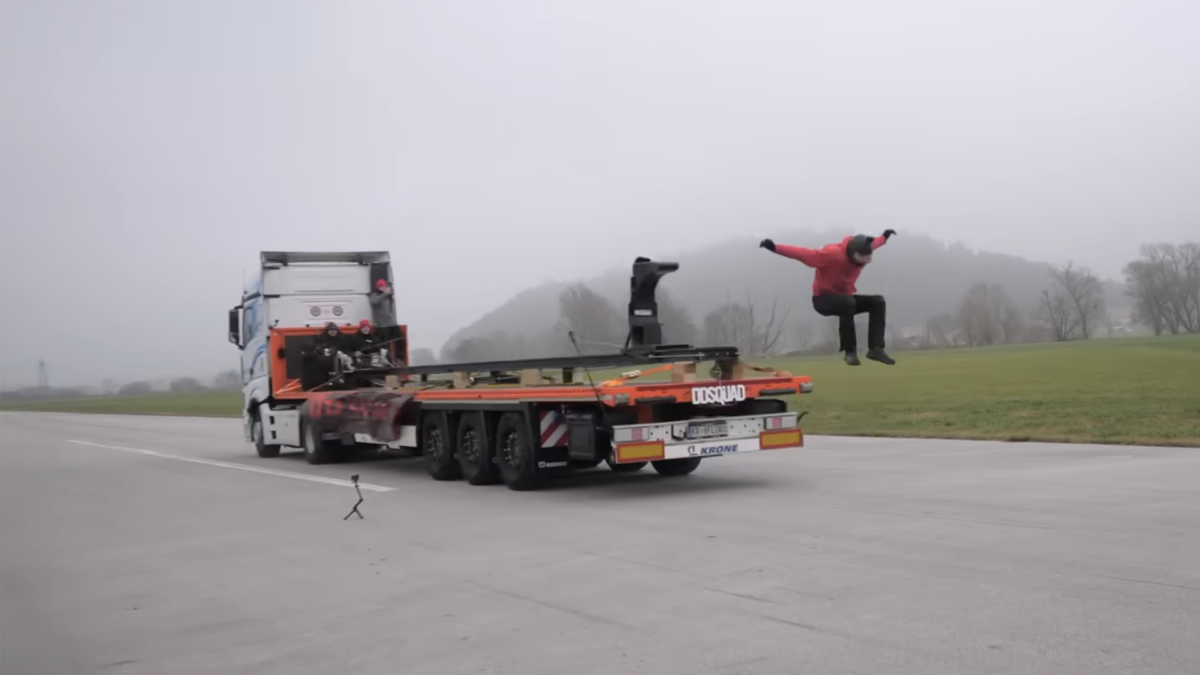
You’ll sometimes hear scientists say that the most exciting thing in science is a discrepancy between a theory’s prediction and an experiment’s actual outcome, because it means you’ve discovered something new. This is a matter of context, though, and when your experiment consists of firing yourself off the back of a truck moving at 50 miles per hour, it’s hard to imagine being anything other than delighted when your theory holds up perfectly.
So we expect it was sighs of relief all round at YouTube channel DD Squad when their video proving the concept of relative motion went off without a hitch.
The idea of relative motion is an aspect of the theory of relativity (strictly, it’s Galilean relativity, rather than Einstein’s more famous E=Mc2 version). It states that velocity is relative, rather than absolute. Which, OK, but what does that mean?
To answer that question, let’s look at DD Squad’s experiment, in which they drive a truck at 50mph down a long straight road. If you happened to be on the side of the road watching the truck go by, it would appear to be moving at 50 mph, while you would be standing still. From the truck’s point of view, however, it’s you who’d appear to be shooting off at 50 mph, in the opposite direction.
Who’s right? Intuitively, we feel like the first point of view is somehow more valid—it’s the truck that’s “really” moving—but in fact, the theory of relativity demands that both answers are correct. (Indeed, this demand is basically what the theory of relativity is—the idea that all points of view, or frames of reference, are equally valid.)
How do we prove this? Well, let’s return to standing on the side of the road and assume, for simplicity, that the truck is moving due west. What would happen if something—or, in the case of this video, someone—on the back of the truck was suddenly fired eastwards at 50mph?
Relative motion predicts that the two motion vectors—50 mph westwards and 50 mph eastwards—will cancel out, leaving a net motion of 0 mph. From your point of view, the person would suddenly appear to be standing still. From the truck’s point of view, the person would appear to go from being stationary to moving eastward at 50mph. And from the person’s point of view, well, they’d be able to walk away safely, rather than being smeared across the next few hundred feet of asphalt.
Of course, it’s not like the prediction is in any real doubt—pretty much every aspect of relativity has been tested in excruciating levels of detail over the centuries, and it has stood up to each and every challenge. No, the question with experiments like this is less to do with what will happen if the two motion vectors are balanced perfectly, and more to do with whether you can, in fact, achieve that balance. This is important, obviously, because if the truck is driving too slowly or too quickly, and/or the velocity at which the person is launched is too high or low, the results will most likely be decidedly unpleasant.
Much of the video’s 22-minute runtime is devoted to how the DD Squad team went about pulling this stunt off—it involves a custom catapult-type device that fires a seat along a race mounted on the back of a flatbed truck, extensive and painstaking testing, and a whole lot of high-fiving. The really interesting part, however, is at 21:29, where we see the stunt from the stuntman’s point of view: the passing landscape decelerates rapidly, and suddenly they’re standing still on the road, with the truck speeding away at 50mph. It’d be interesting to know what they felt as they flew along the race—did it feel like they were accelerating? Or decelerating? Or suddenly standing still?
In any case, the experiment is a success, and the gentleman who drew the short straw for the honor of being launched from a truck lives to fight another day. Science! It works!