
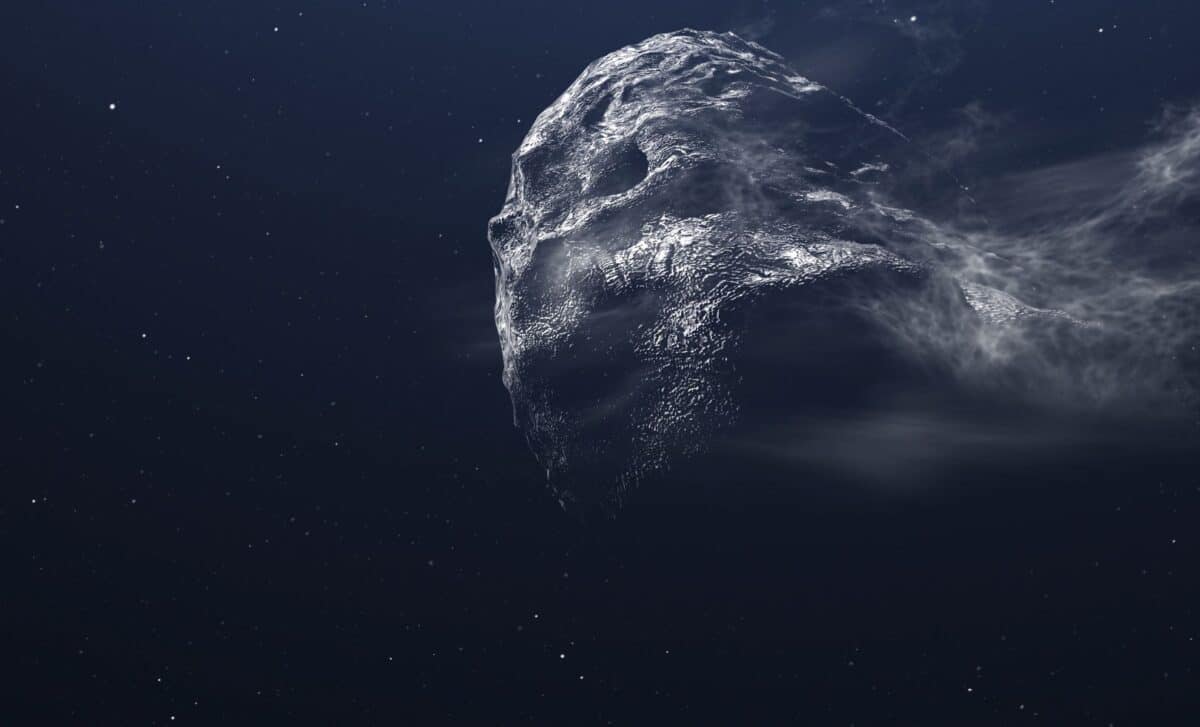
A newly discovered asteroid has shattered speed records, completing a full rotation in just 112 seconds, faster than any other asteroid larger than 500 meters ever observed. Named 2025 MN45, this asteroid’s rapid spin raises the intriguing possibility that it must be made of solid rock to avoid disintegrating under the intense forces of its rotation.
This discovery, made by theVera C. Rubin Observatory in Chile, marks an important step in understanding the nature of the space objects. Beyond just a speed record, this finding could offer valuable insights into the composition of these space objects and the early history of our solar system.
An Unprecedented Speed
Asteroids larger than 500 meters typically spin at a much slower rate, usually once every 30 minutes to an hour, since spinning too quickly could cause them to break apart. But 2025 MN45 defies this expectation, completing a full rotation in just 112 seconds.“It’s unlike anything we’ve been able to see before,” said astronomer Sarah Greenstreet from the University of Washington.
“Since most asteroids are believed to be what we call ‘rubble pile’ asteroids, which means they are made of many, many small pieces of rock and debris that coalesced under gravity during solar system formation or subsequent collisions,” she added.
Its high rotation speed suggests that it isn’t a loosely bound “rubble pile” like many other rocky objects. Instead, 2025 MN45 likely has a solid, dense structure that can withstand the centrifugal forces of such rapid spinning.
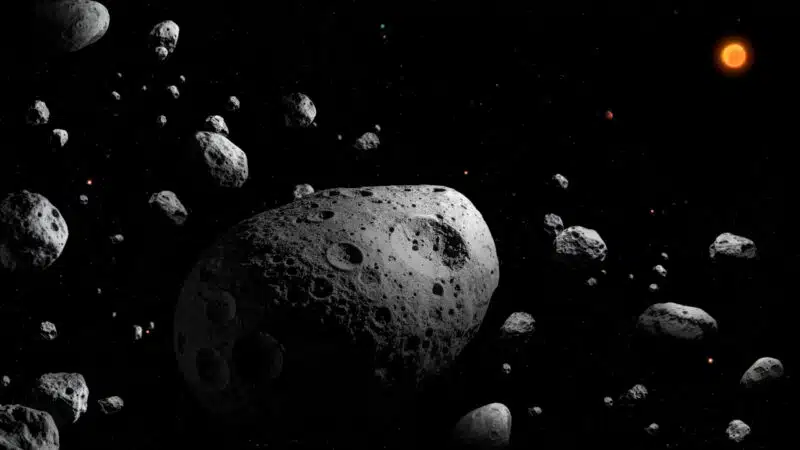 A creative illustration showcasing the rapidly spinning asteroid 2025 MN45. Credit: NSF–DOE Vera C. Rubin Observatory/NOIRLab/SLAC/AURA/P. Marenfeld.
A New Dawn in Astronomy
The Vera C. Rubin Observatory, which began its operations in 2023, was instrumental in detecting this fast-spinning celestial body. Located in Chile, the observatory is designed to map the entire southern sky every few nights over the next decade, allowing it to monitor moving objects like asteroids and comets. Its first set of images, released in June, revealed over 2,100 solar system objects, 90 percent of which had never been seen before.
This ability to monitor the sky in such detail is key to discovering and understanding objects like 2025 MN45. By tracking the brightness variations of asteroids, astronomers can determine their rotation periods. In the case of 2025 MN45, its rapid spin became an important clue, allowing scientists to further explore its composition and behavior.
“As this study demonstrates, even in early commissioning, Rubin is successfully allowing us to study a population of relatively small, very rapidly rotating main-belt asteroids that hadn’t been reachable before,” explained Greenstreet in a statement from the University of Washington.
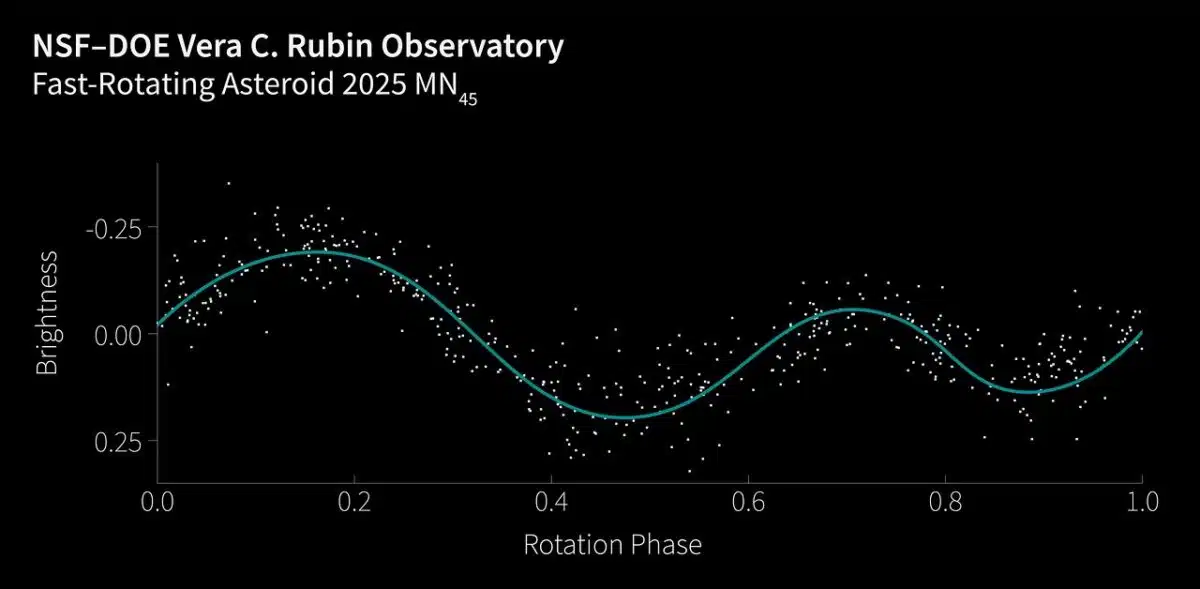 Graph showing the brightness variation of the fast-rotating object 2025 MN45. Credit: NSF–DOE Vera C. Rubin Observatory/NOIRLab/SLAC/AURA/J. Pollard
Reconsidering the Asteroid Belt
The discovery of 2025 MN45 also raises questions about our understanding of the asteroid belt between Mars and Jupiter. Traditionally, scientists have thought of the majority of the space rocks in this region as “rubble piles,” composed of loose fragments held together by gravity. But the discovery of a fast-rotating, solid asteroid like 2025 MN45 suggests that some of them in the belt could be made of solid rock, challenging previous assumptions.
Greenstreet believes that more fast-spinning cosmic rock may exist in the asteroid belt, and studying them could provide new insights into how these objects formed and evolved. These celestial bodies may have been formed from larger parent bodies that broke apart during collisions, which could have influenced the current distribution of asteroids in the solar system.
“These are exciting results but there’s much more to come,” stated co-author Mario Jurić, a UW professor of astronomy. “In the next two years, Rubin will discover a thousand times as many asteroids as were presented here. Rubin’s data will open the window into what’s out there in our solar system, and how it all came to be.”
The Vera C. Rubin Observatory is set to help scientists uncover many more such objects, potentially reshaping our understanding of solar system history.