
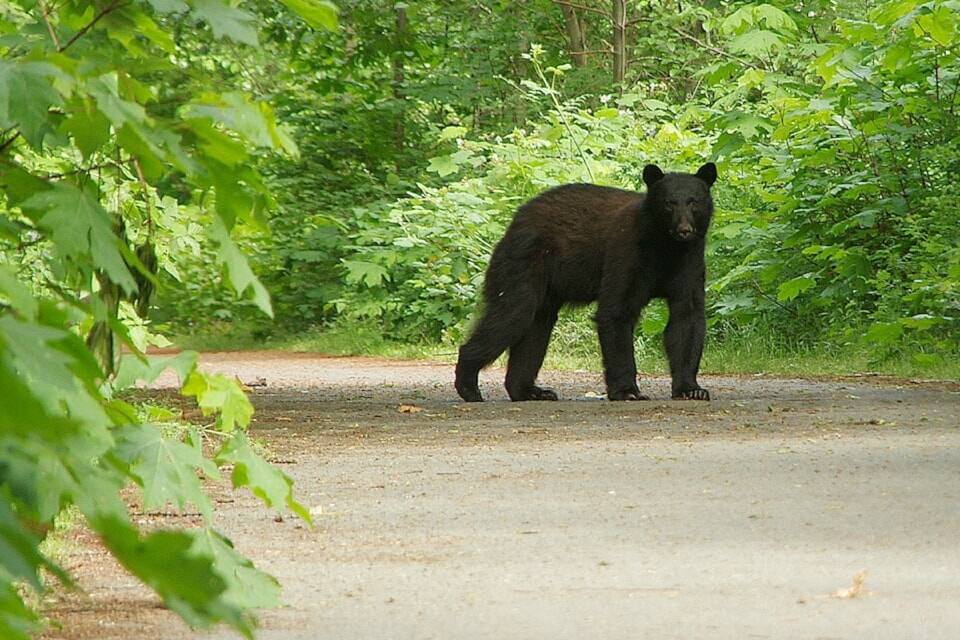
For the first time since 2020, no black bears were killed by the B.C. Conservation Officer Service in Nanaimo the past year, as numbers being killed across the province remain in decline.
Year-over-year, the number of black bears being killed has decreased, dropping from 303 in 2024 and 603 in 2023. In 2025, conservation officers killed 178 black bears for public safety reasons in B.C. and euthanized another 33, for a total of 211. Topping the list was Ucluelet, with 13 killed for safety reasons, and Campbell River, where officers killed seven.
This isn’t only the lowest overall number since B.C. Conservation Officer Service’s predator statistics were first published online in 2011, it is also the fewest annual black bear calls reported to the provincial reporting line since 2011, with 13,672 calls.
In a Facebook statement, Cam Schley, BCCOS chief conservation officer, said while it’s encouraging to see the number continue downward, “we know that many conflicts are preventable.”
“Officers continue to work collaboratively with, and engage communities, organizations and businesses on public education and outreach to help keep people safe, and wildlife wild,” Schley said. “We also hope this shift in reporting outcomes is more transparent for the public, whose trust is critical to serve our communities.”
Lesley Fox, The Fur-Bearers’ executive director, a non-profit which follows the numbers, told the News Bulletin that when the data is adjusted for attendance, the likelihood that a black bear call results in a killed bear has remained largely unchanged, with a kill rate of about one in five attended calls.
“While the total number of bears [killed] is down across the province, we do still have a concern with the rate at which bears are killed,” Fox said. “It’s an important indicator, because we’ve really been pushing the conservation officer service to show more restraint, be more discerning as it relates to bear kills, especially in situations where the bear is being more of a pest or a nuisance than an actual public safety issue.”
Black bears are killed if they become listed as ‘Category 1’ and an investigation determines they are either a serious threat to public safety, significant property damage has occurred, or the bear is injured or suffering from distressed health. According to BCCOS guidelines, animals listed in Category 1 include those that have attacked, injured or killed humans, domestic pets or livestock, and may also include bears that have entered temporary or permanent dwellings.
Unlike with Category 1, with ‘Category 2’ conservation officers may provide technical advice or education, and issue non-lethal responses, so long as the bear is deemed healthy and has a history of low conflict with humans or property.
The guide notes that “if attractants, bears, people and site are not successfully managed, the public safety risk will increase and the bear will likely become a Category 1 bear.”
“Bears are extremely smart,” Fox said. “They’re very intelligent, they’re curious, they follow their noses, and in many cases with proper care, bears are capable of learning and creating those boundaries, and setting those boundaries is a really important part of changing this narrative.”
She said it was “a bit of a surprise” that Vancouver Island fared as badly as it did, taking up both of the top two spots.
“It was really sad to see that because Ucluelet, Tofino – the whole Pacific rim– that whole area on the West Coast is a sensitive area, it’s a very natural area and it has got a lot of tourism. It really benefits those communities to protect wildlife because I think it’s part of the reason it is such a tourism destination.”
Nanaimo, on the other hand, has had a year that reflects well on the community, she said.
“Any time I think when we see zero it’s encouraging, and potentially suggests … that residents are doing their part and the community is doing their part to keep bears safe.”
Keeping those numbers low is a whole community effort, she stated, from the city and bylaw services fining those that improperly dispose of their waste, to residents and property owners ensuring those attractants are managed.
“Cleaning up fallen fruit, not leaving pet food outside, securing garbage and compost, not approaching bears, and being just really mindful of how our actions can cause harm. Also, there is a responsibility though on the conservation office service, because despite the actions of the public, businesses and the city, the officer that pulls the trigger is ultimately responsible.”