
From the outside, Earth doesn’t seem to have a lot going on in the hydrogen department… but that doesn’t mean it’s completely lacking in the most abundant element in the Universe. Bound to oxygen, it sits in plain sight as water.
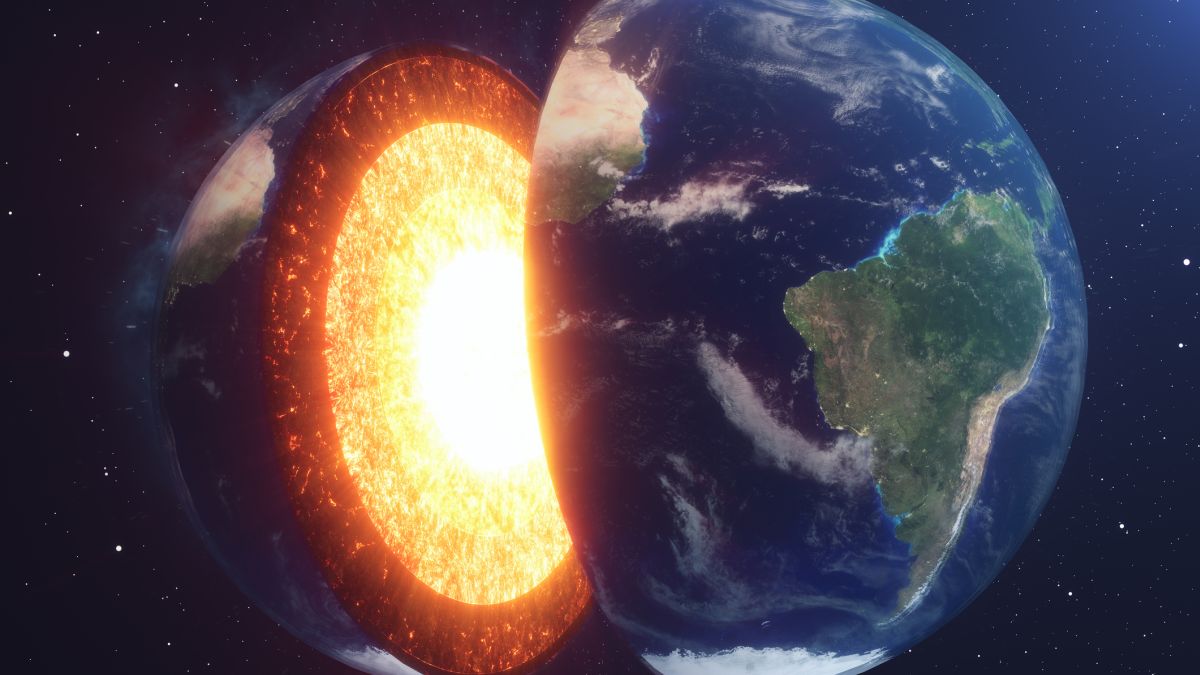
Yet according to a new study, vast amounts of hydrogen could also be locked away in our planet’s core, attached to the densely packed alloyed iron that lurks therein.
How much? Up to 45 times more than the roughly 150 quintillion kilograms of hydrogen contained in Earth’s oceans. That would make the planet’s core the largest reservoir of hydrogen on the planet.
It’s not one we’ll ever get to tap into, of course. But knowing how much hydrogen is trapped in the core helps scientists understand the formation history of our world, how it generates its magnetic field, and where the heck its water came from.
Indeed, “Such an amount would require the Earth to obtain the majority of its water from the main stages of terrestrial accretion, instead of through comets during late addition,” writes a team led by geoscientist Dongyang Huang of Peking University in China.
Constrained as we are by the impossibility of even getting to the core of our planet, let alone breaching it to obtain a sample, our understanding of what it contains is based on lab experiments, simulations, and calculations.
 frameborder=”0″ allow=”accelerometer; autoplay; clipboard-write; encrypted-media; gyroscope; picture-in-picture; web-share” referrerpolicy=”strict-origin-when-cross-origin” allowfullscreen>
The work conducted by Huang and his colleagues is some of the most robust. Using a diamond anvil cell, the researchers squeezed a small iron ball encased in a hydrated silicate glass to pressures up to 111 gigapascals while heating it to temperatures around 5,100 Kelvin. The lower pressure limit in Earth’s core is around 136 gigapascals, and its temperature is roughly between 5,000 and 6,000 Kelvin.
While the pressure of the experiment falls a little short of the pressure in the core, it’s close enough that the experiment provides a reasonable recreation of how these elements behave in such an extreme environment.
Within this temperature range, the sample liquefies completely, with no solid material remaining; the components are thoroughly mixed. In this churning mixture, the iron, silicon, oxygen, and hydrogen move freely, and the system behaves the way we expect Earth’s early molten core did.
It’s about as close as scientists can get to reproducing a core sample in a laboratory, even if the resulting sample lasts just a short time.

The results showed that the hydrogen mixed easily with the iron, and from there bonded with the oxygen and silicon in the mixture. When our planet’s core was forming, billions of years ago, hydrogen could have become sequestered therein in the same way.
We know the core isn’t pure iron; the way it reflects seismic waves suggests it isn’t quite dense enough. Previous analyses have found that somewhere between 2 and 10 percent of the core by weight may be silicon.
Based on these estimates and the way hydrogen bonded to silicon in the anvil experiment, the team calculated 0.07 to 0.36 percent of the core’s mass was hydrogen.
That’s between 9 and 45 times the amount of hydrogen that’s in all the water of Earth’s oceans – a total of 1.35 to 6.75 sextillion kilograms of the element.
Related: Scientists Just Found Oceans of Liquid Water on Mars – But There’s a Catch
Scientists have long suspected that Earth’s core hoards hydrogen, but the amount has been difficult to pin down. This work suggests that, although the planet looks hydrogen-poor from the outside, the hydrogen we can see may represent only a small fraction of Earth’s total inventory.
Understanding how much hydrogen is locked into the core helps scientists reconstruct where Earth’s water came from and how it has been stored and recycled over billions of years. If hydrogen and oxygen can move into and out of the core over time, then water may be far more deeply embedded in the planet than surface oceans alone suggest.
And if this process turns out to be common, it could mean that other rocky planets – even those that look dry from afar – may also harbor hidden water deep beneath their surfaces.
The research has been published in Nature Communications.