
image:
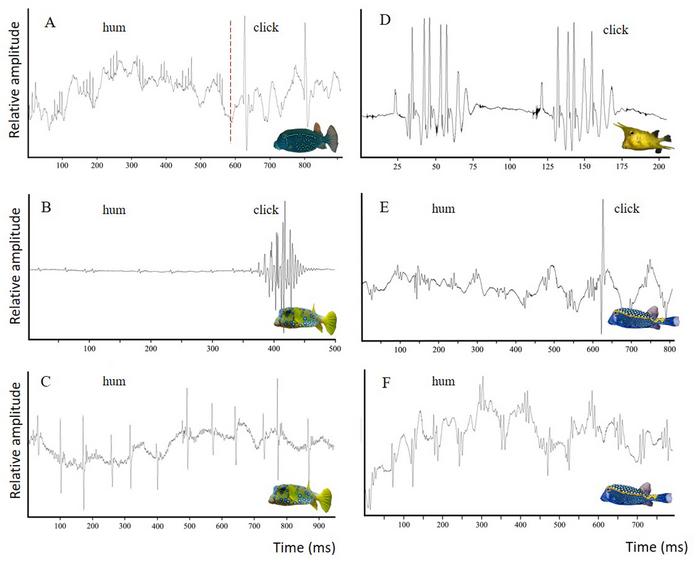
Ostracion solorensis (A), Ostracion cubicus (B, C), Lactoria cornuta (D), and Ostracion meleagris (E, F). Pulses constituting the hums in O. solorensis and O. meleagris are made of bursts of peaks and of a single peak in other studied species. Clicks in L. cornuta and O. cubicus appear to be made of different pulses and of a single pulse in O. meleagris and O. solorensis. The vertical red dashed line in A separates the hum and clicks.
Credit: University of Liège / E.Parmentier
A study new international study reveals the unexpected importance of acoustic communication in the evolution of boxfishes. This discovery offers new perspectives on the role of acoustic communication in the evolutionary history of numerous fish groups.
Generally, studies seeking to understand the evolutionary history of fish groups, notably among Cichlidae or clownfishes, use coloration patterns as means of species recognition or sexual selection. “This approach, however, completely overlooks the fact that many fishes can use acoustic communication for the same purpose,” explains Eric Parmentier, director of the Laboratory of Functional and Evolutionary Morphology (University of Liège, Belgium). “The sounds produced by fishes are then too often relegated to the background by scientists in favor of visual signals. Yet numerous species use sound in social interactions such as reproduction, territory defense, etc.” It is within this context that a new study exploring the mechanisms of sound production in boxfishes was undertaken.
Boxfishes (family Ostraciidae) are immediately recognizable by their rigid, angular body formed by the fusion of bony plates, giving them a highly characteristic box-like shape. Among the 37,000 recognized fish species, only the Ostraciidae and Aracanidae have developed this bony carapace that resembles dermal armor. “This natural armor constitutes effective protection against predators, but comes at an evolutionary cost that severely limits their body flexibility,” continues the researcher. Unable to undulate their bodies like the majority of fishes, boxfishes have had to develop an atypical swimming mode, relying exclusively on their pectoral, dorsal, and anal fins for locomotion. This method gives them a floating appearance, almost like an aquatic drone. This particularity in their swimming and maneuverability in complex environments has moreover enabled improvements in the performance of underwater robots or steerable nacelles, as they are capable of navigating complex marine environments.
The Ostraciidae are divided into two subfamilies: the Ostraciinae, found exclusively in the Indo-Pacific, and the Lactophrysinae, native to the Atlantic. “All species are capable of producing sounds, but acoustic data are lacking, particularly for Atlantic species whose sound mechanism remained unknown until now,” explains Professor Éric Parmentier. The researchers have demonstrated in these Atlantic species a novel sound apparatus, called the sphaera sonica. This structure consists of two globular masses of connective tissue surrounded by fast sonic muscles. “The system can be likened to spheres used in swimming pools to generate waves. The contraction/relaxation cycles of these muscles drive back-and-forth movements of the masses within the swim bladder, thereby generating sound. Pacific species possess a more specialized system, without globular masses, but with well-defined muscles organized around the swim bladder.” Thus, Atlantic species would represent relicts of the Ostraciidae, whereas in the Indo-Pacific they would have been supplanted by fishes that developed a more specialized acoustic system.
The story does not end there. A comparative anatomical analysis also revealed the absence of a sound mechanism in the Aracanidae, whose external armor is less rigid. The comparison between the two families highlights that certain muscles involved in undulatory swimming movements in the Aracanidae would be homologous to the sonic muscles of the Ostraciidae. In the latter, encasement in a more rigid bony box would have led to the loss of the initial locomotor function of these muscles. Two evolutionary pathways were then possible: their outright disappearance or the development of a new function. “It is this second option that materialized during evolution toward the Ostraciidae, with the emergence of acoustic communication. This transformation illustrates a marked evolutionary transition, from mute fishes to vocal species, accompanied by progressive specialization of sound-producing structures.”
This study demonstrates an evolutionary transition from one function to another with, moreover, secondary evolution toward a more elaborate sound mechanism, and underscores the importance of acoustic communication as an evolutionary factor, arguing for a reassessment of its role in the natural history of fishes.
Journal
Biological Journal of the Linnean Society
Article Title
Morphological innovations and evolutionary transitions in boxfish acoustic communication
Article Publication Date
2-Oct-2025
Disclaimer: AAAS and EurekAlert! are not responsible for the accuracy of news releases posted to EurekAlert! by contributing institutions or for the use of any information through the EurekAlert system.