
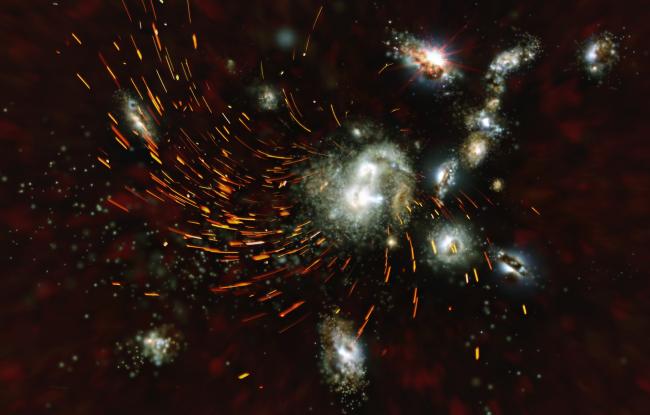
New radio observations of molecular gas reveal how dozens of galaxies could have rapidly merged together in the early Universe.
The existence of massive, evolved elliptical galaxies in the early Universe has puzzled astronomers for decades. At a point in the development of our cosmos when researchers expect to only find galaxies with young or forming stars, precocious elliptical galaxies containing older stellar populations and represent a major twist.
Now a team led by Max Planck Institute for Radio Astronomy (MPIfR) astronomers—including University of British Columbia (UBC) researchers—are shedding new light on the cosmic mystery.
“In a Universe where larger galaxies grow hierarchically through gravitational interactions and mergers of smaller building-blocks, some giant ellipticals must have formed completely differently than previously thought,” says Dr. Nikolaus Sulzenauer, PhD researcher at the MPIfR and University of Bonn, and first author on the paper published today in the Astrophysical Journal.
“Instead of slowly assembling mass throughout 14 billion years, a massive elliptical galaxy might swiftly emerge in just a few hundred million years. It can form through the collapse and coalescence of a major primordial structure in the time it takes the Sun to orbit around the Milky Way’s center once.”
Using data from the Atacama Large Millimeter-Submillimeter Array (ALMA) the team observed cold gas and dust in the center of SPT2349-56, a protocluster seen just 1.4 billion years after the Big Bang. Located in the southern constellation Phoenix, SPT2349-56 enables a rare glimpse of the Universe’s first clusters, the main hubs of massive elliptical galaxies.
“In the center, we found four tightly-interacting galaxies forging one star every 40 minutes,” adds Dr. Ryley Hill from UBC. “For comparison, it currently takes a whole year for three or four stars to form in the Milky Way.”
“SPT2349-56 holds the record for the most vigorous stellar factory,” remarks Dr. Axel Weiß, a researcher at MPIfR who was also involved in the original discovery of SPT2349-56.
The galaxy quartet launches coherent giant tidal arms at 300 kilometers per second, stretching over an area much larger than the Milky Way. The arms glow intensely at submillimeter wavelength, their brightness boosted ten-fold by shock-waves exciting ionized carbon atoms.
“This bright emission allowed us to precisely measure the motion of gas in this gravitationally ejected spiral, resembling beads on a string encircling the protocluster core,” adds Dr. Sulzenauer.
“To our surprise, clumps of tidal debris link to a chain of 20 additional colliding galaxies in the outer parts of the collapsing structure. This hints at a common origin. For the first time, we are witnessing the onset of a cascading merging transformation. Most of the 40 gas-rich galaxies in this core will be destroyed and will eventually transform into a giant elliptical galaxy within less than 300 million years – a mere blink of an eye.”
Duncan MacIntyre and Joel Tsuchitori, two UBC undergraduate students and part of the team, ran detailed numerical simulations. These were essential to bridge observations of this protocluster collapse with previous studies of mature galaxy clusters.
The striking match between the different types of objects, found at different cosmic times, might not just demonstrate the importance of simultaneous major mergers during massive galaxy formation. It may also help to explain how heavy elements (such as carbon) are heated and transported throughout the first galaxy clusters.
“While our findings offer exciting new insights into rapid elliptical galaxy assembly, the various interactions between the merger shocks, gas heating from the growth of supermassive black holes, and their effect on the fuel for star-formation, remain big mysteries,” remarks team member Dr. Scott Chapman of Dalhouse University.
“It might be too early to claim a full understanding of the ‘early childhood’ of giant ellipticals, but we’ve come a long way in linking tidal debris in protoclusters to the formation process of massive galaxies located in today’s galaxy clusters.”