
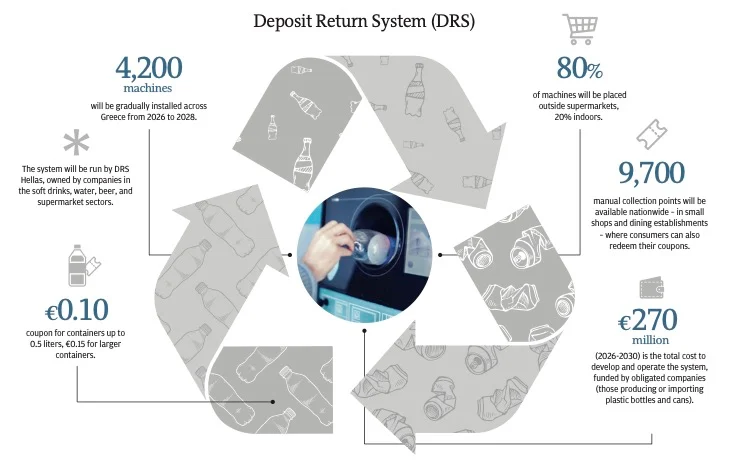
Major changes in recycling are coming to Greece in 2026. The country is set to roll out a new system for returning plastic bottles and metal cans in exchange for a refund. The system will gradually cover the entire country over two years, with more than 4,200 return machines and 9,700 non-machine collection points, ranging from small grocery stores and large kiosks to restaurants. Its introduction will also bring changes to the blue recycling bin, as the packaging collection system will need to be adjusted. Additionally, the first systems for collecting old mattresses and furniture are expected to be launched this year.
No longer optional
The concept of a deposit return system (DRS) is not new. In 1989, Iceland became the first country to implement a system for recovering single-use plastic bottles and aluminum cans. In Greece, a similar system has long been familiar through glass beer bottles. The DRS works by adding a small deposit to the product price, which is refunded to the consumer when the bottle is returned to a designated collection point. The system offers two key benefits: high recycling rates and exceptionally “clean” materials for recycling.
For the European Union, such systems are now mandatory. EU directives on single-use plastics and waste management require member-states to implement similar systems at least for single-use bottles. Across Europe, these systems have typically been organized by the private sector – that is, the companies considered “producers” under the law, including importers and retailers. Implementing a DRS is complex, requiring close cooperation among competing companies, strong state oversight, and significant investment.
In Greece, the system’s rollout has been delayed. It was legislated under Law 4736/20, but two years were needed to finalize the details through a joint ministerial decision in 2022, which was amended in 2025. Initially, the plan was to include glass bottles and milk cartons, but these were ultimately excluded. The start date was postponed several times, reaching December 2025, and the system never launched.
New authority
A few months ago, DRS Hellas was established to manage the deposit system. Its shareholders include the Greek Supermarket Association and 11 companies, ranging from multinationals like Coca-Cola 3E, Athenian Brewery, and Olympic Brewery, to Greek producers of brands such as Vikos, Zagori, Loux, Seli, and Epsa. In the coming months, DRS Hellas will submit its operational plan to the Environment Ministry’s Hellenic Recycling Agency (HRA/EOAN), detailing how the system will expand over the next five years.
“It is a complex project with many stakeholders, requiring excellent organization and communication to succeed,” Nikos Mamoulis, general manager of DRS Hellas, tells Kathimerini. “After considerable effort, we have finalized the operational plan, which will be submitted for EOAN approval within the next two months. Our goal is for the system to recycle 90% of packaging circulating in the Greek market by the end of 2028. Any water, beverage, or soft drink packaging that does not bear the DRS logo – that is, has not joined the recycling system – will not be allowed on the market.”
As expected, the system’s launch will need to be postponed. DRS Hellas says it can begin operations this summer. “We are already well prepared. Legislation does not allow for a pilot rollout, so we must launch simultaneously nationwide and reach full coverage within two years. Geographic factors, including Greece’s islands and seasonal tourism, have all been considered.”
How the DRS will work
Once operational, consumers will be able to return plastic bottles and aluminum cans for 10 euro cents per container up to half a liter, and 15 euro cents for larger sizes. Refunds will be issued via coupons redeemable at supermarkets.
Mamoulis explains that collection and refunds will occur either through machines, primarily located outside supermarkets, or manually at smaller points such as large kiosks or restaurants. In limited spaces, machines may also be placed in shared public areas – though this has raised debate due to the “recycling huts” (better known in Greek as “spitakia”) that have previously occupied squares and sidewalks. “I believe citizens will quickly see the positive impact the system will have on recycling,” he says.
The rollout plan
According to Kathimerini sources, operations will begin with 3,400 machines in 2026, growing to 4,200 machines by 2028. Eighty percent will be outdoors, at supermarkets or other locations, and will operate six days a week. Around 9,700 manual collection points will exist nationwide, where refund coupons will be issued. Machine purchase costs are estimated at €188 million, with annual operating costs of €25-30 million. Market sources note that competition over the selection of machines has been a key reason for DRS delays. When asked if he had faced any external pressure, Mamoulis replied no.
Impact on recycling
The new system for bottles and cans of soft drinks, water, and beer is expected to trigger chain reactions across Greece’s recycling system. The first to be affected will be packaging recycling – namely, the blue bins managed by Hellenic Recovery Recycling Corporation (HERRCO/EEAA) and the Rewarding Recycling “huts.”
“The start of the DRS will redefine our activities,” says Yiannis Razis, general manager of EEAA. “These packages account for just 8% of packaging waste by weight – about 70,000-90,000 tons per year – but plastic packaging occupies significant volume. If diverted through DRS, the blue bin will ‘breathe,’ improving overall collection efficiency. The main challenge will be financial: EEAA will lose member contributions for managing these quantities, and, more significantly, revenue from selling PET (Polyethylene Terephthalate, a type of plastic commonly used for drink bottles) and aluminum in the recycling market – around €810 million per year. Once DRS is licensed, the packaging recycling system will need to be restarted. This is an opportunity to resolve long-standing issues.”
EEAA is currently finalizing its five-year business plan, due to EOAN by March. “To meet our goals, recycling vehicles and bins must be renewed, and sorting centers (KDAY) modernized, as no major investments have been made since 2009 due to the financial crisis. State approval will also be needed for an increase in contributions from obligated companies,” Razis adds.
“The stagnation in recycling must end. DRS will be the catalyst,” says Manolis Grafakos, general secretary for waste management coordination at the Environment Ministry. “It is crucial to create a system that increases recycling while being citizen-friendly. We are in final discussions to ensure DRS is implemented in 2026.”
Grafakos emphasizes that separate sorting will be strengthened in the coming years. “We expect at least a doubling of glass collection points, a separate network of yellow bins for paper, and increased collection equipment. The ministry will provide municipalities with equipment for other recyclables beyond packaging. This year, systems for mattresses and furniture will also be introduced.”