
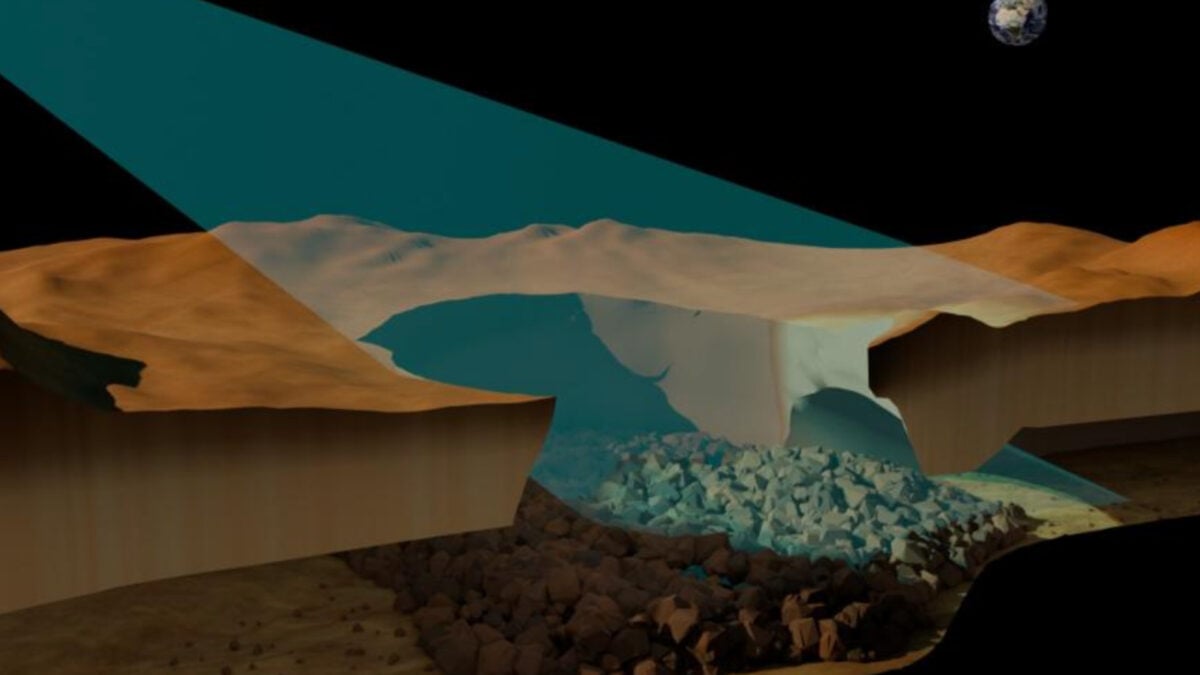
Researchers had only hypothesized the existence of underground lava tubes on Venus—until now.
Using decades-old radar data, a team of scientists in Italy has discovered an empty, subsurface lava tube on the solar system’s hottest planet. It represents the first time researchers have proven the presence of lava tubes, also known as pyroducts, on Venus, frequently referred to as Earth’s twin sister.
“Until now we have never had the opportunity to directly observe processes occurring beneath the surface of Earth’s twin planet. The identification of a volcanic cavity is therefore of particular importance, as it allows us to validate theories that for many years have only hypothesized their existence,” Lorenzo Bruzzone, head of the Remote Sensing Laboratory at the University of Trento’s Department of Information Engineering and Computer Science, said in a university statement. “This discovery contributes to a deeper understanding of the processes that have shaped Venus’s evolution and opens new perspectives for the study of the planet.”
From theory to discovery
Bruzzone is co-author of the study published yesterday in the journal Nature Communications. He and his colleagues found the empty lava tube by studying radar images from NASA’s Magellan spacecraft, which mapped the planet’s surface at the beginning of the 1990s with its Synthetic Aperture Radar instrument. Radar identifies and investigates faraway things by shooting out radio waves.
In the recent study, they investigated the images with “signs of localized surface collapses using an imaging technique that we have developed to detect and characterize underground conduits near skylights,” Bruzzone explained. Skylights in the context of lava tubes are not that different from their architectural counterparts. They’re holes where the pyroduct’s ceiling—which is also the planet’s surface—has fallen in.
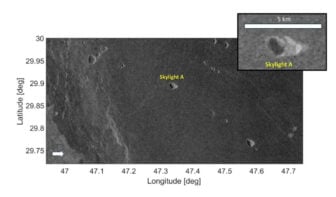 When part of a lava tube ceiling caves in, it forms a skylight. © Image taken from the paper, Nature Communications, 2026, doi 10.1038/541467-026-68643-6
The team found a large underground channel in Venus’ Nux Mons area, which they determined to be a potential lava tube. They estimated its diameter to be around 0.62 miles (1 kilometer) and its roof 492 feet (150 meters) or more thick.
“The available data allow us to confirm and measure only the portion of the cavity close to the skylight. However, analysis of the morphology and elevation of the surrounding terrain, together with the presence of other pits similar to the one studied, supports the hypothesis that the subsurface conduits may extend for at least 45 kilometers [28 miles],” continued Bruzzone. “To test this hypothesis and identify additional lava tubes, new higher-resolution images and data acquired by radar systems capable of penetrating the surface will be required.”
Volcanic Venus
Radar data from Magellan had previously revealed indications of live volcanic processes on Venus. Volcanic activity has significantly molded Venus’ geology and surface, but identifying extraterrestrial pyroducts is difficult. These underground structures tend to exist out of sight, unless skylights form, possibly unveiling the lava tube and a possible entrance. Venus’ dense cloud coverage furthers the difficulties—regular cameras can’t see the planet’s surface, so researchers have to use radar images. Lava tubes on the Moon might one day shelter humans. On Earth, we’ve hung out in at least one pyroduct.
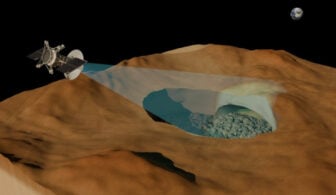 Researchers used radar data to identify Venus’ lava tube. © RSLab University of Trento
The apparent Venusian lava tube seems to be taller and wider than the ones observed on our planet. Given the planet’s longer and larger lava channels compared to the ones seen on other planets, this doesn’t come as a surprise.
The advanced radar systems on spacecraft associated with the forthcoming NASA’s Veritas and the European Space Agency’s EnVision Venus missions will enable researchers back on Earth to investigate small holes on the planet’s surface more meticulously.
“In addition, EnVision will carry an orbital ground penetrating radar (Subsurface Radar Sounder) capable of probing Venus’s subsurface to depths of several hundred meters and potentially detecting conduits even in the absence of surface openings,” Bruzzone said. “Our discovery therefore represents only the beginning of a long and fascinating research activity.”