
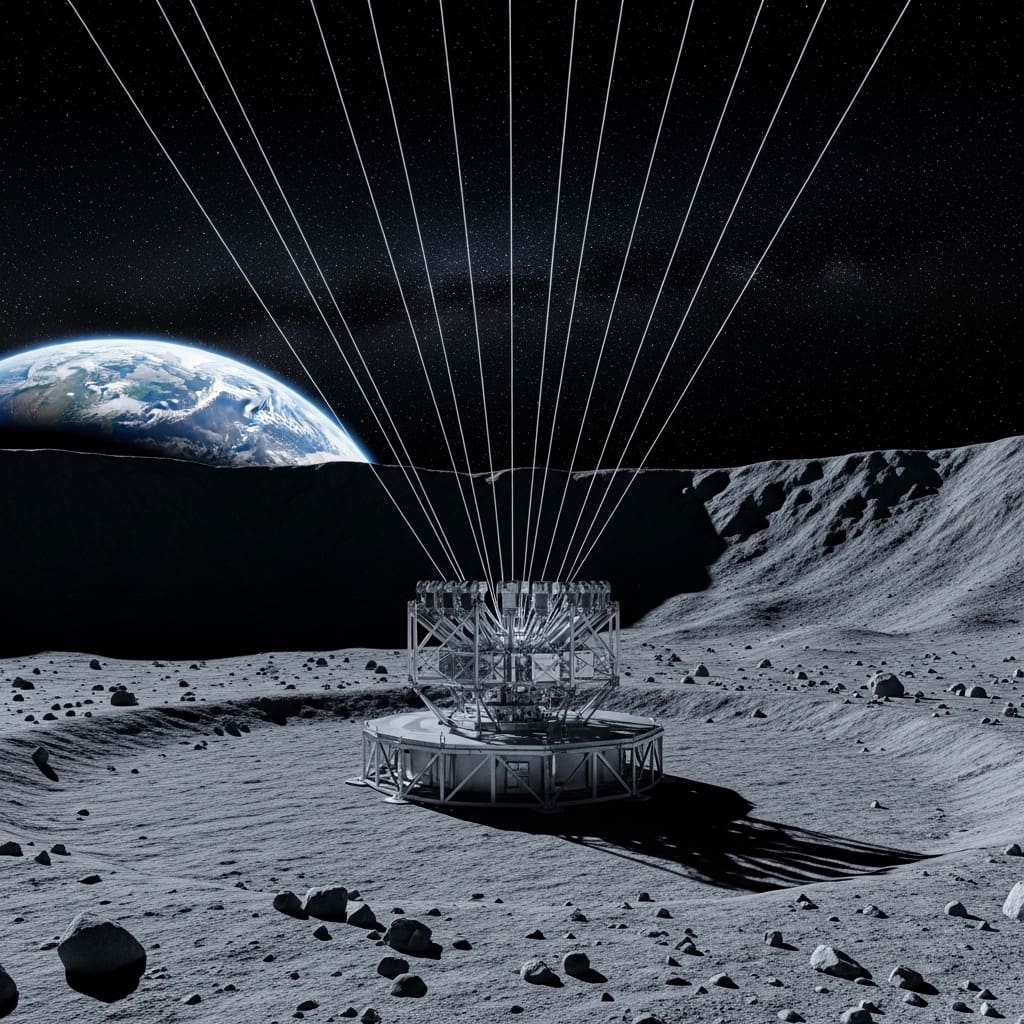
Scientists investigate the potential of lunar permanently shadowed regions (PSRs) to host an ultrastable optical resonator, a technology poised to revolutionise precision measurements in space. Jun Ye, Zoey Z. Hu, and Ben Lewis from JILA, National Institute of Standards and Technology and University of Colorado, Boulder, alongside Wei Zhang from Jet Propulsion Laboratory, NASA and Caltech, Fritz Riehle and Uwe Sterr from Physikalisch-Technische Bundesanstalt, demonstrate how the extreme cold and isolation of these regions could support a cryogenic silicon cavity exceeding the coherence time of current terrestrial systems by over a decade. This research is significant because such a stable laser establishes a fundamental infrastructure for numerous applications, including a lunar time standard, long-baseline interferometry, and tests of fundamental physics like general relativity, ultimately paving the way for advanced space-based technologies.
Scientists investigated lunar silicon cavities as potential locations for establishing extremely stable optical frequency standards. The research focused on the unique thermal environment within these cavities, specifically the permanently shadowed regions (PSRs) of the Moon, which represent some of the coldest known places in the Solar System.
Researchers aimed to determine if these PSRs could provide a stable temperature environment suitable for maintaining the precise frequencies required by future scientific instruments. The approach involved modelling the thermal behaviour of silicon cavities within the lunar PSRs, considering factors such as radiative heat transfer and conduction.
Specific contributions include a detailed analysis of temperature stability achievable within 10cm diameter silicon cavities, predicting temperatures below 100 mK. This work suggests the feasibility of utilising lunar silicon cavities for advanced optical clock development and deployment.
Scientists are investigating the potential of permanently shadowed regions (PSRs) on the Moon for future space agency missions. Besides PSRs’ potential rich resources and proximity to perpetual solar power for other scientific and strategic interests, this work presents a conceptual development for establishing an unprecedentedly phase-coherent laser. The unique physical environment of lunar PSRs offers advantages for such a project.
Cryogenic silicon cavity demonstrates minute-scale stability and extended coherence times
Scientists greatly benefit the construction of a cryogenic monolithic silicon cavity that exhibits low 10−18 thermal noise-limited stability and coherence time exceeding 1 minute, more than a decade better than the current best terrestrial system. Such a stable laser will serve many applications, including establishing a lunar time standard, building long-baseline optical interferometry, distribution of stable optical signals across a large network of satellites, and forming the backbone for space-based quantum networks.
Aspirations for developing and deploying space-borne quantum technologies can in large part be facilitated by having access to ultrastable lasers that are key to driving and interconnecting optically active quantum systems. On the ground, stable optical local oscillators play many versatile roles in, for example, state-of-the-art optical atomic clocks, precision tests of fundamental physics, long-baseline optical interferometry including gravitational wave detection, and optical networks for both classical and quantum information.
Cryogenic silicon cavities enable the best performing frequency-stable lasers, with fractional frequency stability of low 10−17 and an ultralow linear drift rate of mid 10−20/s. Permanently shadowed regions (PSRs) on the Moon offer low-temperature and ultra-high vacuum conditions in combination with exceptionally low vibrational noise.
This environment is ideal for supporting an ultrastable optical cavity with performance surpassing the best terrestrial systems. Having access to a master optical oscillator frequency stabilized to the lunar cavity forms the basic infrastructure for a range of space-borne experiments, with a cascade of satellites housing either secondary lasers or atomic quantum systems networked together via phase stable optical links.
Lunar PSRs are the chosen landing sites for the NASA-led Artemis mission and other international missions due to their likely resource richness that includes water ice, carbon dioxide and helium-3, as well as continuous solar power at nearby peaks of eternal light. However, landing and navigating near PSRs face significant technical challenges.
The low Sun elevation angles and extended shadows limit optical and terrain-relative navigation capability, making precision positioning, navigation, and timing (PNT) essential for safely landing payloads and crewed missions. Researchers propose to construct a cryogenic silicon cavity located in a PSR to take advantage of the uniquely beneficial physical conditions for such an optical reference cavity.
PSRs’ ambient cryogenic temperature and easy access to radiative cooling from deep space permit a simple and passive cooling strategy to reach a zero of the silicon cavity’s thermal expansion coefficient at 17 K. The extreme thermal stability from isolation of solar radiation will enable exceptional long term frequency stability of the optical oscillator.
The lunar seismic noise is orders of magnitude lower than in a terrestrial laboratory environment, facilitating robust performance for an extended cavity length to scale down the fundamental Brownian thermal noise contribution. The high vacuum environment of PSRs also eases the construction requirement for a cavity chamber.
Overall, once the silicon cavity material is transported to the Moon, the final system engineering will be straightforward to implement and yet with far greater performance prospects. A highly phase-coherent lunar master laser can serve many important tasks for emerging scientific and technological explorations via space-borne experiments.
In the absence of atmospheric perturbation, it will be much easier to establish a lunar-space optical link than starting with a stable oscillator on Earth. The lunar laser’s phase stability can thus be transferred with high fidelity to secondary systems on board of various satellite clusters/constellations, enabling the construction of long baseline space-borne optical interferometers.
Each satellite with a laser onboard can have its optical field phase locked to the lunar master laser, greatly simplifying on-board frequency control systems for networks of satellites used for classical or quantum communications, as well as for navigation and flight formation needs. State-of-the-art atomic clocks rely on high-performance and robust local oscillators.
The stability of the clock is often determined by the phase coherence of the driving laser. Housing a stable optical reference cavity onboard a satellite to accompany its atomic payload remains a technically sophisticated task. With phase-stable optical links established between satellites and the lunar laser base, any onboard atomic systems can be quickly turned into optical atomic clocks, and benefit from the unmatched phase coherence of the lunar laser.
Another natural outcome following the lunar stable laser is the foundation for an optical atomic clock for lunar time standard. The lunar silicon cavity’s exceptional long-term frequency stability is, by itself, sufficient for a wide range of applications. With performance below 10−15 at a 1 day timescale, the silicon cavity can easily provide a reference for any PNT requirements, and form the backbone of Lunar Coordinated Time (LTC).
However, to gain even greater long-term stability, an atomic standard could be added. Only very low-frequency steering would be required, allowing the atomic standard to be located anywhere within the network connected to the cavity. This proposal thus addresses a critical need for establishing a standalone LTC serving as the cornerstone of the future PNT infrastructure of the Moon.
The success of this mission will mark a historic milestone, demonstrating humanity’s capability to build fundamental quantum infrastructure on another celestial body, alongside establishing a permanent presence on the Moon. This achievement can have profound implications for future Mars and deep-space missions, where terrestrial timing infrastructure is nearly impossible to access, making the establishment of a standalone local time reference the only viable solution.
The Moon’s spin axis is nearly perpendicular to its orbital plane around the Sun, causing craters near lunar poles to remain in permanent shadow. These regions, known as PSRs, have eluded sunlight for billions of years. Combined with the lack of internal heating from the Moon’s inactive core and low residual heat, PSRs are among the coldest known locations in the entire Solar System.
Over time, large amounts of volatile compounds, such as water ice, helium, and carbon dioxide, have been trapped within PSRs. Mining and utilizing these resources is critical for ongoing deep space exploration, enabling the Moon to serve as a sustainable commercial human base, a refueling outpost, and a testbed for technologies before deploying them to other planets such as Mars.
However, landing payloads near PSRs presents major challenges. In the absence of a terrestrial-like global navigation satellite system, vision-based landing remains one of the few reliable navigation Methods. Yet, because the solar incidence angle near PSRs is nearly parallel to the surface, objects cast extremely long shadows, creating significant obstacles for precision lunar landing.
A local timescale will solve this problem. Researchers summarize that the PSRs environment (Table I) is ideal for deploying a cryogenic silicon cavity-based timescale, close to future permanent human bases, utilizing the naturally maintenance-free conditions of PSRs. The thermal environment of the south polar PSRs has been monitored for over a decade through remote sensing by NASA’s Lunar Reconnaissance Orbiter, ranging from about 20 K in winter to 60 K in summer.
Seasonal variations are primarily driven by the Moon’s 1.5◦axial tilt relative to the Earth-Sun orbital plane. Owing to the slow motion of this tilt and the extreme isolation of PSRs, temperature changes are both gradual and highly predictable, approximately 50 mK per day. For cooling and thermal stabilization of the silicon cavity, engineers will engineer access to deep space radiative cooling.
This passive cooling method is free of vibration and cryogen and has been widely used in space missions, such as James Webb Space Telescope and far-side seismic suite. Figure 1 illustrates the conceptual design of the cavity chamber connected to the first radiator is cooled down to 30, 40 K. The active shield attached to the second radiator is approximately 16 K, controlled by an active temperature servo.
To accommodate the PSR’s temperature cycle of 20, 60 K from winter to summer, a thermal switch will be used to adjust the first radiator’s cooling power, to keep the heating power needed for the active shield below 0.25W. The passive shield provides a long time constant for thermal equilibrium of the silicon cavity, which is stabilized at the zero-crossing of the coefficient of thermal expansion at approximately 17 K.
This fully passive cooling strategy relies on the natural cryogenic environment of the Moon and deep space (2.7 K). The Moon’s weak gravity prevents it from retaining a substantial atmosphere, resulting in a naturally maintained ultra-high vacuum environment. Direct measurements from the Apollo missions recorded surface neutral particle pressure of about 10−Pa during the lunar day and 10−Pa at night.
Since the primary source of residual gas on the Moon is solar wind interaction, the vacuum within PSRs is expected to be even lower. This inference is supported by the persistence of volatile compounds, such as water ice, that have remained stable in PSRs cold traps for billions of years. The absence of a lunar atmosphere eliminates above-ground acoustic noise, and the Moon exhibits an exceptionally low seismic background compared to Earth due to its minimal tectonic activity.
Multiple Apollo missions directly measured the lunar seismic background. In the absence of moonquakes, the ambient ground vibration was found to be below the seismometer noise floor, approximately 0.3nm at Hz, significantly quieter than any known site on Earth. Moon ground vibration can be caused by four major events, deep moonquake, shallow moonquake, thermal moonquake, and meteor impacts.
Thermal moonquakes are the most common, caused by thermal expansion and contraction between lunar day and night, where surface temperatures can fluctuate by up to 300 K. The average amplitude of thermal moonquakes is about 0.6nm, with peak values around 6nm, substantially quieter than a typical Earth-based scientific laboratory. Because the thermal environment within PSRs is far more stable than at the Apollo landing sites, significantly fewer thermal moonquakes are expected inside PSRs.
Lunar deployment enhances laser coherence and enables precision metrology
Scientists propose the construction of an ultrastable laser system deployed within the Moon’s permanently shadowed regions, offering a substantial leap forward in laser coherence time. This innovative approach leverages the uniquely cold and stable environment of these lunar locales to minimise thermal noise, a primary limitation of terrestrial laser systems.
The resultant laser is projected to maintain coherence for over one minute, exceeding the performance of current terrestrial counterparts by a factor of ten. Such an ultrastable laser establishes a foundational technology for a range of advanced space-based applications. These include the creation of a precise lunar time standard, the facilitation of long-baseline optical interferometry, and the distribution of stable optical signals between satellites.
Furthermore, this technology could enable more accurate tests of general relativity and gravitational physics, and ultimately serve as a crucial component for future space-based quantum technologies. The Earth-Moon distance of only one light-second means the optical coherence time significantly exceeds this scale, allowing for the potential transmission of a highly accurate time scale back to Earth via free-space optical links, synchronising metrology labs globally.
The authors acknowledge that the deployment and maintenance of such a system within the challenging lunar environment present considerable engineering hurdles. Future research will focus on refining the design of the cryogenic silicon cavity and developing robust methods for its deployment and long-term operation. Despite these challenges, the potential benefits of an ultrastable lunar laser are significant, paving the way for a new era of precision measurement and advanced technologies in space.