
Prime Tire Newsletter | This is The Athletic’s F1 newsletter. Sign up here to receive Prime Tire directly in your inbox twice a week during the season and weekly in the offseason.
Welcome back to Prime Tire, where today we can acknowledge that Formula 1 launch season is over, preseason is still going with the second test starting tomorrow and the actual season of racing is still to come.
Classic, complicated, F1.
I’m Alex, and Madeline Coleman will be along later.
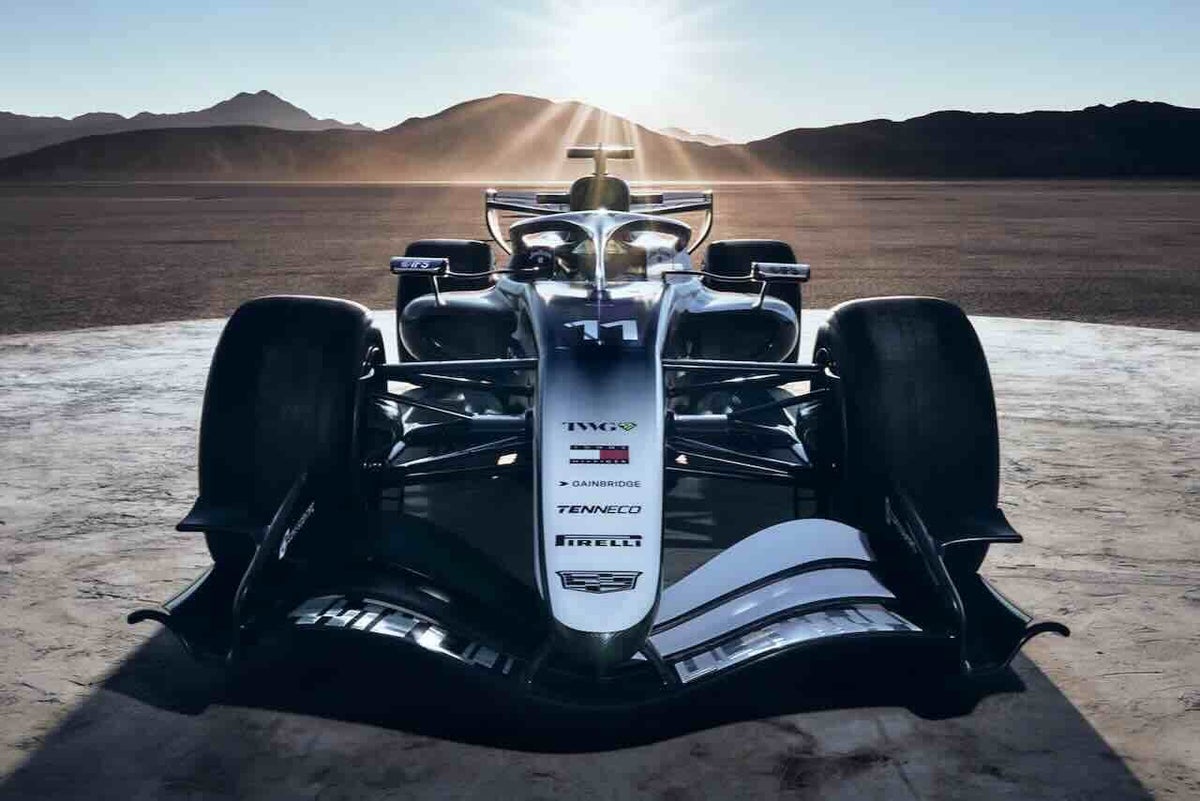
Super Bowl Splash: Cadillac reveals livery after ad lawsuit filed
Given Cadillac spent around $7 million-8 million to reveal its first F1 livery during Super Bowl LX — along with a joint reveal of the color scheme on a show car positioned in New York’s Times Square — there was plenty to anticipate from the team on Sunday.
Unfortunately for F1’s newest team, its TV commercial slot came in the fourth quarter of a game that was long over, thanks to a terrorizing Seahawks defense and lack of Patriots offense.
Anyway … Cadillac delivered a slick, if complex, commercial. One that split both actual advertisement critics and commenters on Madeline’s story about the reveal (see some of the comments below).
There was a lot to unpack, starting with a story that actually broke ahead of the commercial airing: Hollywood director Michael Bay is suing Cadillac for $1.5 million. The complaint alleges team CEO Dan Towriss and his team “have apparently stolen Bay’s ideas and work for the commercial, without paying for them.”
That alone is staggering.
Then there’s how Cadillac’s asymmetric livery — it’s mostly black on one side of the car and white on the other — gets entangled in F1’s often baffling rules. Specifically, Article A2.3.4.e of Section A of F1’s 2026 ruleset.
This rule states: “Liveries may not protrude beyond the bodywork of the F1 car and must be substantially similar on both sides of the F1 car.”
Officially, that rule has existed since 1998 to force teams to run two cars in the same color scheme, regardless of sponsorship deals they may agree to, unlike in NASCAR or IndyCar. Unofficially, that rule had existed for a decade beforehand.
There had been instances of teams running different liveries across cars going even further back in F1 history — such as McLaren at 1984 Portuguese Grand Prix, or Tyrrell for much of that year.
But, generally, team uniformity was the norm. At the end of the last century, F1’s main stakeholders really wanted cars to look the same to help build brands and aid spectators in viewing cars flashing by at 200 mph.
Enter British American Racing.
The team, which today competes as Mercedes, was most commonly known as its acronym BAR for the seven F1 seasons it completed before selling up to Honda. The team later became Brawn GP and then Mercedes in 2010.
Unlike Cadillac’s approach of under-promising in the hope of over-delivering on track, BAR was bombastic about its chances in its debut F1 season in 1999 (it ultimately scored no points that year).
In a bid to promote two of the cigarette brands under team owner British American Tobacco, BAR wanted its first F1 design to have two different liveries for drivers Jacques Villeneuve and Ricardo Zonta.
But the FIA said this contravened the new late-1998 rule addition. And things got ugly.
BAR boss Craig Pollock argued this rule restricted his team’s commercial work and a complaint was even filed with the European Commission executive branch.
This followed the FIA ruling BAR couldn’t run different liveries and the team presenting a compromise of one livery that split the two liveries over one car. (More classic F1 complexity.)
Eventually, both sides settled their dispute and BAR was not banned from competing in any races in 1999. That’s how far things could’ve gone.
The rules on F1 liveries have barely changed since — bar small updates such as the requirement to add larger driver numbers to the cars, again to aid spectator viewing, which came in 2017. And the issue hasn’t arisen again, until now.
In a launch season where Red Bull’s livery is harking back to its first F1 golden age of the early 2010s and the new cars overall look like the machines that competed in the 2000s, Cadillac’s color choice just evoked even more F1 memories.
The team sought clarification on whether it could have an asymmetric livery, and this was apparently forthcoming from the FIA.

As these readers’ comments show, people care how F1 cars look, even the basic elements, such as paint. (Note: Cars are mostly colored in vinyl wrapping these days, but let’s not introduce MORE complexity …) And the largely black color schemes of recent years used to save weight annoyed many fans.
It’s one of those classic over-a-beverage topics. And we’re going to be delving even further into it in the coming days, when Luke Smith and Madeline rank all 11 2026 liveries now that they’re all out in the open.
For me, the livery looks … good. Solid, even.
The intriguing asymmetry saves it from a negative adjective, and I really like white F1 cars (the Racing Bulls design since 2025 has topped the class for me). But I do wish Cadillac went a bit bolder.
The team stayed in the news today as it announced Lewis Hamilton’s long-time manager Marc Hynes as its chief racing officer. Hynes also has a long history with Cadillac team principal Graeme Lowdon.
Now over to Madeline for an update on Cadillac’s plans to build its own F1 engine.
Inside the Paddock with Madeline Coleman: Cadillac’s own engine still 3 years away
Cadillac’s goal for introducing its own F1 engine is still 2029, Towriss said yesterday.
“The project’s ahead of schedule, actually,” he said. “As of right now, we’re slated to bring the Cadillac power unit online to compete in 2029, and there’s some developing power unit regulations as well.
“So we’re keeping a close eye on all of that. But in terms of this current reg set, we’re on schedule to have a power unit for 2029.”
Cadillac will use a customer Ferrari engine for its first three F1 seasons, but last spring, the FIA approved Performance Power Units to be an engine supplier starting in 2029. The company was founded by TWG Motorsports and General Motors.
F1’s next engine regulation rule change is slated to occur in 2031, but there have been conversations about whether to move that up.
“We’re really following the conversation on the regs closely,” Towriss said. “It’s possible that they don’t change before 2031. Regardless of the funding, I think it’s important that we see a Cadillac power unit on the grid as soon as possible.
“That’s really the main focus, from my standpoint. If there are ways to speed it up, we will. But right now, the focus is still 2029.”
Back to you, Alex.
Antonelli’s Crash: Italian not expected to miss testing time
Mercedes driver Kimi Antonelli was involved in a road car crash near his home in San Marino on Saturday.
The 19-year-old — just 13 months from obtaining his road license ahead of his F1 debut with Mercedes in 2025 — crashed on the freeway near Serravalle, San Marino.
No other vehicles were involved, and Antonelli is still expected to join George Russell for the three days of testing starting in Bahrain tomorrow.
Italian newspaper Gazzetta dello Sport reported that law enforcement is investigating the cause and details of the incident, which it said involved Antonelli’s extremely long-named Mercedes-AMG GT 63 Pro 4Matic+ Motorsport Collectors Edition super car.
Here’s all we know so far, including an update on the engine argument currently involving Antonelli’s Mercedes team. If it wins that debate, it seems set for a strong 2026 season, if not more pain could be on the way — as Luke explained here last week.
Outside the points
🍊 Madeline has McLaren’s 2026 livery reveal.
🇺🇸 Madeline also broke the news that 16-year-old American driver Payton Westcott will represent Mercedes in F1 Academy this year.
🇬🇧 Madeline also also covered Aston Martin finally presenting its 2026 F1 car.
✅ With that, F1’s 2026 launch season concluded. The second test starts tomorrow and runs until Friday, with the third following next week.
📫 Love Prime Tire? Check out The Athletic’s other newsletters.