
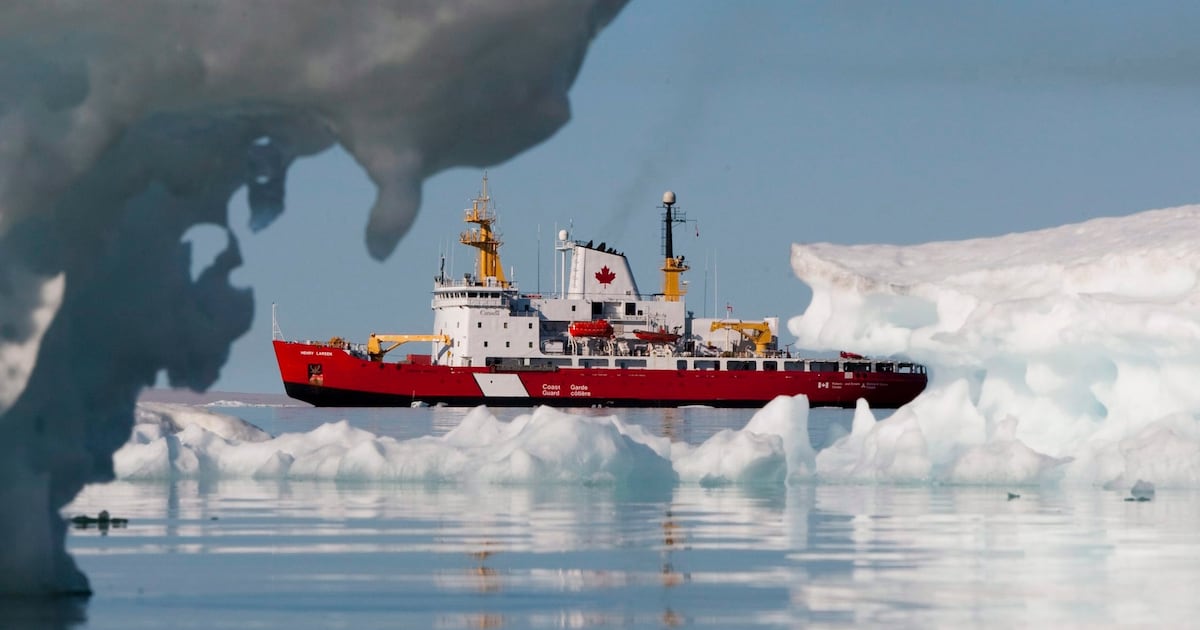
Former chief of defence staff retired Gen. Tom Lawson says it’s more difficult for the military to deploy to Canada’s Arctic archipelago than to Greenland.
Gen. Tom Lawson is a retired Royal Canadian Air Force general. He was Chief of the Defence Staff of Canada’s Armed Forces from October 2012 to July 2015 and was previously Deputy Commander of the North American Aerospace Defence Command. He is currently Chair of the Board at the Conference of Defence Associations Institute (CDAI) and consults Canadian and American defence and security firms. This is his guest column for CTVNews.ca.
Unless you have spent long hours flying over Canada’s Arctic, it is difficult to grasp its scale, its harshness, or its emptiness. And yet this forbidding territory is becoming one of the most strategically important parts of our country’s future.
Why does it matter? Who else is interested in it? And what must Canada do to protect its sovereignty?
The supply flight from the air base in Trenton, Ont. to Canadian Forces Station Alert, the northernmost station on Ellesmere Island, takes roughly the same time as to fly from Trenton to Ireland. And from about an hour north of Trenton onward, there are almost no settlements to see; only rock, ice, water, and wilderness.
Canada’s Arctic Archipelago, more than 36,000 islands north of the mainland, is home to just 25,000 people. By comparison, the United Kingdom is six times smaller in area and home to 70 million people. Many of these islands are ice-covered year-round, and the most northerly endure months of continuous winter darkness. This land may look empty and inhospitable, but it is far from worthless.
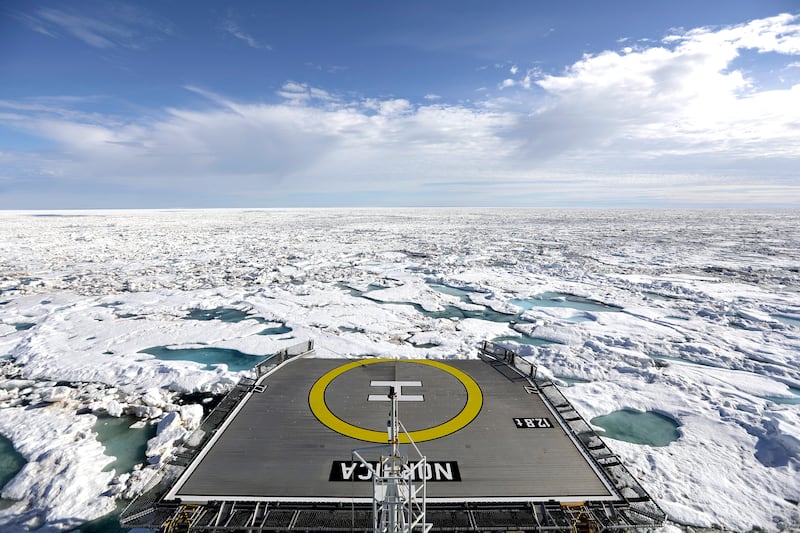 Canada’s Arctic Archipelago The Finnish icebreaker MSV Nordica sails through sea ice floating on the Victoria Strait along the Northwest Passage in the Canadian Arctic Archipelago on July 21, 2017. (AP Photo / David Goldman)
For decades, scientists have known the Arctic holds vast reserves of oil, gas, and critical minerals. Climate change and advancing technology are now making those resources increasingly accessible. At the same time, melting ice is opening maritime routes through the waterways between the islands.
As a result, Canada’s claim to sovereignty over the archipelago, and its long-standing position that these waterways are internal Canadian waters, not international straits, is being viewed with growing skepticism by rival powers with strategic and economic interests in the region.
Canada’s legal claim to the Arctic Archipelago dates to 1880, when Britain transferred sovereignty to Canada. But that history is not without weakness. Many islands were not fully mapped until decades later, and some were discovered by European and American explorers.
To strengthen its claim, Canada sent expeditions north as early as 1908 and established RCMP posts and patrols in the 1920s. Over time, trade posts were built, Inuit presence was recognized as a foundational element of sovereignty, disputes were resolved with the United States and Denmark, and Canada became a founding member of the Arctic Council.
For much of the 20th century, this was enough. Few nations cared much about the Arctic, and even fewer about the Canadian Arctic. Its harsh climate and isolation made it strategically inconvenient and economically unattractive. Canadian governments grew comfortable. But some historians, diplomats, and defence officials warned that this complacency would not last.
Legal claims aren’t enough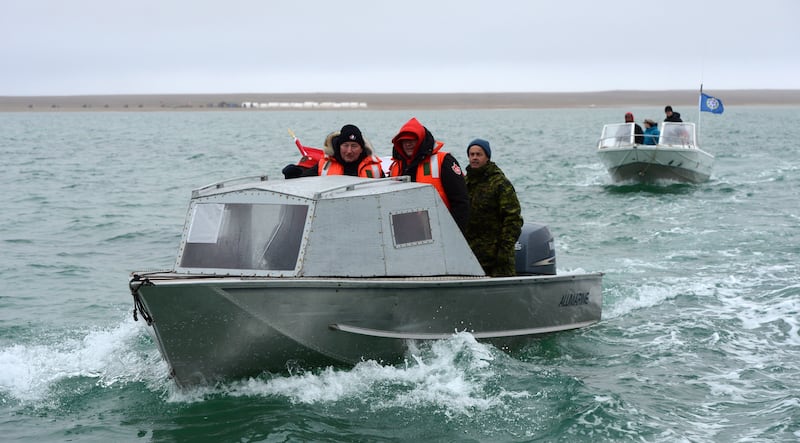 Stephen Harper Rob Nicholson Tom Lawson File photo of Prime Minister Stephen Harper (centre), Minister of Defence Rob Nicholson (left) and Chief of Defence Staff Gen. Tom Lawson (right) take part in a patrol near Gjoa Haven, Nunavut on Wednesday, Aug. 21, 2013. THE CANADIAN PRESS/Sean Kilpatrick
In the mid-2010s, when I was Chief of the Defence Staff, the rhetoric around the Arctic grew stronger. I would accompany Prime Minister Stephen Harper on his annual summer visits to the high north where he famously spoke of “forces on the ground, ships in the sea, and proper surveillance.”
But ambition was not matched by investment. The long-promised naval facility at Nanisivik remains unfinished. Arctic radar systems were last modernized in the 1980s and offer limited awareness of activity across the archipelago. Communications remain unreliable because few satellites effectively cover the high north. Canada talked sovereignty but lacked the tools to enforce it.
To be fair, Canada has never been blind to the problem. Successive defence policies emphasized Arctic operations. Annual military exercises pushed the Canadian Armed Forces farther north.
But reality intervened: the navy lacked ice-capable ships, the army lacked vehicles suited for tundra and ice, the air force lacked northern operating bases, and all services lacked the infrastructure for sustained command, control, and domain awareness. Sovereignty, in practical terms, requires presence, and presence requires capability.
Here is the good news: that is finally changing.
Investment becoming reality
Canada is now investing in the systems that make sovereignty real. Satellite constellations for Arctic surveillance and communications, new radar systems, remotely piloted aircraft, maritime sensors, modernized northern airfields, new submarines, Arctic-capable support hubs, and powerful new Coast Guard icebreakers are all underway.
These are not slogans; they are funded projects. Some will arrive before the end of this decade. Others will take longer, but the direction is finally clear.
In addition, following Prime Minister Mark Carney’s address at Davos, it is clear that Canada will welcome middle-powers partnering to assist in sovereignty protection. For example, Canada has opened a consulate in Nuuk, Greenland, to assist Denmark with their sovereignty.
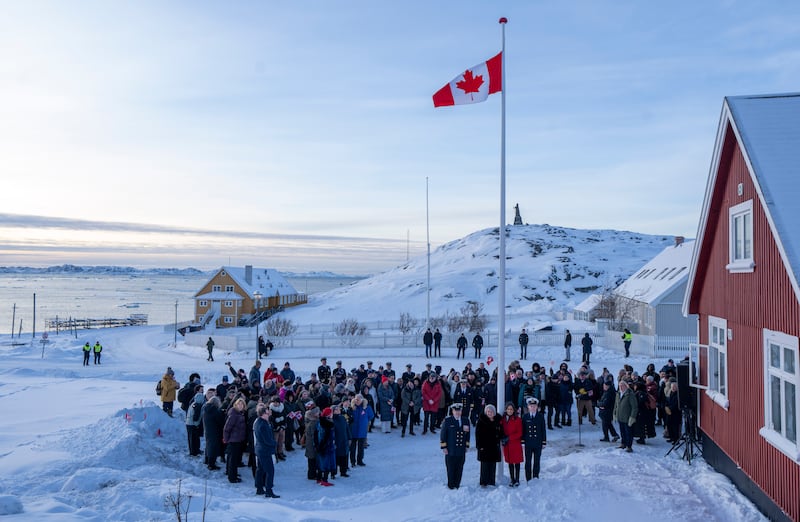 Canadian consulate in Greenland Gov.-Gen. Mary Simon, second from front left, and Foreign Affairs Minister Anita Anand, second from front right, pose for photos following the raising of the Canadian flag at the new Canadian consulate in Nuuk, Greenland on Feb. 6, 2026. THE CANADIAN PRESS/Christinne Muschi
This may signal a first step in Canada seeking to partner with Arctic Council allies like Denmark, Sweden and Finland in forming a stewardship alliance that would patrol and monitor each others’ Arctic regions.
This matters because sovereignty is not just a legal argument. It is a practical condition. If you cannot see what is happening in your territory, cannot move forces through it, cannot respond to emergencies, and cannot control access to it, then your sovereignty becomes theoretical. And theory is not enough in a world where great powers are increasingly willing to test boundaries.
While fears of a U.S. seizure of the Canadian Arctic may sound extreme, the logic of power politics is simple: ungoverned space invites challenge. The same applies to Russia and China, both of which are expanding Arctic capabilities and presence. The best defence against confrontation is not rhetoric or protest; it is credible control.
Every satellite launched, every radar installed, every runway modernized, every icebreaker delivered, and every Arctic operation conducted strengthens Canada’s position. With each step, the risk of confrontation decreases. With each delay, it grows.
Canada’s Arctic is not empty. It is not irrelevant. It is not a frozen wasteland beyond our concern. It is territory, identity, security, and future prosperity. Sovereignty is not something you assert once in history and assume forever. It is something you continuously build, maintain, and defend.
Complacency has already cost us time. Now, momentum matters. Investment must accelerate. Projects must deliver. Presence must become permanent. Because in the Arctic, as in all matters of sovereignty, the rule is simple:
What you cannot see, you cannot control. What you cannot control, you cannot truly claim.
And Canada can no longer afford to merely claim the Arctic; it must command it.
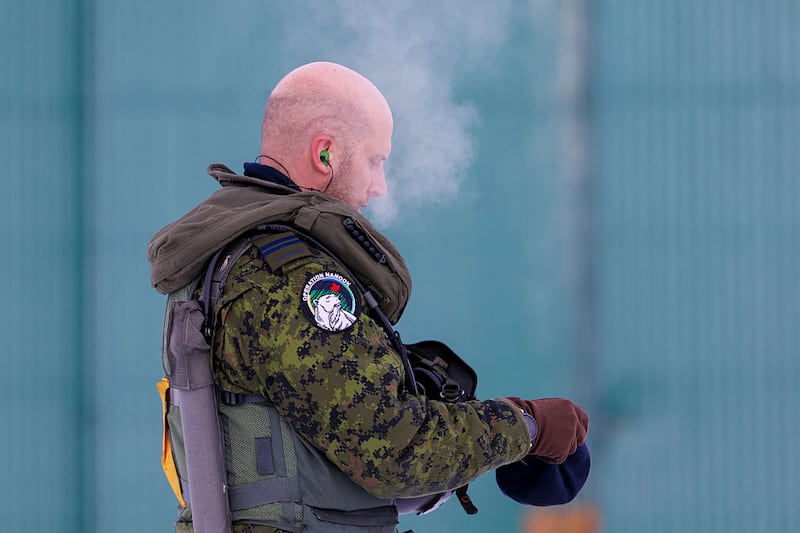 Canada Arctic sovereignty, military Capt. Jonathan Vokey walks the tarmac after landing his Chinook helicopter on Parsons Lake during Operation Nanook, the Canadian Armed Forces’ annual Arctic training and sovereignty operation, in Inuvik, NWT on March 1, 2025. (Photo by COLE BURSTON / AFP via Getty Images)