
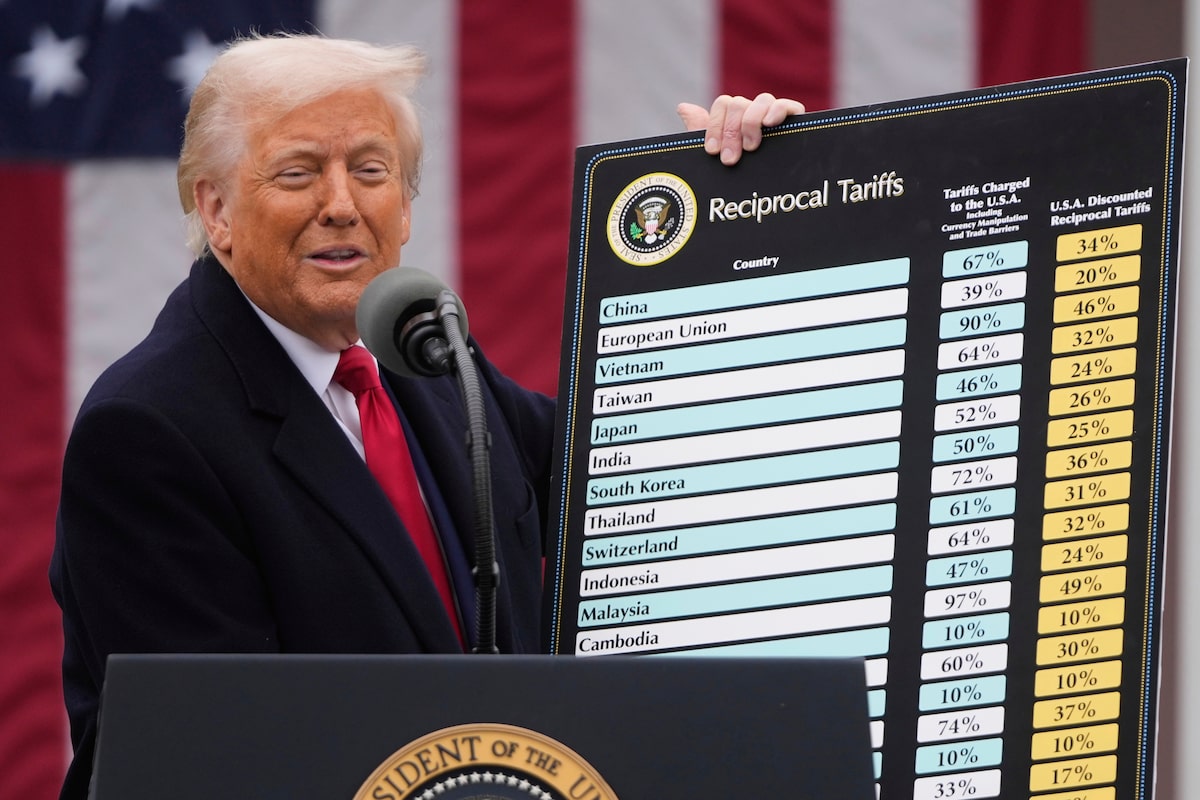
U.S. President Donald Trump speaks during an event announcing new tariffs on April 2, 2025.Mark Schiefelbein/The Associated Press
After I painted a rather sombre picture of the Canadian economy in my Globe and Mail column last week, the question that came back to me is what I would do as Prime Minister to bring Canada out of its prolonged malaise. I had a rather tense interview with the CBC about this, and the anchor seemed upset with me that I didn’t trash U.S. President Donald Trump’s trade actions when I went through my list of reasons as to why the Canadian economy remains on such soft ground.
All I said was that Canada’s economic stagnation was intact long before the launch of the tariff war in the spring of 2025, and that Canadian politicians were using this file as camouflage, allowing them to convince Canadians that all of the woes boil down to tariff and trade tensions.
The reality is that, in global comparison terms, Canada actually got off fairly light from the Trump trade actions to date. Not that this isn’t an overhang, but the Canada-U.S. trading relationship is not the only impediment to growth. I keep hearing about the need to reduce interprovincial barriers to trade, but quite frankly, this has been talked about incessantly since I showed up on Bay Street in the mid-1980s.
Tony Keller: Mark Carney has turned the Titanic. He needs to keep turning
I reluctantly gave Ottawa’s budget from last year a B- grade, thinking that there were some nifty supply-side measures in the document, such as easing requirements and fast-tracking natural resource development and pipeline expansion. Not that this isn’t happening, but rather it is happening at a snail’s pace.
And it is foolhardy to believe that Canada can ever diversify all that much from the U.S. economy, given the proximity and cheap transportation costs, not to mention how lucky we are to have access to a large and rich consumer base, as well as the fact that the North American supply chain is too intertwined to ever really be broken or even tweaked.
So, yes, diversifying trading relationships abroad and signing deals with non-U.S. countries is all well and good, but it is not ever going to spin the dial on economic growth all that much, in my view. But it sounds good on paper and allows the government to try to convince the electorate that it has a plan.
To have allowed Mr. Trump (and Congress) to have pulled the U.S. top marginal business tax rate in late 2017 to 21 per cent from 35 per cent, with nary a response from Ottawa, is the real mortal blow to the Canadian economy (the top Canadian blended rate is 26.5 per cent).
It’s interesting that we respond to every trade twitch out of the White House, but to this day, there has been no attempt to make Canada tax competitive again.
To the folks in the Canadian federal government, it’s as if this never happened – but this relative shift in tax competitiveness represented a major negative shock to the domestic economy that receives precious little attention. Then again, how would such tax reform ever buy votes, right? This is what made Brian Mulroney, may he rest in peace, courageous.
To be sure, it would be nice to see top combined marginal income tax rates ease from their current confiscatory levels of over 50 per cent in Canada, but my focus is on the business sector because people just can’t get up and willy-nilly move to the U.S., especially today.
Andrew Coyne: No more half measures: to get out of our growth rut, Canada needs radical tax reform
It would be nice if someone from Ottawa could tell us how it is that Ireland managed to emerge as a global tax haven without political upheaval, a social revolution or a blowout in its fiscal finances. All it has been left with is economic performance that every Canadian should be envious of. It has a top marginal tax rate for individuals of 40 per cent and, for the business sector, 12.5 per cent. Its deficit and debt ratios are far better than Canada’s, even as it has a robust public health care system. Its unemployment rate is nearly two percentage points below ours, and its average annual growth in real per capital GDP is over four per cent versus virtually nil here.
Shame on us, because we keep electing people to Ottawa who don’t seem to get it. I come back to this: the greatest crime against the Canadian economy is actually not Mr. Trump – believe it or not, the net effective tariff rate has not really gone up that much, even though some industries have been hit (to 5.9 per cent from 0.1 per cent; compared with the global assault to 16.9 per cent from 2.4 per cent).
The real assault has been a made-in-Canada event, primarily this decision to close our eyes and pretend that America never really did slice its top marginal tax rate on business incomes eight years ago.
David Rosenberg is founder of Rosenberg Research.