
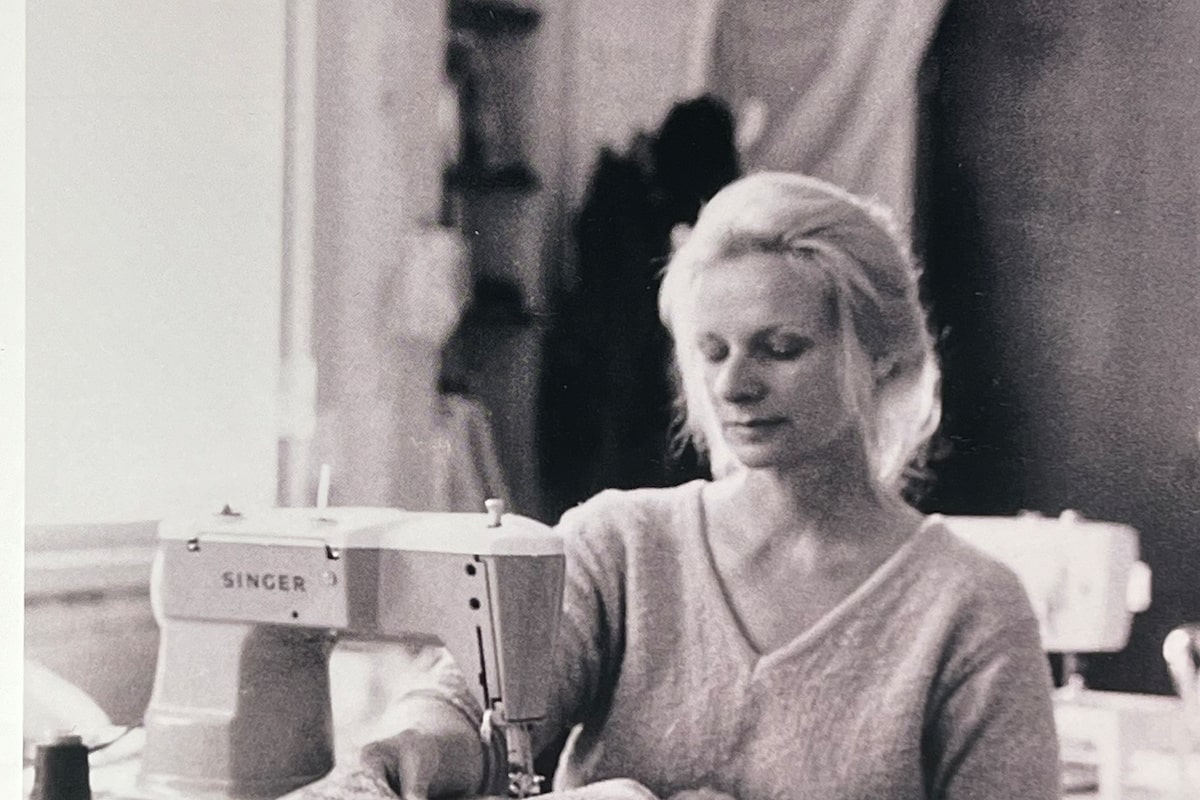
Carole Sabiston works on ‘Sailing’, 1981.Courtesy of family
It was an audacious move for a single mom and her four-year-old son, most especially in 1970: A year on the Spanish island of Ibiza, living on $2,000 in carefully scrimped savings and testing whether it was possible to make the jump from high-school art teacher to full-time artist.
By the time Carole Sabiston returned home to Victoria, B.C., she was a rising star. She could even claim a well-known celebrity as a patron, British comedy actor Terry-Thomas, who commissioned Ms. Sabiston to make him a flamboyant robe and hosted her and her son at his Ibiza home.
Ms. Sabiston died in hospital in Victoria on Jan. 26, age 86. The two children she and her late husband Jim Munro raised together were at her side. She leaves her son, Andrew Sabiston; stepdaughters, Andrea Skinner, Jenny Munro and Sheila Munro; and five grandchildren.
Carole Slater was born in London, England on Oct. 1, 1939, to George and Doris Slater. The family immigrated to Canada when she was nine years old.
The Slaters took up residence in Victoria, where Mr. Slater opened a butcher shop that still carries his name, Slater’s Meats. Carole was their only child, and initially appeared to be heading for a career in dance. In her teens, she was an avid ballet dancer prepping for an audition with the National Ballet of Canada.
But “at the age of 17, I decided I didn’t have the physical commitment to devote the next 20 years or so of my life to ballet,” she said in a 1986 interview with The Globe and Mail. “I felt I needed a more random approach to life. So I went back to [the University of Victoria] to study fine arts.”
Soon after graduation, she was married and teaching art to high-school students in London, Ont., where she had relocated with her husband Brian Sabiston, an immunologist. Andrew was born there in 1965. Ms. Sabiston was part of the London Regionalism movement that transformed the city into a pre-eminent centre for contemporary art in Canada in those years. “They were the halcyon days, that heart-of-London era,” she recalled of that period,
But the Sabistons divorced not long after their son was born. Newly single, Ms. Sabiston returned to Victoria with her son. She taught art at Oak Bay High School, where she caught the attention of artist and fellow teacher Bill West, who would become an important mentor and friend. She began saving for her year in Ibiza.
Ms. Sabiston was a painter initially, primarily acrylics after the day she caught her young son gnawing at one of her toxic oil-paint tubes. But it was her often super-sized fabric works that would make her name around the world starting in the 1970s.
Carole Sabiston in her studio, 1985.Courtesy of family
The artworks were tactile, colourful, sparkly and compelling, and as big as anyone might want them as long as they could pay Ms. Sabiston’s going rate of $30 a square foot. But they always carried an underlying message, says former Canadian senator Patricia Bovey, who was director of the Art Gallery of Greater Victoria for many years and a long-time friend and fan of Ms. Sabiston and her art.
“She was inventive, creative, and people loved her, and she won many awards for her works. But I don’t think people even now have fully understood her ability to incorporate humour, symbols, a sense of light and sensibility into her works, and then turn all of that toward an issue,” Ms. Bovey says. “Everything in her work has real connection and symbolic relevance.”
Ms. Sabiston met the local bookstore owner Jim Munro in the mid-1970s, and they married in 1976. Andrew remembers the phone call coming while he was in Ontario for his usual summer holiday visit with his father: “Andrew! I’ve met someone and we’re going to get married!”
She and her son moved into the turn-of-the-century home that Mr. Munro and his first wife, the short-story writer Alice Munro, had bought in 1966, in Victoria’s Rockland neighbourhood. Mr. Munro had been living there with his youngest daughter, Andrea. Ms. Sabiston would live the rest of her life in the home.
Every wall and shelf of the house is lined with her art and that of her friends: a vivid yellow cape made for a major B.C. sporting event; wall hangings; paintings; maquettes; whimsical “flying carpets” that Ms. Sabiston gave faux-scientific names to and joked that they had been caught in her butterfly net. Scattered amid the art are displays of some of Ms. Sabiston’s many collections: skeleton keys, wooden spoons, carpet beaters, masks.
In her studio – built with the money from the sale of her house after she moved in with Mr. Munro – towering cupboards full of carefully labelled fabric bits and pieces await a call to action. Her time devoted to art diminished after the late Mr. Munro retired in 2014, her son says, but she continued to do workshops.
Ms. Sabiston’s ‘Ibiza, the Citadel’. Numerous honours were bestowed on Ms. Sabiston over the years recognizing her work.Courtesy of family
Ms. Sabiston would work for an intense month or more on a particular commission. Her son recalls her renting various downtown spaces in Victoria specifically because the dimensions of the room suited the size of the piece she was working on.
Her Blush Pink Planet, one of a series she made in 1986 for the 4 King West building in Toronto, measured 5.5 metres by 4.7 metres. A 1984 commission for the lobby of Victoria’s McPherson Playhouse weighed almost 70 kilograms.
The works were prized by architects and designers looking to adorn the wide-open spaces and big walls of their luxury hotels and commercial buildings. British prime minister Edward Heath was on hand in August, 1973 when the Skyline Park Tower opened in London, England, with a Sabiston wall hanging in its foyer.
“Big-scale work is very exciting, but I find four hours’ stitching a day is about all I can take,” she said in an interview with the Toronto Star Weekly that year.
Sometimes described in the media as a fabric artist, Ms. Sabiston hated that term. She considered her works to be fabric assemblage – and her, an assemblagist. She became known for using an overlay of netting to create a kind of watercolour effect, subtly shading and dappling a fabric’s colour.
Her early works featured thousands of hand-sewn stitches. Later, she used her Singer sewing machine more often – the same one she’d had since she was a teenager. Later still, she partnered with Pacific Opera Victoria to make lavish costumes for productions including Rigoletto and The Magic Flute.
Ms. Sabiston’s ‘The Flying Rondels at Dawn’. Her artworks were tactile, colourful, sparkly and compelling.Courtesy of family
She was a long-time member of B.C.’s Society of Limners, a group of visual artists known for their talents, a 37-year history of supporting each other, and the great parties they threw.
More recently, the Sabiston-Munro household was in the spotlight in 2024 after Ms. Munro’s daughter Andrea Skinner revealed publicly that she had been sexually abused as a child by her stepfather, Gerald Fremlin.
Andrew Sabiston was 11 years old and Andrea nine when she returned to their shared home in Victoria after a summer visit with her mother and Mr. Fremlin, and confided in her stepbrother about the abuse. The two children then told Ms. Sabiston, who reported it to Mr. Munro.
A framed photo from 2016 sits on an end table in Ms. Sabiston’s living room, of the family gathered around Ms. Skinner during her time at The Gatehouse trauma healing centre in Etobicoke, a suburb in Toronto’s west end.
Mr. Sabiston remembers his mother as a night owl, working late in her studio yet always up early enough to see him and Andrea off to school when they were children. Jim Munro’s two older daughters were adults with their own lives by the time he and Ms. Sabiston married.
Ms. Sabiston’s studio in those years was upstairs at the bookstore that Mr. Munro owned on Government Street, Munro’s. Downstairs, her series of eight wall hangings, The Seasons, brought new life to the walls of the converted bank building.
“I didn’t decide to change from painting to this kind of ‘painting’ in a day,” Ms. Sabiston told The Globe in her 1986 interview. “It was a thought-and-experience process over a number of years. The fabric in itself is just tightly bundled threads. It has no power, but when I release it in my work, it opens up. It seems to become filled with energy.”
Ms. Sabiston’s ‘Reflective Horizon’ in the artist’s home.Courtesy of family
Numerous honours were bestowed on Ms. Sabiston over the years recognizing her work. She won the $20,000 Saidye Bronfman Award for Excellence in Crafts in 1987, and was inducted into the Order of B.C. in 1992. She led an international textile project for the closing ceremonies of the 1994 Commonwealth Games, “Commonwealth Cape of Many Hands,” which was then presented to Malaysia as hosts of the next Games four years later. Her alma mater, the University of Victoria, awarded her an honorary doctorate in fine arts in 1995.
Ms. Sabiston’s works will have resonance for new audiences long into the future, Ms. Bovey says.
“We declare specific art works a national treasure here in Canada, but I wish we were like the Japanese and actually designated the artists themselves,” Ms. Bovey says. “Carole was definitely a national treasure. More of our society really needs to see these beautiful works of hers.”
You can find more obituaries from The Globe and Mail here.
To submit a memory about someone we have recently profiled on the Obituaries page, e-mail us at obit@globeandmail.com.