
CBC’s 2026 Olympic broadcasting production setup at their headquarters in Toronto. The national public broadcaster received approximately 1,180 complaints about ads during the Winter Games opening ceremony, according to its head of public affairs.Sammy Kogan/The Globe and Mail
Annoyed by the avalanche of advertisements during CBC’s broadcast of the Milan Cortina Winter Games opening ceremony on Friday? You weren’t alone.
CBC/Radio-Canada received approximately 1,180 complaints about those interrupting ads, according to Chuck Thompson, head of public affairs at the national public broadcaster.
English-language viewers were much more irate: 1,100 of the complaints were directed to the CBC.
“While fully acknowledging the frustration some viewers had with ads interrupting their viewing experience, it was a very small number juxtaposed to the 16 million people we reached over the course of the event,” Thompson wrote to The Globe and Mail.
It still seems like a notable amount of CBC kvetching to me, however. Especially when you combine them with the flurry of real-time rage on social media sites Bluesky and X.
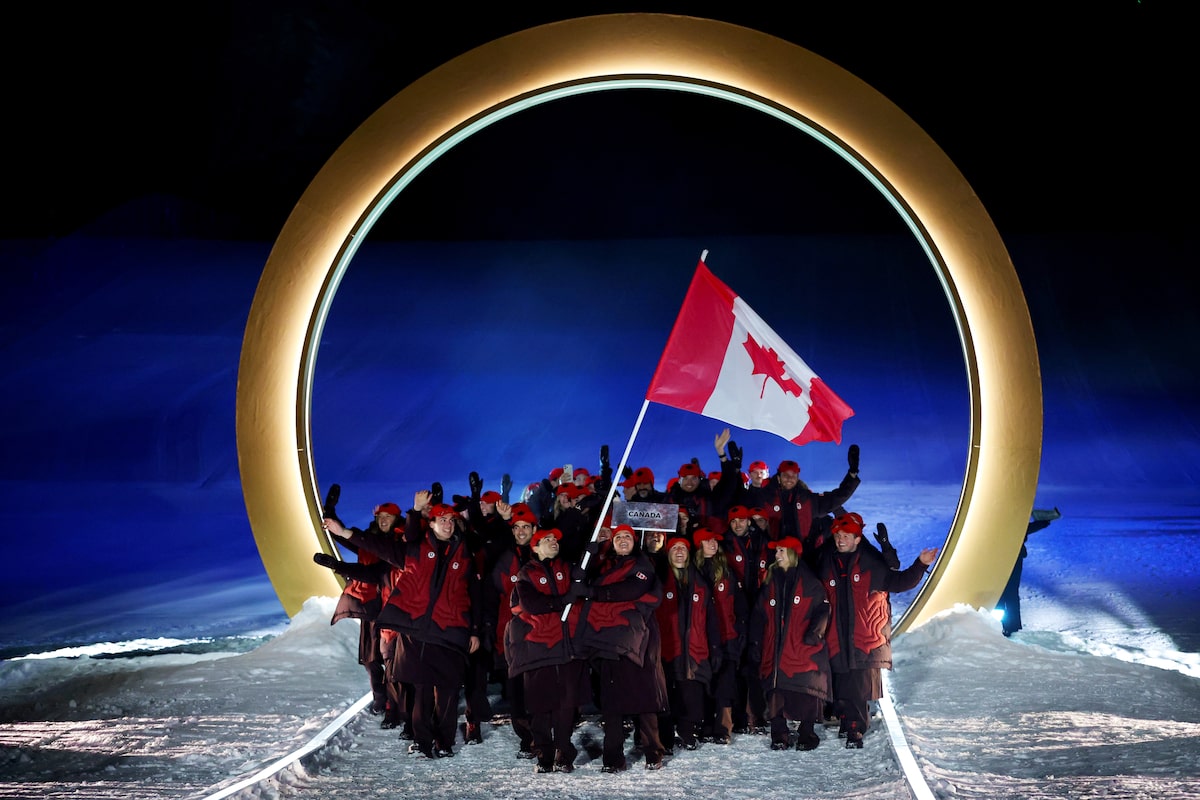
Canada’s flag bearers Marielle Thompson and Mikael Kingsbury enter with the team, during the opening ceremony.Cameron Spencer/The Associated Press
My personal feeds showed multiple Canadians posting that they were switching over to the American NBC coverage instead. Ouch!
Meanwhile, Carole MacNeil, a former CBC journalist, went as far as to call her old employer’s broadcast “unwatchable” in an X post.
Was that hyperbole? Let’s look at the numbers.
Thompson writes that CBC aired 31 minutes of commercials and Radio-Canada ran 30 minutes of ads during the opening ceremony – an average of 7.5 minutes of ads per hour.
“That’s down from ten minutes per hour with past Games,” Thompson wrote, noting, too, that this “fell well below the regulatory provisions of 12 minutes per hour” formerly mandated by the CRTC.
Perhaps that average may be accurate over four hours of coverage, but it does not in any way represent how frustrating it was for Canadians who tuned in at the start of the actual ceremony live from Italy.
I went back to rewatch my CBC recording and this is what I counted: 15 minutes and 15 seconds of ads between 2 p.m. and 3 p.m. ET.
Most egregiously, 13 minutes and 15 seconds of the ads came during the 40-minute section of dance, music and pomp that led up to the entrance of the athletes.
We asked readers for fond memories of past Winter Olympics. These ones owned the podium
Fully a third of the artistic introduction to the Games planned by creative director Marco Balich was rendered literally unwatchable because of advertisements.
That’s including both full-on ad breaks and what are misleadingly known as “side by sides” – when the ceremony was shrunk down, put in a corner and the sound was turned off.
Over the full ceremony, flipping back and forth between CBC and NBC, I noted that Canadians missed out on recitations of Italian poetry both classic and contemporary – and an animated segment featuring Italian actress Sabrina Impacciatore (The White Lotus) that was, frankly, skippable.
Dancers wearing heads that esemble three great masters of Italian opera, Giuseppe Verdi, Giacomo Puccini and Gioachino Rossini perform during the opening ceremony at the San Siro stadium in Milan.GABRIEL BOUYS/AFP/Getty Images
But worse than the omissions was that there was hardly a single choreographed segment that was shown in full; chopped up, or miniaturized and muted, the stories the Italians were trying to tell the world through movement became incomprehensible.
What a schiaffo morale − a slap in the face − to the host country’s performing artists.
Thompson points out that “like many public broadcasters” CBC/Radio-Canada has a mixed funding model and says revenue from ads allows the broadcaster to offer Canadians “extensive coverage of the Olympic Games, no less than 3,000 hours of live content across multiple platforms.”
Whenever the CBC’s not up to snuff, that’s essentially the response: You get what you pay for.
It’s absolutely true that Canadians pay less per capita for public broadcasting than pretty much every country that isn’t run by Donald Trump.
If you fired up a VPN, for instance, you could have watched the opening ceremony via the British Broadcasting Corporation or the Australian Broadcasting Corporation without ads. But we pay about two-thirds per capita what Aussies do – and a third of what Brits fork out.
What happened at the Olympics today
That doesn’t explain why there were fewer commercials – and better placed ones – on the commercial broadcaster NBC in the U.S., however.
Canadians foot the vast majority of the bill for the CBC – yet are treated like second-class citizens to advertisers.
In 2024-2025 for instance (the last Olympic year), CBC/Radio-Canada earned $343.9-million in TV and digital advertising.
It received $1.4-billion – four times as much – in government funding, that is to say from citizens.
I’m of the view that a 20-per-cent bigger CBC with ads is worth less than a 20-per-cent smaller one without, when this is the outcome. (I’d like to see the CBC get more money, too – but that’s a hard sell when it behaves like a public-private broadcaster.)
The Olympics are one of the few moments when Canadians rush to the CBC – and, instead of capitalizing on that moment to show how well it can serve us, the CBC used our first taste of “Canada’s most unifying sporting event!” (as its website for ad buyers puts it) to sell to us.
Canadians unified, all right – to complain about the CBC, our second most popular national sport.